ENEA, Italian National Agency for New Technologies, Energy and Sustainable Economic Development, Casaccia Research Center, 00123, Rome, Italy.
University of Rome "La Sapienza", Piazzale Aldo Moro, 5, 00185, Rome, Italy.
BMC Biotechnol. 2018 Feb 17;18(1):11. doi: 10.1186/s12896-018-0416-3.
Chlamydomonas reinhardtii is an unicellular green alga used for functional genomics studies and heterologous protein expression. A major hindrance in these studies is the low level and instability of expression of nuclear transgenes, due to their rearrangement and/or silencing over time.
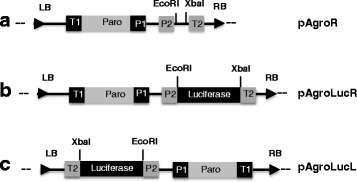
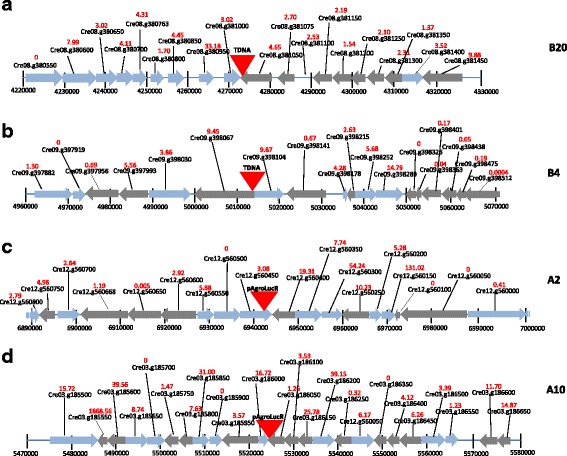
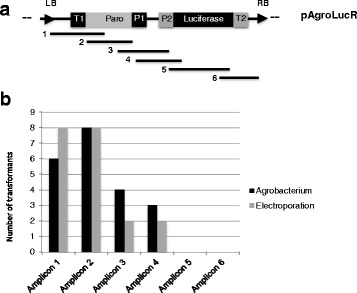
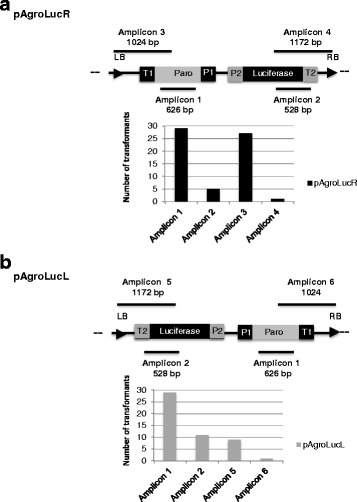
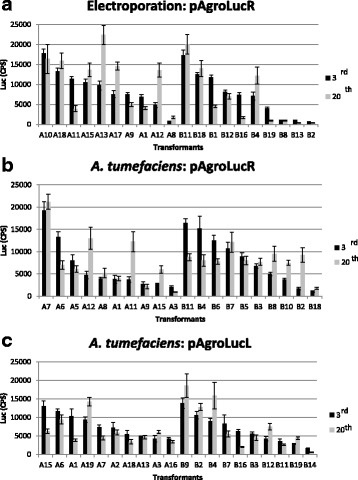
We constructed dedicated vectors for Agrobacterium-mediated transformation carrying, within the T-DNA borders, the Paromomycin (Paro) selectable marker and an expression cassette containing the Luciferase (Luc) reporter gene. These vectors and newly developed co-cultivation methods were used to compare the efficiency, stability and insertion sites of Agrobacterium- versus electroporation-mediated transformation. The influence of different transformation methods, of the cell wall, of the virulence of different Agrobacterium strains, and of transgene orientation with respect to T-DNA borders were assessed. False positive transformants were more frequent in Agrobacterium-mediated transformation compared to electroporation, compensating for the slightly lower proportion of silenced transformants observed in Agrobacterium-mediated transformation than in electroporation. The proportion of silenced transformants remained stable after 20 cycles of subculture in selective medium. Next generation sequencing confirmed the nuclear insertion points, which occurred in exons or untraslated regions (UTRs) for 10 out of 10 Agrobacterium-mediated and 9 out of 13 of electroporation-mediated insertions. Electroporation also resulted in higher numbers of insertions at multiple loci.
Due to its labor-intensive nature, Agrobacterium transformation of Chlamydomonas does not present significant advantages over electroporation, with the possible exception of its use in insertional mutagenesis, due to the higher proportion of within-gene, single-locus insertions. Our data indirectly support the hypothesis that rearrangement of transforming DNA occurs in the Chlamydomonas cell, rather than in the extracellular space as previously proposed.
莱茵衣藻是一种单细胞绿藻,用于功能基因组学研究和异源蛋白表达。由于核转基因的重排和/或沉默,其在这些研究中的表达水平低且不稳定,这是一个主要的障碍。
我们构建了专门用于农杆菌介导转化的载体,在 T-DNA 边界内携带了巴龙霉素(Paro)选择标记和包含荧光素酶(Luc)报告基因的表达盒。这些载体和新开发的共培养方法被用于比较农杆菌介导转化与电穿孔介导转化的效率、稳定性和插入位点。评估了不同转化方法、细胞壁、不同农杆菌菌株的毒力以及转基因相对于 T-DNA 边界的方向的影响。与电穿孔相比,农杆菌介导转化中假阳性转化体更为频繁,这补偿了农杆菌介导转化中观察到的沉默转化体比例略低于电穿孔的情况。在选择性培养基中连续传代 20 次后,沉默转化体的比例保持稳定。下一代测序证实了核插入点,其中 10 个农杆菌介导的插入和 13 个电穿孔介导的插入中的 10 个发生在外显子或非翻译区(UTR)中。电穿孔还导致在多个基因座上插入更多数量的基因。
由于其劳动强度大,农杆菌转化衣藻并不比电穿孔具有显著优势,除了在插入诱变方面的应用,这是由于在基因内、单基因座插入的比例更高。我们的数据间接支持了这样的假设,即转化 DNA 的重排发生在衣藻细胞内,而不是先前提出的细胞外空间。