Laboratory of Tumor Biology, Angiogenesis and Nanomedicine Research, National Centre for Cell Science, SP Pune University Campus, Pune, 411007, India.
Department of Cancer Biology, The University of Texas MD Anderson Cancer Center, Houston, Texas, 77054, USA.
Mol Cancer. 2018 Feb 19;17(1):34. doi: 10.1186/s12943-018-0797-x.
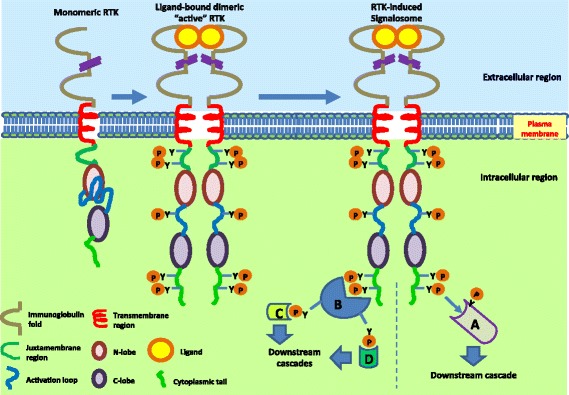
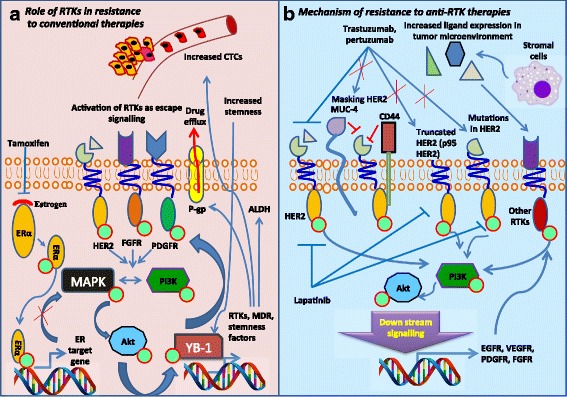
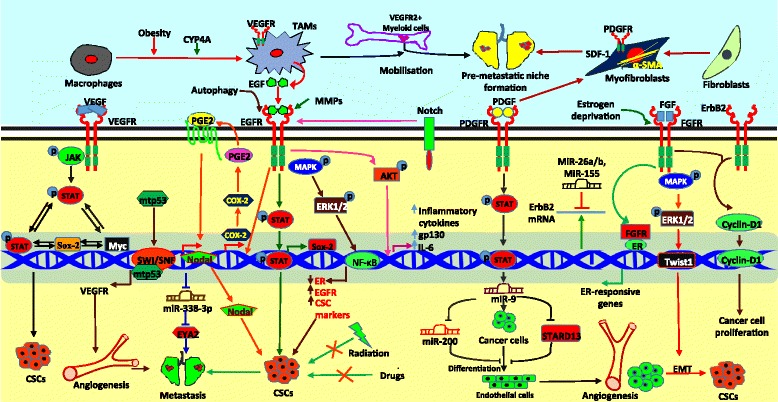
Breast cancer is a multifactorial disease and driven by aberrant regulation of cell signaling pathways due to the acquisition of genetic and epigenetic changes. An array of growth factors and their receptors is involved in cancer development and metastasis. Receptor Tyrosine Kinases (RTKs) constitute a class of receptors that play important role in cancer progression. RTKs are cell surface receptors with specialized structural and biological features which respond to environmental cues by initiating appropriate signaling cascades in tumor cells. RTKs are known to regulate various downstream signaling pathways such as MAPK, PI3K/Akt and JAK/STAT. These pathways have a pivotal role in the regulation of cancer stemness, angiogenesis and metastasis. These pathways are also imperative for a reciprocal interaction of tumor and stromal cells. Multi-faceted role of RTKs renders them amenable to therapy in breast cancer. However, structural mutations, gene amplification and alternate pathway activation pose challenges to anti-RTK therapy.
乳腺癌是一种多因素疾病,由于遗传和表观遗传变化的获得,导致细胞信号通路的异常调节。一系列生长因子及其受体参与癌症的发生和转移。受体酪氨酸激酶(RTKs)是一类在癌症进展中发挥重要作用的受体。RTKs 是细胞表面受体,具有特殊的结构和生物学特征,通过启动肿瘤细胞中适当的信号级联反应来响应环境线索。RTKs 已知可调节各种下游信号通路,如 MAPK、PI3K/Akt 和 JAK/STAT。这些途径在调节癌症干性、血管生成和转移中起着关键作用。这些途径对于肿瘤和基质细胞的相互作用也是必不可少的。RTKs 的多方面作用使其成为乳腺癌治疗的靶点。然而,结构突变、基因扩增和替代途径激活给抗 RTK 治疗带来了挑战。