Institute for Inflammation Research, Department of Rheumatology and Spine Disease, Copenhagen University Hospital Rigshospitalet, Copenhagen, Denmark.
Haematopoietic Stem Cell Transplantation and Primary Immune Deficiency, Department of Pediatrics and Adolescent Medicine, Copenhagen University Hospital Rigshospitalet, Copenhagen, Denmark.
Front Immunol. 2018 Feb 2;9:109. doi: 10.3389/fimmu.2018.00109. eCollection 2018.
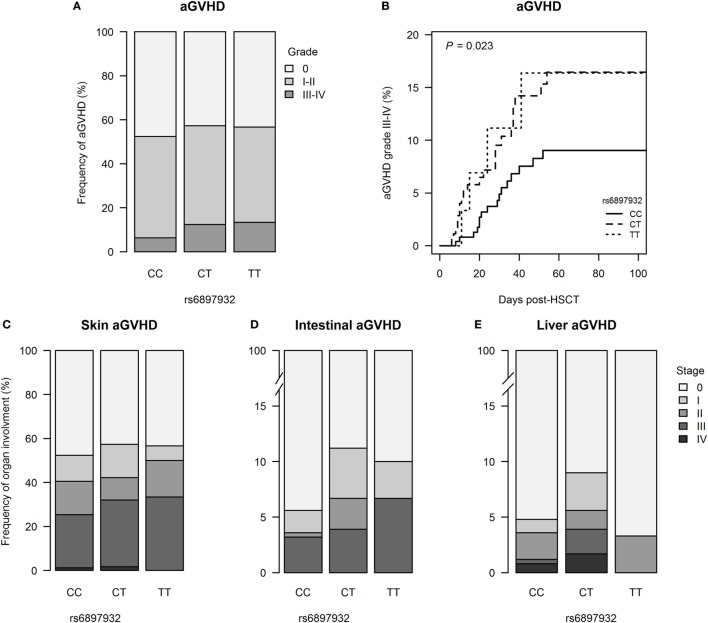
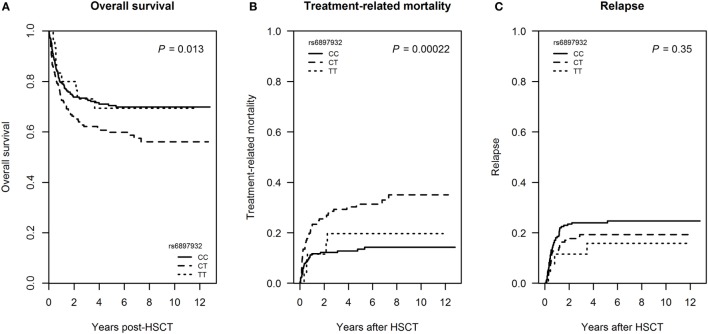
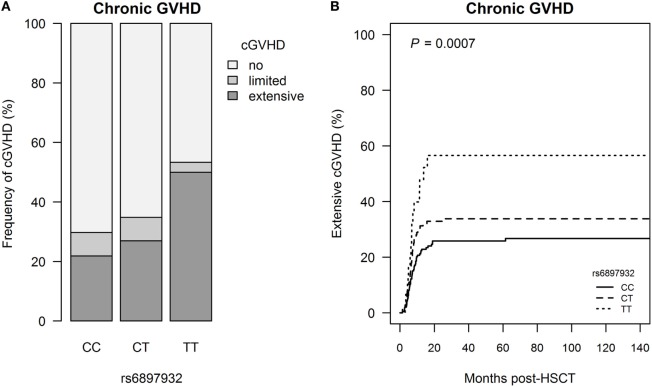
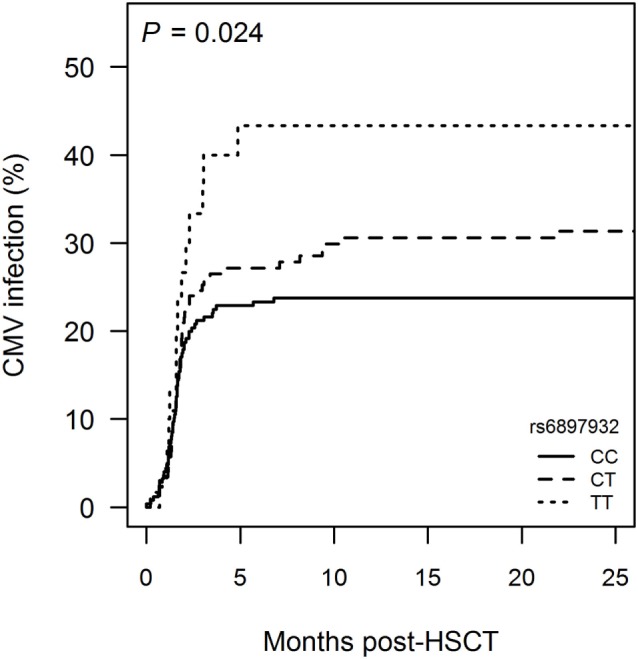
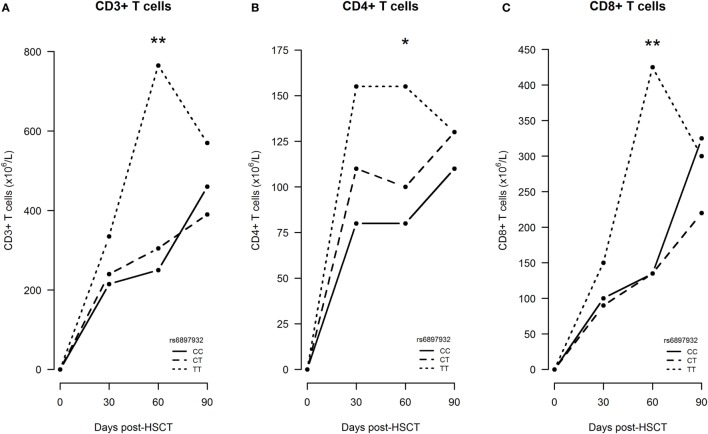
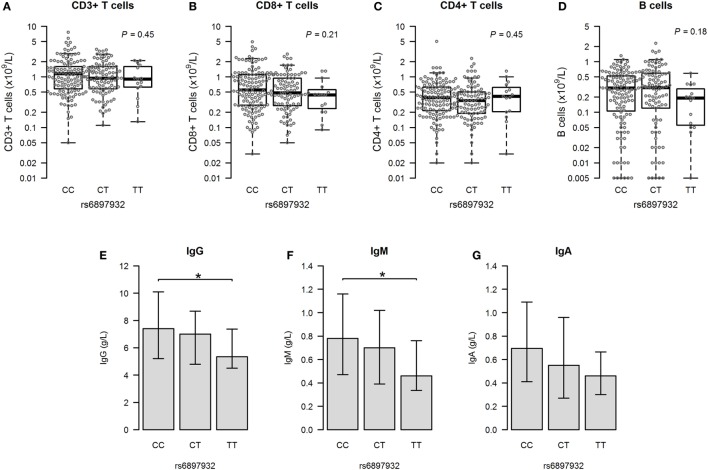
The efficacy of allogeneic hematopoietic stem cell transplantation (HSCT) is challenged by acute and chronic graft-versus-host disease (aGVHD and cGVHD) and viral infections due to long-lasting immunodeficiency. Interleukin-7 (IL-7) is a cytokine essential for T cell generation in thymus and peripheral T cell homeostasis. In this study, we investigated the impact of the single nucleotide polymorphism in the IL-7 receptor α-chain (IL-7Rα) which has previously been associated with several autoimmune diseases. We included 460 patients undergoing allogeneic HSCT after a myeloablative conditioning. Patients had a median age of 26.3 years (0.3-67.0 years), and 372 (80.9%) underwent HSCT for malignant diseases. Donors were matched sibling donors ( = 147), matched unrelated donors ( = 244) or mismatched unrelated donors ( = 69), and the stem cell source were either bone marrow ( = 329) or peripheral blood ( = 131). DNA from donors was genotyped for the IL-7Rα single nucleotide polymorphism (SNP) using an allele-specific primer extension assay (CC: = 252, CT: = 178, TT: = 30). The donor T allele was associated with a higher risk of grades III-IV aGVHD (HR = 2.0, 95% CI = 1.1-3.8, = 0.034) and with significantly increased risk of extensive cGVHD (HR = 2.0, 95% CI = 1.1-3.6, = 0.025) after adjustment for potential risk factors. In addition, the TT genotype was associated with a higher risk of cytomegalovirus (CMV) infection post-transplant (HR = 2.4, 95% CI = 1.2-4.3, = 0.0068). Numbers of T cells were significantly higher on day +60 in patients receiving a TT graft (CD3+: 109% increase, = 0.0096; CD4+: 64% increase, = 0.038; CD8+: 133% increase, = 0.011). Donor heterozygosity for the T allele was associated with inferior overall survival (HR = 1.7, 95% CI = 1.2-2.3, = 0.0027) and increased treatment-related mortality (HR = 2.3, 95% CI = 1.3-4.0, = 0.0047), but was not associated with the risk of relapse ( = 0.35). In conclusion, the IL-7Rα genotype of the donor is predictive of aGVHD and cGVHD, CMV infection, and mortality following HSCT. These findings indicate that IL-7Rα SNP typing of donors may optimize donor selection and facilitate individualization of treatment in order to limit treatment-related complications.
同种异体造血干细胞移植(HSCT)的疗效受到急性和慢性移植物抗宿主病(aGVHD 和 cGVHD)以及病毒感染的挑战,这是由于长期免疫缺陷所致。白细胞介素 7(IL-7)是胸腺中 T 细胞生成和外周 T 细胞稳态所必需的细胞因子。在这项研究中,我们研究了先前与多种自身免疫性疾病相关的白细胞介素 7 受体 α 链(IL-7Rα)单核苷酸多态性(SNP)的影响。我们纳入了 460 名接受清髓性预处理后进行同种异体 HSCT 的患者。患者的中位年龄为 26.3 岁(0.3-67.0 岁),372 名(80.9%)因恶性疾病接受 HSCT。供者为匹配的同胞供者( = 147)、匹配的无关供者( = 244)或不匹配的无关供者( = 69),干细胞来源为骨髓( = 329)或外周血( = 131)。使用等位基因特异性引物延伸测定法(CC: = 252,CT: = 178,TT: = 30)对供者的 IL-7Rα SNP 进行 DNA 基因分型。供者的 T 等位基因与 III-IV 级 aGVHD(HR = 2.0,95%CI = 1.1-3.8, = 0.034)的风险增加相关,并且与广泛的 cGVHD(HR = 2.0,95%CI = 1.1-3.6, = 0.025)的风险显著增加相关,调整了潜在的危险因素。此外,TT 基因型与移植后巨细胞病毒(CMV)感染(HR = 2.4,95%CI = 1.2-4.3, = 0.0068)的风险增加相关。接受 TT 移植物的患者在第 60 天的 T 细胞数量明显增加(CD3+:增加 109%, = 0.0096;CD4+:增加 64%, = 0.038;CD8+:增加 133%, = 0.011)。供者 T 等位基因的杂合性与总生存不良相关(HR = 1.7,95%CI = 1.2-2.3, = 0.0027)和治疗相关死亡率增加(HR = 2.3,95%CI = 1.3-4.0, = 0.0047)相关,但与复发风险无关( = 0.35)。总之,供者的 IL-7Rα 基因型可预测 HSCT 后 aGVHD 和 cGVHD、CMV 感染和死亡率。这些发现表明,供者的 IL-7Rα SNP 分型可能优化供者选择,并促进个体化治疗,以限制与治疗相关的并发症。