Xu Junnan, Sun Tao, Guo Xiangyu, Wang Yan, Jing Mingxi
Department of Medical Oncology, Cancer Hospital of China Medical University, Liaoning Cancer Hospital and Institute, Shenyang, Liaoning 110042, P.R. China.
Oncol Lett. 2018 Mar;15(3):2855-2862. doi: 10.3892/ol.2017.7637. Epub 2017 Dec 19.
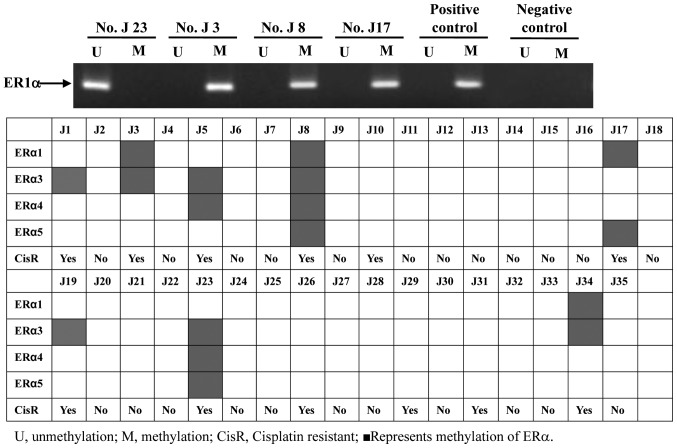
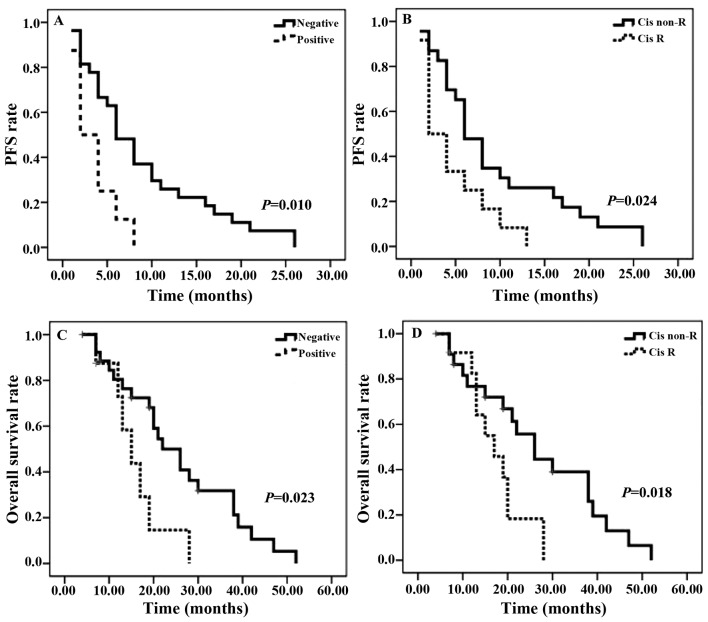
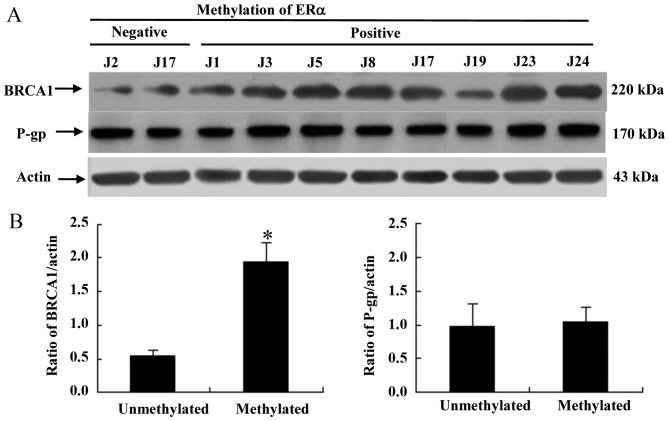
A number of previous studies have indicated the presence of a link between estrogen receptor-α (ERα) methylation and triple-negative breast cancer (TNBC). However, the association between ERα methylation and drug resistance during the treatment of TNBC remains unclear. Methylation-specific polymerase chain reaction was used to investigate the methylation of ERα in the genomic DNA of 35 patients with TNBC who were defined as cisplatin-based chemotherapy-resistant using chemosensitivity testing. Survival probabilities by covariates were assessed using Kaplan-Meier estimator survival analysis and Cox's proportional hazards models, adjusting for age, menopausal status, tumor size, lymph node metastasis and ERα promoter DNA methylation. Of the 35 patients with TNBC analyzed, 8 exhibited ERα promoter DNA methylation. Cisplatin resistance was confirmed to be overwhelmingly associated with ERα methylation by univariate and multivariate analysis. Even in a limited analysis in patients with ERα methylation, the results generated from methylated tumor tissue and unmethylated tumor tissue revealed that expression of breast cancer type 1/2 susceptibility proteins was increased in ERα-methylated breast tumor tissue compared with in unmethylated tissue. The ERα methylation group tended to have significantly shorter progression-free (P=0.010) and overall (P=0.023) survival times compared with those in the unmethylated group. Similarly, shorter progression-free (P=0.024) and overall (P=0.018) survival times were observed in the cisplatin-resistant group compared with the cisplatin-non-resistant group. ERα methylation predicts a poor clinical outcome for patients with TNBC. The results of the present study indicated that ERα methylation may be a candidate surrogate biomarker for outcome prediction and cisplatin resistance in TNBC. Further investigation is required to identify potential biomarkers in a larger cohort in a prospective study.
此前的多项研究表明,雌激素受体α(ERα)甲基化与三阴性乳腺癌(TNBC)之间存在联系。然而,TNBC治疗过程中ERα甲基化与耐药性之间的关联仍不明确。采用甲基化特异性聚合酶链反应,对35例TNBC患者基因组DNA中的ERα甲基化情况进行研究,这些患者经化疗敏感性测试被定义为对顺铂为基础的化疗耐药。使用Kaplan-Meier估计生存分析和Cox比例风险模型评估协变量的生存概率,并对年龄、绝经状态、肿瘤大小、淋巴结转移和ERα启动子DNA甲基化进行校正。在分析的35例TNBC患者中,8例表现出ERα启动子DNA甲基化。单因素和多因素分析均证实顺铂耐药与ERα甲基化密切相关。即使在对ERα甲基化患者进行的有限分析中,甲基化肿瘤组织和未甲基化肿瘤组织的结果显示,与未甲基化组织相比,ERα甲基化的乳腺肿瘤组织中乳腺癌1型/2型易感蛋白的表达增加。与未甲基化组相比,ERα甲基化组的无进展生存期(P=0.010)和总生存期(P=0.023)明显更短。同样,与顺铂不耐药组相比,顺铂耐药组的无进展生存期(P=0.024)和总生存期(P=0.018)更短。ERα甲基化预示着TNBC患者的临床预后不良。本研究结果表明,ERα甲基化可能是TNBC患者预后预测和顺铂耐药的候选替代生物标志物。需要进一步研究以在前瞻性研究中更大的队列中鉴定潜在的生物标志物。