He Yong, Xiao Lianbo, Zhai Weitao, Kasparek Maximilian F, Ouyang Guilin, Boettner Friedrich
Department of Orthopedic Surgery, Shanghai Guanghua Hospital, No.540 Xinhua Road, 200052, Shanghai, China.
Department of Orthopedics, Vienna General Hospital, Medical University of Vienna, Waehringer Guertel 18-20, 1090 Vienna, Austria.
Open Orthop J. 2018 Jan 30;12:17-23. doi: 10.2174/1874325001812010017. eCollection 2018.
Data on indication of Unicompartmental Knee Arthroplasty (UKA) in the Asian population are currently not available. The current paper evaluates patients undergoing knee replacement at a Chinese Orthopaedic Specialty Hospital to report the percentage of patients who meet radiographic and clinical indication criteria for UKA.
Over a one-year period 463 consecutive patients (515 knees) underwent primary knee replacement surgery. Clinical data were recorded and preoperative radiographs were assessed. Patients were classified as suitable candidates for UKA based on the degree of deformity, preoperative ROM and radiographic appearance of osteoarthritis. The different indication criteria for body weight and extend of patellofemoral osteoarthritis as reported by Kozinn and Scott as well as the Oxford Group were applied.
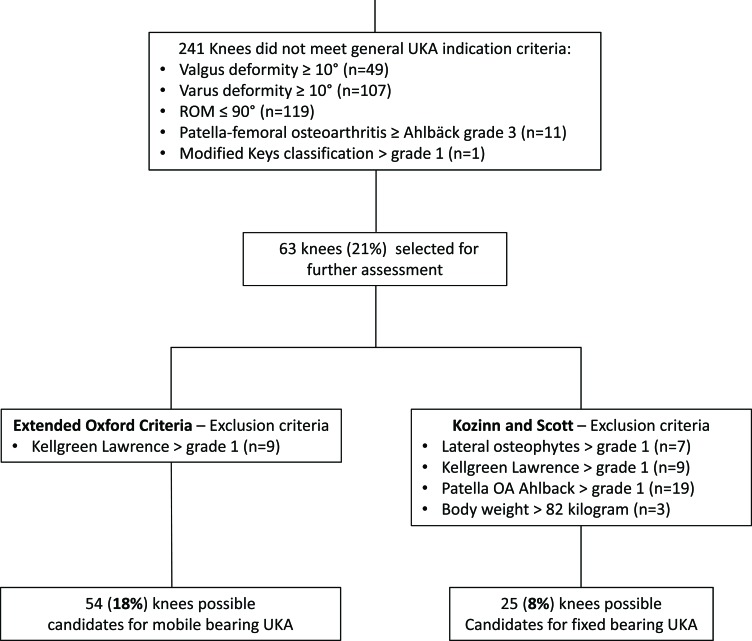
160 knees (31%) were excluded because of inflammatory and posttraumatic arthritis. 55 knees had to be excluded because of incomplete radiographs. Of the remaining 300 knees with osteoarthritis, 241 knees were excluded because of extend of deformity (n=156), decreased range of motion (n=119), advanced patellofemoral arthritis with bone loss (n=11) and AP instability (n=1). Of the remaining 63 knees, 54 knees (18%) met the modified Oxford criteria for mobile UKA and only 25 knees (8%) met the Scott and Kozinn criteria for fixed UKA.
The current paper suggests that in comparison to Caucasian population, only a smaller percentage of patients at a Chinese Orthopaedic Specialty Hospital meet the indication criteria for UKA. Therefore, it might make sense to concentrate UKA surgeries in high volume centers.
目前尚无亚洲人群单髁膝关节置换术(UKA)适应症的数据。本文评估了一家中国骨科专科医院接受膝关节置换的患者,以报告符合UKA影像学和临床适应症标准的患者百分比。
在一年的时间里,463例连续患者(515膝)接受了初次膝关节置换手术。记录临床数据并评估术前X线片。根据畸形程度、术前活动度和骨关节炎的影像学表现,将患者分类为UKA的合适候选者。应用了Kozinn和Scott以及牛津研究组报告的不同体重适应症标准和髌股关节炎范围。
160膝(31%)因炎性和创伤后关节炎被排除。55膝因X线片不完整而被排除。在其余300例骨关节炎患者中,241膝因畸形程度(n = 156)、活动度降低(n = 119)、伴有骨质流失的晚期髌股关节炎(n = 11)和前后位不稳定(n = 1)而被排除。在其余63膝中,54膝(18%)符合改良牛津活动UKA标准,仅25膝(8%)符合Scott和Kozinn固定UKA标准。
本文表明,与白种人群相比,中国一家骨科专科医院中只有较小比例的患者符合UKA适应症标准。因此,将UKA手术集中在大容量中心可能是有意义的。