Micheal Shazia, Niewold Ilse Therésia Gabriëla, Siddiqui Sorath Noorani, Zafar Saemah Nuzhat, Khan Muhammad Imran, Bergen Arthur A B
Department of Clinical Genetics, Academic Medical Centre, Meibergdreef 9, 1105 AZ Amsterdam, The Netherlands.
Department of Pediatric Ophthalmology and Strabismus, Al-Shifa Eye Trust Hospital Jhelum Road, Rawalpindi 46000, Pakistan.
Genes (Basel). 2018 Feb 20;9(2):112. doi: 10.3390/genes9020112.
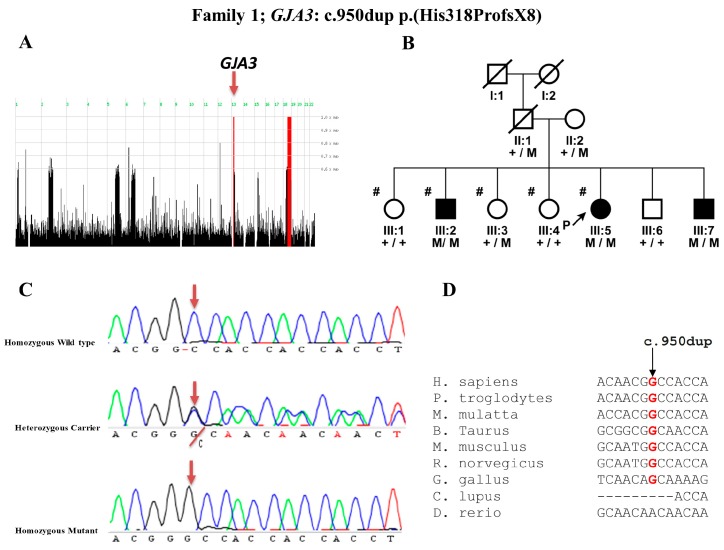
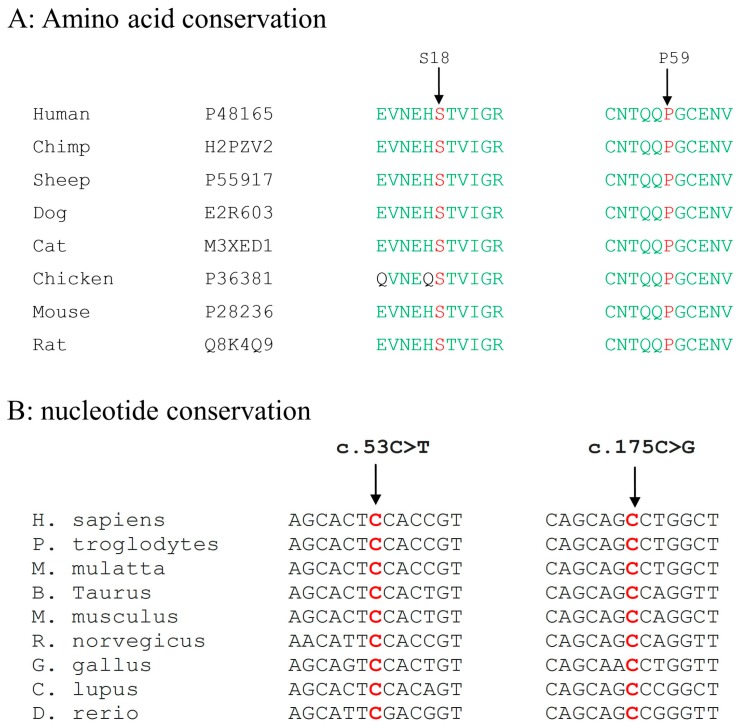
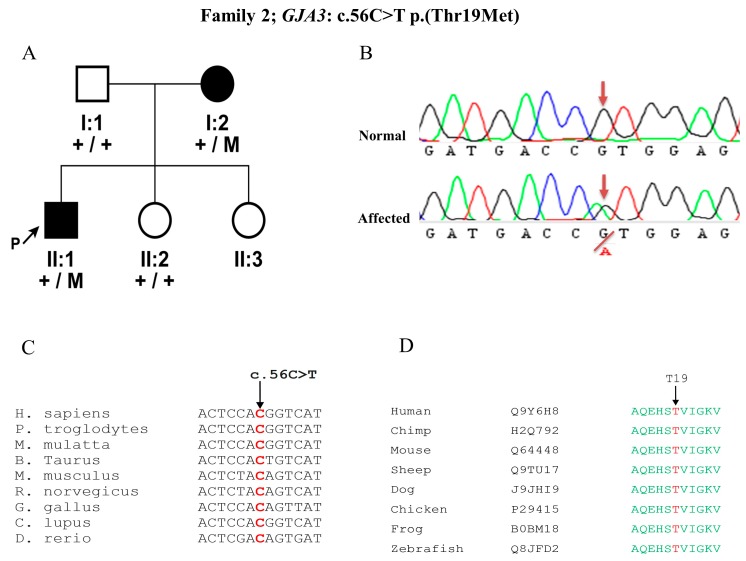
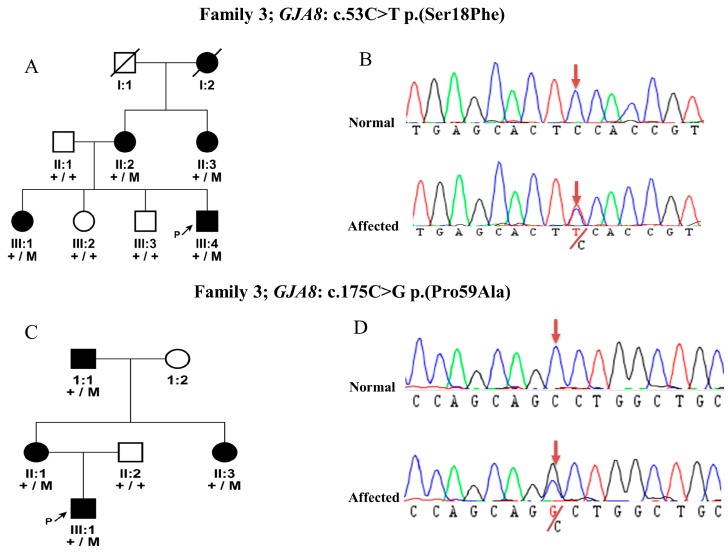
Congenital cataract is a clinically and genetically heterogeneous disease. The present study was undertaken to find the genetic cause of congenital cataract families. DNA samples of a large consanguineous Pakistani family were genotyped with a high resolution single nucleotide polymorphism Illumina microarray. Homozygosity mapping identified a homozygous region of 4.4 Mb encompassing the gene . Sanger sequence analysis of the gene revealed a novel homozygous variant c.950dup p.(His318ProfsX8) segregating in an autosomal recessive (AR) manner. The previously known mode of inheritance for gene mutations in cataract was autosomal dominant (AD) only. The screening of additional probands ( = 41) of cataract families revealed a previously known mutation c.56C>T p.(Thr19Met) in gene. In addition, sequencing of the exon-intron boundaries of the gene in 41 cataract probands revealed two additional mutations: a novel c.53C>T p.(Ser18Phe) and a known c.175C>G p.(Pro59Ala) mutation, both co-segregating with the disease phenotype in an AD manner. All these mutations are predicted to be pathogenic by in silico analysis and were absent in the control databases. In conclusion, results of the current study enhance our understanding of the genetic basis of cataract, and identified the involvement of the in the disease etiology in both AR and AD manners.
先天性白内障是一种临床和遗传异质性疾病。本研究旨在寻找先天性白内障家族的遗传病因。利用高分辨率单核苷酸多态性Illumina微阵列对一个巴基斯坦近亲大家族的DNA样本进行基因分型。纯合性定位确定了一个包含该基因的4.4 Mb纯合区域。对该基因进行桑格序列分析,发现一个新的纯合变异c.950dup p.(His318ProfsX8),以常染色体隐性(AR)方式遗传。此前已知的白内障基因突变的遗传模式仅为常染色体显性(AD)。对白内障家族的其他先证者(n = 41)进行筛查,发现该基因存在一个已知突变c.56C>T p.(Thr19Met)。此外,对41名白内障先证者的该基因外显子-内含子边界进行测序,发现另外两个突变:一个新的c.53C>T p.(Ser18Phe)和一个已知的c.175C>G p.(Pro59Ala)突变,两者均以AD方式与疾病表型共分离。所有这些突变经计算机分析预测均为致病性突变,且在对照数据库中不存在。总之,本研究结果增进了我们对白内障遗传基础的理解,并确定了该基因在疾病病因学中以AR和AD方式的参与情况。