RIKEN Center for Sustainable Resource Science, 1-7-22 Suehiro-cho, Tsurumi, Yokohama, Kanagawa, 230-0045 Japan.
Department of Plant Biology and Genome Center, University of California, Davis, One Shields Avenue, Davis, CA 95616, USA.
Plant Cell Physiol. 2018 Apr 1;59(4):765-777. doi: 10.1093/pcp/pcy013.
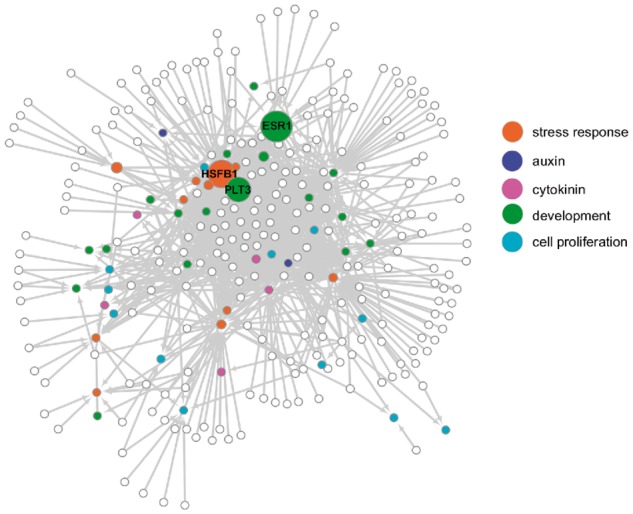
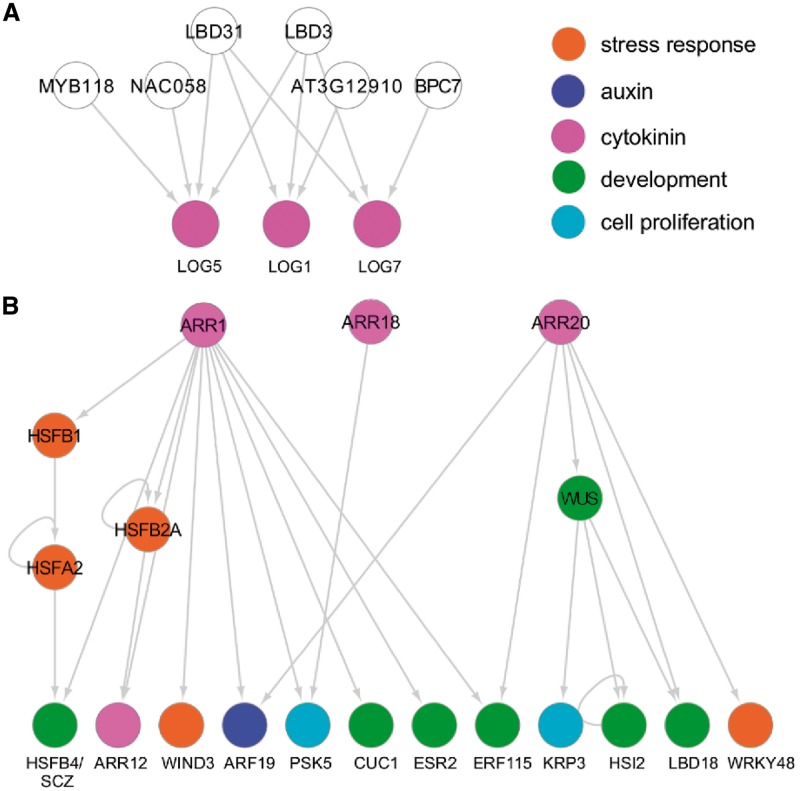
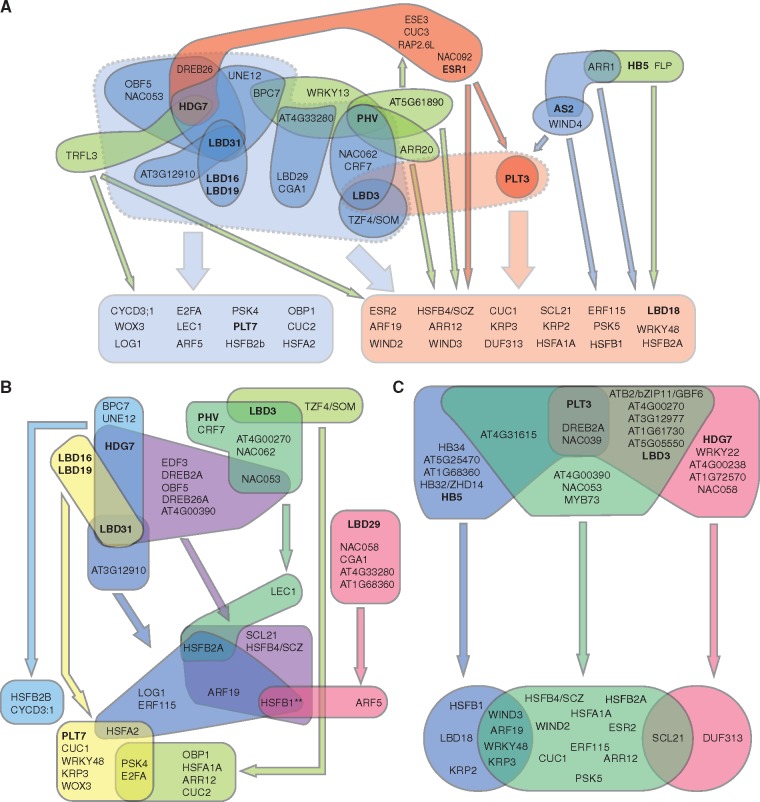
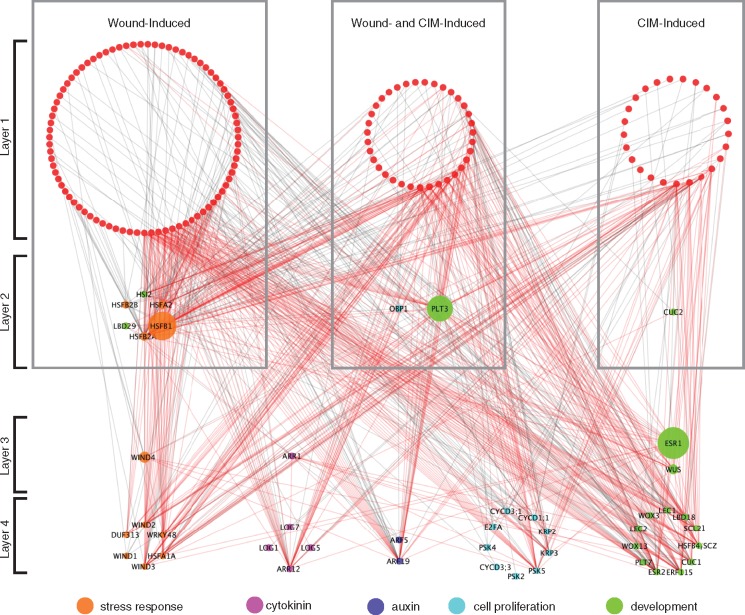
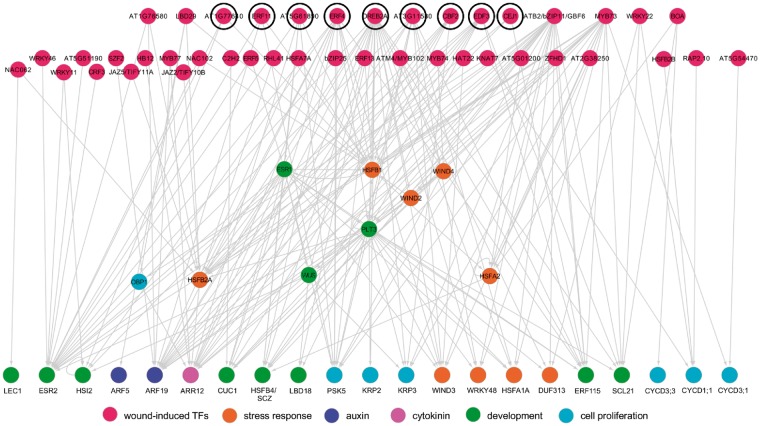
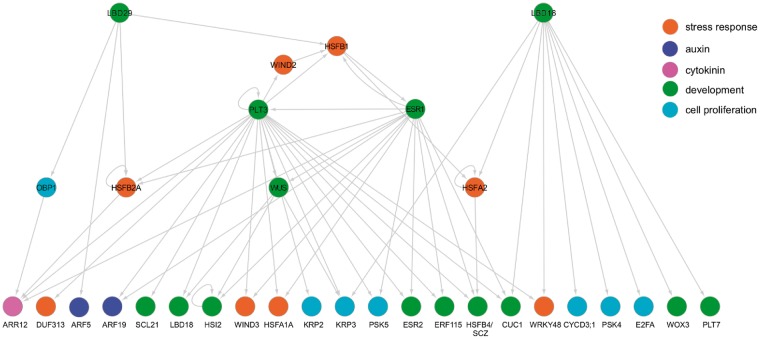
Wounding triggers organ regeneration in many plant species, and application of plant hormones, such as auxin and cytokinin, enhances their regenerative capacities in tissue culture. Recent studies have identified several key players mediating wound- and/or plant hormone-induced cellular reprogramming, but the global architecture of gene regulatory relationships underlying plant cellular reprogramming is still far from clear. In this study, we uncovered a gene regulatory network (GRN) associated with plant cellular reprogramming by using an enhanced yeast one-hybrid (eY1H) screen systematically to identify regulatory relationships between 252 transcription factors (TFs) and 48 promoters. Our network analyses suggest that wound- and/or hormone-invoked signals exhibit extensive cross-talk and regulate many common reprogramming-associated genes via multilayered regulatory cascades. Our data suggest that PLETHORA 3 (PLT3), ENHANCER OF SHOOT REGENERATION 1 (ESR1) and HEAT SHOCK FACTOR B 1 (HSFB1) act as critical nodes that have many overlapping targets and potentially connect upstream stimuli to downstream developmental decisions. Interestingly, a set of wound-inducible APETALA 2/ETHYLENE RESPONSE FACTORs (AP2/ERFs) appear to regulate these key genes, which, in turn, form feed-forward cascades that control downstream targets associated with callus formation and organ regeneration. In addition, we found another regulatory pathway, mediated by LATERAL ORGAN BOUNDARY/ASYMMETRIC LEAVES 2 (LOB/AS2) TFs, which probably plays a distinct but partially overlapping role alongside the AP2/ERFs in the putative gene regulatory cascades. Taken together, our findings provide the first global picture of the GRN governing plant cell reprogramming, which will serve as a valuable resource for future studies.
创伤触发许多植物物种的器官再生,应用植物激素,如生长素和细胞分裂素,可增强其组织培养中的再生能力。最近的研究已经确定了几个介导创伤和/或植物激素诱导的细胞重编程的关键因子,但植物细胞重编程的基因调控关系的全局结构仍远不清楚。在这项研究中,我们通过系统地使用增强型酵母单杂交(eY1H)筛选来鉴定 252 个转录因子(TFs)和 48 个启动子之间的调控关系,揭示了一个与植物细胞重编程相关的基因调控网络(GRN)。我们的网络分析表明,创伤和/或激素诱导的信号表现出广泛的串扰,并通过多层次的调控级联调控许多常见的重编程相关基因。我们的数据表明,PLETHORA 3(PLT3)、增强芽再生 1(ESR1)和热休克因子 B 1(HSFB1)作为关键节点,具有许多重叠的靶标,并可能将上游刺激与下游发育决策联系起来。有趣的是,一组创伤诱导的 APETALA 2/ETHYLENE RESPONSE FACTORS(AP2/ERFs)似乎调控这些关键基因,这些基因反过来又形成正反馈级联,控制与愈伤组织形成和器官再生相关的下游靶标。此外,我们发现了另一条由侧生器官边界/不对称叶 2(LOB/AS2)TFs 介导的调控途径,该途径可能在假定的基因调控级联中与 AP2/ERFs 发挥独特但部分重叠的作用。总之,我们的研究结果提供了调控植物细胞重编程的 GRN 的第一个全局图景,这将成为未来研究的宝贵资源。