Department of Urology, Medical Faculty, Heinrich Heine University, 40225 Duesseldorf, Germany.
Institute of Cell Biology (Cancer Research), University of Duisburg-Essen Medical School, 45122 Essen, Germany.
Int J Mol Sci. 2018 Feb 16;19(2):590. doi: 10.3390/ijms19020590.
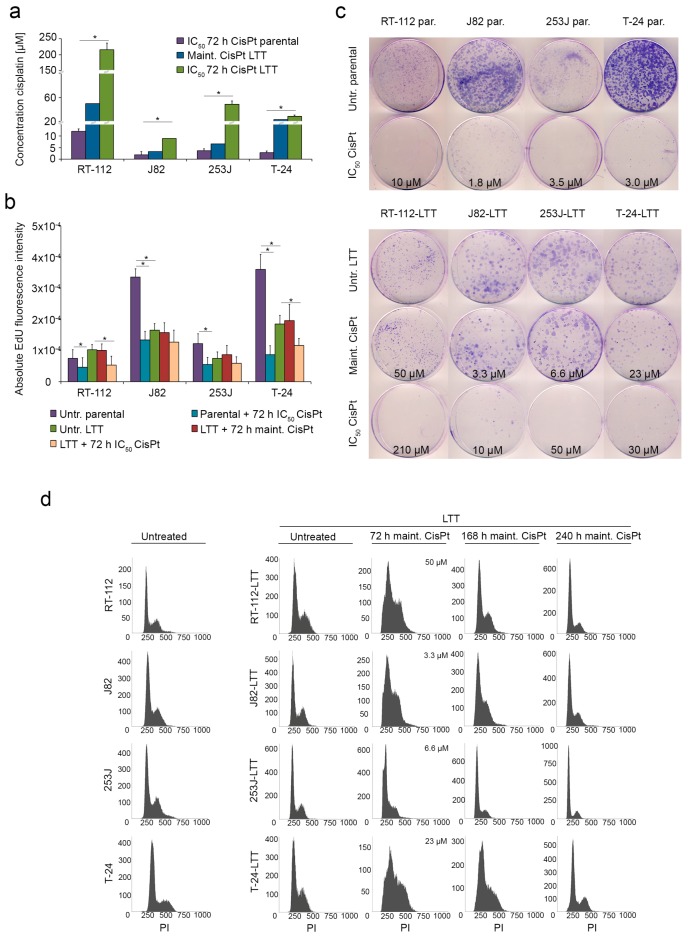
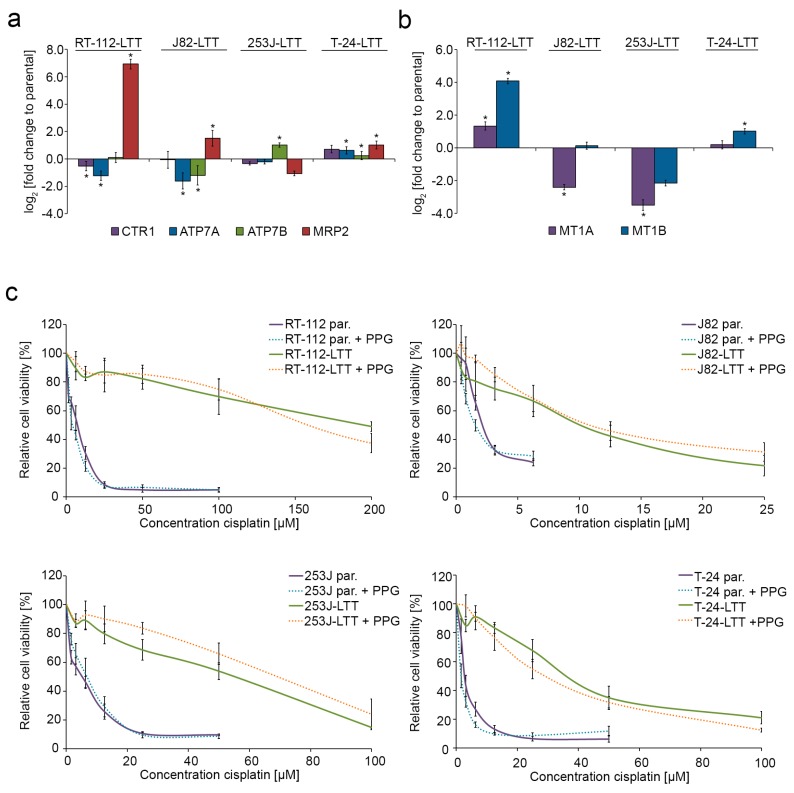
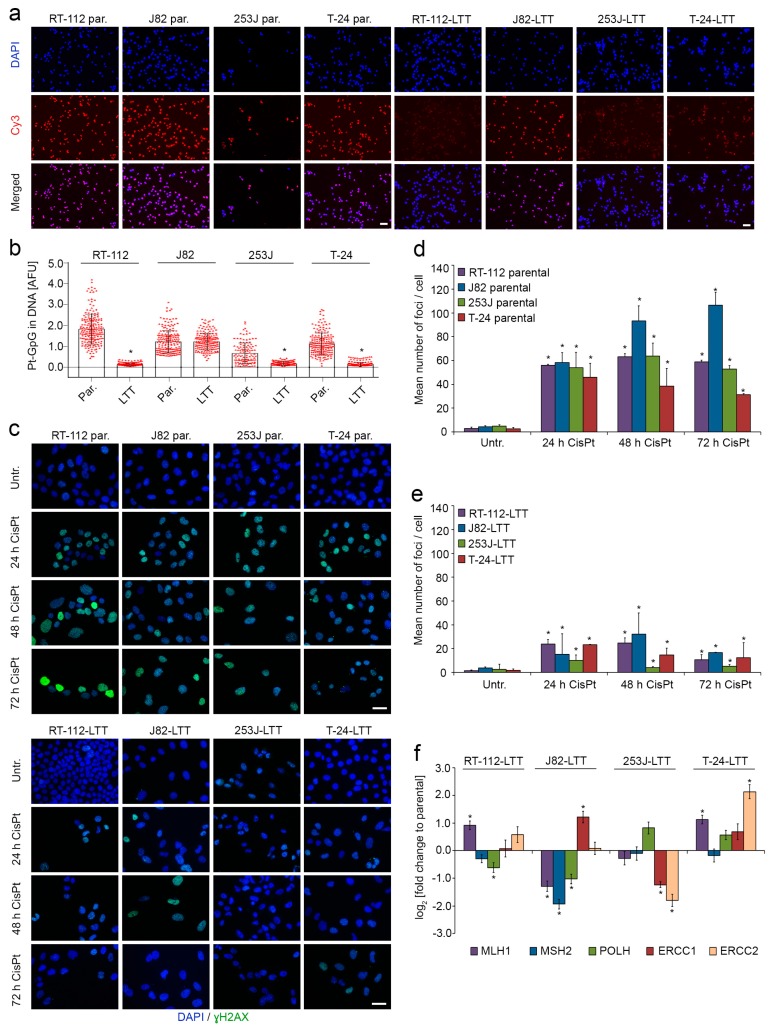
Therapeutic efficacy of cisplatin-based treatment of late stage urothelial carcinoma (UC) is limited by chemoresistance. To elucidate underlying mechanisms and to develop new approaches for overcoming resistance, we generated long-term cisplatin treated (LTT) UC cell lines, characterised their cisplatin response, and determined the expression of molecules involved in cisplatin transport and detoxification, DNA repair, and apoptosis. Inhibitors of metallothioneins and Survivin were applied to investigate their ability to sensitise towards cisplatin. Cell growth, proliferation, and clonogenicity were examined after cisplatin treatment by MTT 3-(4,5-dimethylthiazol-2-yl)-2,5-diphenyltetrazolium bromide, EdU (5-ethynyl-2'-deoxyuridine) incorporation assay, and Giemsa staining, respectively. Cell cycle distribution and apoptosis were quantified by flow cytometry. mRNA and protein expressions were measured by real-time quantitative (qRT)-PCR, western blot, or immunofluorescence staining. LTTs recovered rapidly from cisplatin stress compared to parental cells. In LTTs, to various extents, cisplatin exporters and metallothioneins were induced, cisplatin adduct levels and DNA damage were decreased, whereas expression of DNA repair factors and specific anti-apoptotic factors was elevated. Pharmacological inhibition of Survivin, but not of metallothioneins, sensitised LTTs to cisplatin, in an additive manner. LTTs minimise cisplatin-induced DNA damage and evade apoptosis by increased expression of anti-apoptotic factors. The observed diversity among the four LTTs highlights the complexity of cisplatin resistance mechanisms even within one tumour entity, explaining heterogeneity in patient responses to chemotherapy.
顺铂治疗晚期尿路上皮癌(UC)的疗效受到化疗耐药性的限制。为了阐明潜在机制并开发克服耐药性的新方法,我们生成了长期顺铂处理(LTT)的 UC 细胞系,表征了它们对顺铂的反应,并确定了参与顺铂转运和解毒、DNA 修复和凋亡的分子的表达。应用金属硫蛋白和 Survivin 的抑制剂来研究它们对顺铂增敏的能力。通过 MTT 3-(4,5-二甲基噻唑-2-基)-2,5-二苯基四氮唑溴盐、EdU(5-乙炔基-2'-脱氧尿苷)掺入测定法和 Giemsa 染色分别检测顺铂处理后细胞生长、增殖和集落形成能力。通过流式细胞术定量细胞周期分布和细胞凋亡。通过实时定量(qRT)-PCR、western blot 或免疫荧光染色测量 mRNA 和蛋白质表达。LTTs 从顺铂应激中迅速恢复,与亲本细胞相比。在 LTTs 中,不同程度地上调了顺铂外排泵和金属硫蛋白,降低了顺铂加合物水平和 DNA 损伤,而 DNA 修复因子和特定抗凋亡因子的表达升高。Survivin 的药理学抑制,但不是金属硫蛋白的抑制,以附加方式使 LTTs 对顺铂增敏。LTTs 通过增加抗凋亡因子的表达来最小化顺铂诱导的 DNA 损伤并逃避凋亡。在四个 LTTs 中观察到的多样性突出了即使在一种肿瘤实体中,顺铂耐药机制的复杂性,解释了患者对化疗反应的异质性。