Skowron Margaretha A, Niegisch Günter, Albrecht Philipp, van Koeveringe Gommert, Romano Andrea, Albers Peter, Schulz Wolfgang A, Hoffmann Michèle J
Department of Urology, Medical Faculty, Heinrich-Heine-University, Duesseldorf 40225, Germany.
Department of Neurology, Medical Faculty, Heinrich-Heine-University, Duesseldorf 40225, Germany.
Int J Mol Sci. 2017 Aug 2;18(8):1680. doi: 10.3390/ijms18081680.
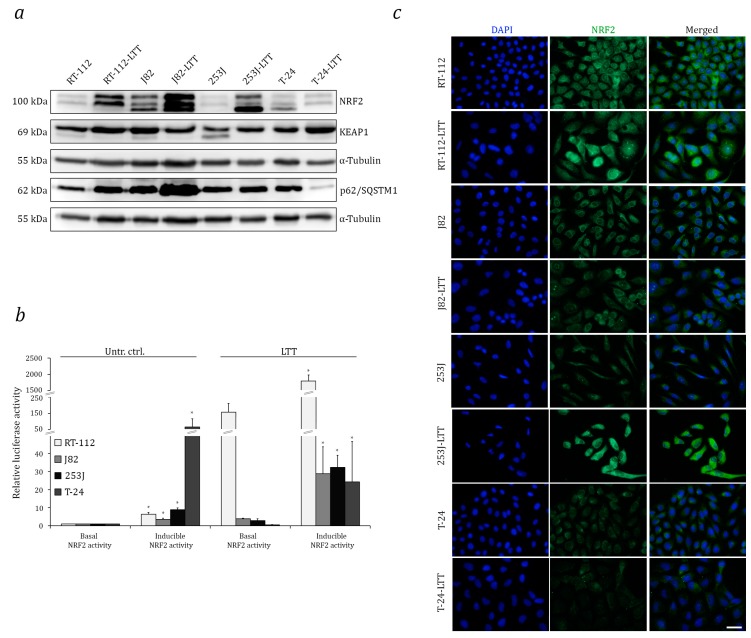
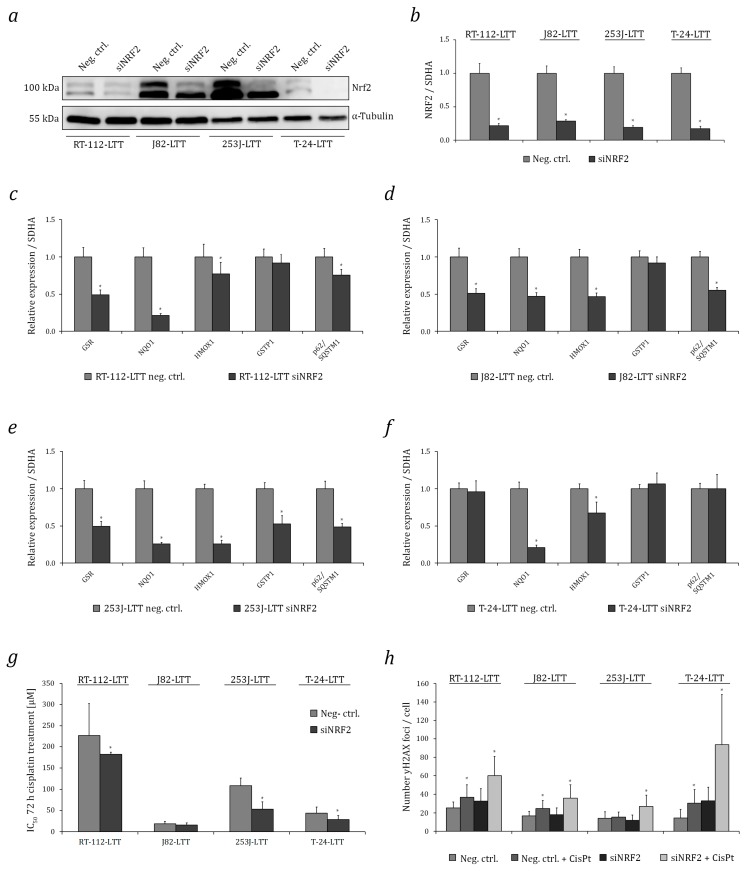
Therapeutic efficacy of cisplatin-based chemotherapy for advanced-stage urothelial carcinoma (UC) is limited by drug resistance. The nuclear factor (erythroid-derived 2)-like 2 (NRF2) pathway is a major regulator of cytoprotective responses. We investigated its involvement in cisplatin resistance in long-term cisplatin treated UC cell lines (LTTs). Expression of NRF2 pathway components and targets was evaluated by qRT-PCR and western blotting in LTT sublines from four different parental cells. NRF2 transcriptional activity was determined by reporter assays and total glutathione (GSH) was quantified enzymatically. Effects of siRNA-mediated NRF2 knockdown on chemosensitivity were analysed by viability assays, γH2AX immunofluorescence, and flow cytometry. Increased expression of NRF2, its positive regulator p62/SQSTM1, and elevated NRF2 activity was observed in 3/4 LTTs, which correlated with KEAP1 expression. Expression of cytoprotective enzymes and GSH concentration were upregulated in some LTTs. NRF2 knockdown resulted in downregulation of cytoprotective enzymes and resensitised 3/4 LTTs towards cisplatin as demonstrated by reduced IC values, increased γH2AX foci formation, and elevated number of apoptotic cells. In conclusion, while LTT lines displayed diversity in NRF2 activation, NRF2 signalling contributed to cisplatin resistance in LTT lines, albeit in diverse ways. Accordingly, inhibition of NRF2 can be used to resensitise UC cells to cisplatin, but responses in patients may likewise be variable.
基于顺铂的化疗对晚期尿路上皮癌(UC)的治疗效果受到耐药性的限制。核因子(红系衍生2)样2(NRF2)途径是细胞保护反应的主要调节因子。我们研究了其在长期顺铂处理的UC细胞系(LTTs)中对顺铂耐药性的影响。通过qRT-PCR和蛋白质印迹法评估了来自四种不同亲本细胞的LTT亚系中NRF2途径成分和靶点的表达。通过报告基因测定法确定NRF转录活性,并通过酶法对总谷胱甘肽(GSH)进行定量。通过活力测定、γH2AX免疫荧光和流式细胞术分析了siRNA介导的NRF2敲低对化疗敏感性的影响。在3/4的LTTs中观察到NRF2、其正向调节因子p62/SQSTM1的表达增加以及NRF2活性升高,这与KEAP1表达相关。在一些LTTs中,细胞保护酶的表达和GSH浓度上调。NRF2敲低导致细胞保护酶下调,并使3/4的LTTs对顺铂重新敏感,表现为IC值降低、γH2AX焦点形成增加和凋亡细胞数量增加。总之,虽然LTT系在NRF2激活方面表现出多样性,但NRF2信号通路以不同方式促成了LTT系中的顺铂耐药性。因此,抑制NRF2可用于使UC细胞对顺铂重新敏感,但患者的反应可能同样存在差异。