Translational Health Research Institute, School of Medicine, Western Sydney University, Campbelltown Campus, Locked Bag 1797, Penrith, NSW, 2571, Australia.
Ingham Institute for Applied Medical Research, University of New South Wales, 1 Campbell Street, Liverpool, NSW, 2170, Australia.
BMC Psychiatry. 2018 Feb 20;18(1):49. doi: 10.1186/s12888-018-1598-x.
Depression is a leading source of morbidity and health loss in Australian women. This study investigates the determinants of antenatal depressive symptoms and postnatal depressive symptoms in an Australian population, including people from culturally and linguistically diverse (CALD) backgrounds.
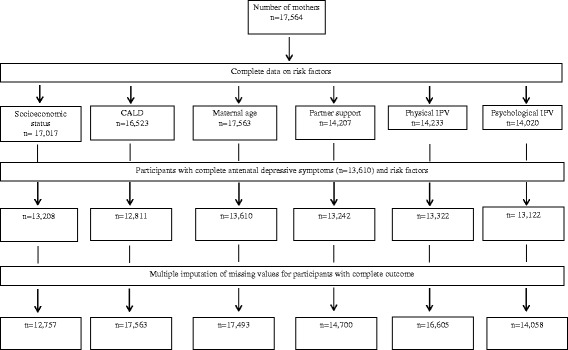
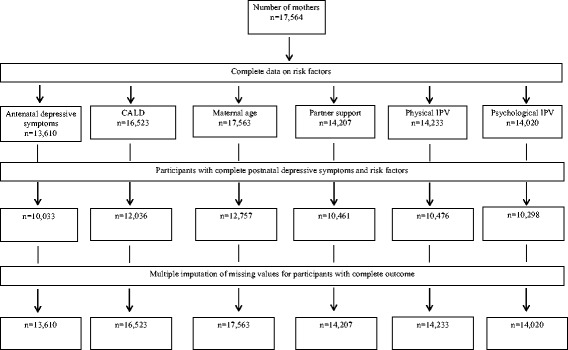
The study used a retrospective cohort of mothers of all live births in public health facilities in 2014 (N = 17,564) within South Western Sydney Local Health District and Sydney Local Health District in New South Wales, Australia. Prevalence of antenatal and postnatal depressive symptoms were estimated for the cohort. Multivariate logistic regression models were conducted to investigate the sociodemographic, psychological and health service determinants of antenatal and postnatal depressive symptoms, measured using the Edinburgh Postnatal Depression Scale (EPDS).
The prevalence of antenatal and postnatal depressive symptoms was 6.2% and 3.3% of the cohort, respectively. Significant risk factors for maternal depressive symptoms during pregnancy were, a lack of partner support, history of intimate partner violence, being from the CALD population and low socioeconomic status. Self-reported antenatal depressive symptoms were strongly associated with postnatal depressive symptoms. Risk factors for postnatal depressive symptoms were similar to those for antenatal depressive symptoms, as well as assisted delivery.
Factors relating to demographic and psychosocial disadvantage were associated with subsequent antenatal and postnatal depressive symptoms in New South Wales, Australia. Our study suggests that screening for probable depression and timely referral for expert assessment of at-risk mothers may be an effective strategy to improve maternal mental health outcomes.
在澳大利亚女性中,抑郁是导致发病和健康损失的主要原因。本研究调查了澳大利亚人群(包括具有文化和语言多样性背景的人群)中产前抑郁症状和产后抑郁症状的决定因素。
该研究使用了澳大利亚新南威尔士州南西部悉尼地方卫生区和悉尼地方卫生区公共卫生机构所有活产母亲的回顾性队列(N=17564)。对队列中的产前和产后抑郁症状的患病率进行了估计。使用爱丁堡产后抑郁量表(EPDS)对社会人口统计学、心理和卫生服务决定因素进行了多变量逻辑回归模型分析,以调查产前和产后抑郁症状。
该队列中产前和产后抑郁症状的患病率分别为 6.2%和 3.3%。母亲在怀孕期间出现抑郁症状的显著危险因素包括缺乏伴侣支持、有亲密伴侣暴力史、来自文化和语言多样性人群以及社会经济地位低。自我报告的产前抑郁症状与产后抑郁症状密切相关。产后抑郁症状的危险因素与产前抑郁症状相似,还有辅助分娩。
与人口统计学和心理社会劣势相关的因素与澳大利亚新南威尔士州随后的产前和产后抑郁症状有关。我们的研究表明,对可能患有抑郁症的产妇进行筛查,并及时转介给有经验的专家进行评估,可能是改善产妇心理健康结果的有效策略。