Institute of Reproductive Biology, Leibniz Institute for Farm Animal Biology (FBN), Wilhelm-Stahl-Allee 2, 18196, Dummerstorf, Germany.
Reprod Biol Endocrinol. 2018 Feb 20;16(1):15. doi: 10.1186/s12958-018-0332-3.
The LH-induced folliculo-luteal transformation is connected with alterations of the gene expression profile in cells of the granulosa layer. It has been described that hypoxic conditions occur during luteinization, thus favoring the formation of L-lactate within the follicle. Despite being a product of anaerobic respiration, L-lactate has been shown to act as a signaling molecule affecting gene expression in neuronal cells. During the present study, we tested the hypothesis that L-lactate may influence differentiation of follicular granulosa cells (GC).
In a bovine granulosa cell culture model effects of L- and D-lactate, of increased glucose concentrations and of the lactate transport inhibitor UK5099 were analyzed. Steroid hormone production was analyzed by RIA and the abundance of key transcripts was determined by quantitative real-time RT-PCR.
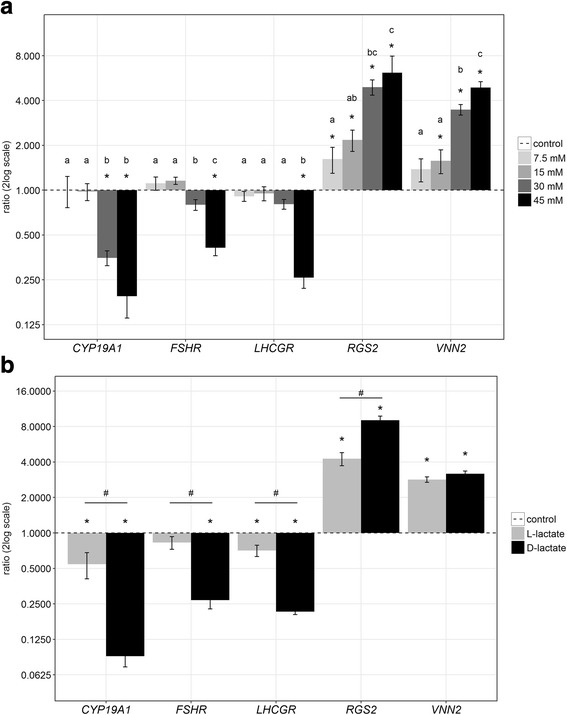
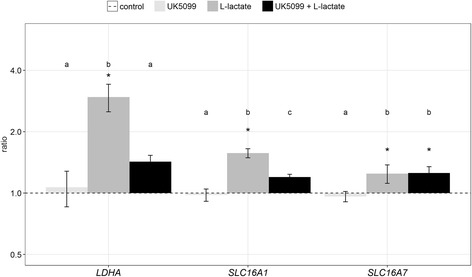
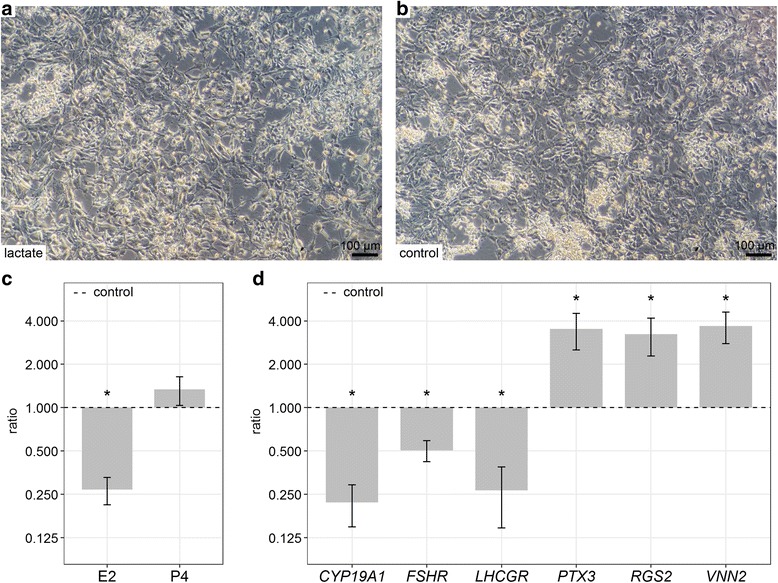
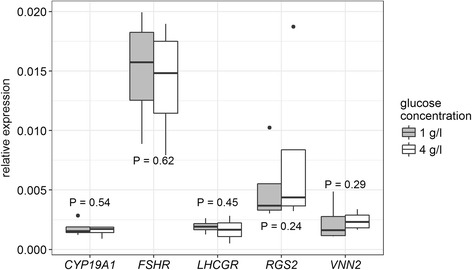
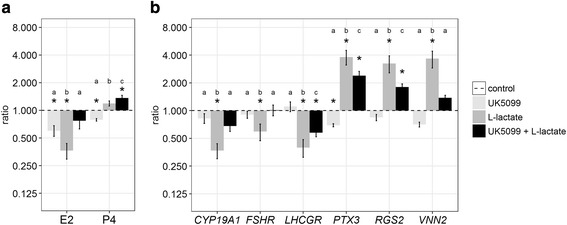
L-lactate decreased the production of estradiol and significantly affected selected genes of the folliculo-luteal transition as well as genes of the lactate metabolism. CYP19A1, FSHR, LHCGR were down-regulated, whereas RGS2, VNN2, PTX3, LDHA and lactate transporters were up-regulated. These effects could be partly or completely reversed by pre-treatment of the cells with UK5099. The non-metabolized enantiomer D-lactate had even more pronounced effects on gene expression, whereas increased glucose concentrations did not affect transcript abundance.
In summary, our data suggest that L-lactate specifically alters physiological and molecular characteristics of GC. These effects critically depend on L-lactate uptake, but are not triggered by increased energy supply. Further, we could show that L-lactate has a positive feedback on the lactate metabolism. Therefore, we hypothesize that L-lactate acts as a signaling molecule in bovine and possibly other monovular species supporting differentiation during the folliculo-luteal transformation.
LH 诱导的卵泡-黄体转化与颗粒细胞层细胞基因表达谱的改变有关。已经描述了在黄体化过程中会出现缺氧条件,从而有利于卵泡内 L-乳酸的形成。尽管 L-乳酸是无氧呼吸的产物,但它已被证明作为一种信号分子,影响神经元细胞中的基因表达。在本研究中,我们检验了这样一个假设,即 L-乳酸可能影响卵泡颗粒细胞(GC)的分化。
在牛颗粒细胞培养模型中,分析了 L-和 D-乳酸、葡萄糖浓度升高和乳酸转运抑制剂 UK5099 的作用。通过 RIA 分析类固醇激素的产生,并通过定量实时 RT-PCR 确定关键转录物的丰度。
L-乳酸降低了雌二醇的产生,并显著影响了卵泡黄体转化的选定基因以及乳酸代谢的基因。CYP19A1、FSHR、LHCGR 下调,而 RGS2、VNN2、PTX3、LDHA 和乳酸转运蛋白上调。这些作用可以通过细胞预处理 UK5099 部分或完全逆转。非代谢的对映体 D-乳酸对基因表达的影响甚至更为明显,而增加葡萄糖浓度不会影响转录物丰度。
总之,我们的数据表明,L-乳酸特异性地改变了 GC 的生理和分子特征。这些作用严重依赖于 L-乳酸的摄取,但不是由增加的能量供应触发的。此外,我们还表明,L-乳酸对乳酸代谢有正反馈作用。因此,我们假设 L-乳酸作为一种信号分子在牛和可能其他单胎物种中发挥作用,支持卵泡-黄体转化过程中的分化。