Institute of Reproductive Biology, Leibniz Institute for Farm Animal Biology (FBN), Wilhelm-Stahl-Allee 2, 18196, Dummerstorf, Germany.
Institute for Immunology, University of Rostock, 18055, Rostock, Germany.
BMC Genomics. 2019 Apr 5;20(1):273. doi: 10.1186/s12864-019-5657-6.
Previously, we could show that L-lactate affects cultured bovine granulosa cells (GC) in a specific manner driving the cells into an early pre-ovulatory phenotype. Here we studied genome wide effects in L-lactate-treated GC to further elucidate the underlying mechanisms that are responsible for the L-lactate induced transformation. Cultured estrogen producing GC treated either with L-lactate or vehicle control were subjected to mRNA microarray analysis.
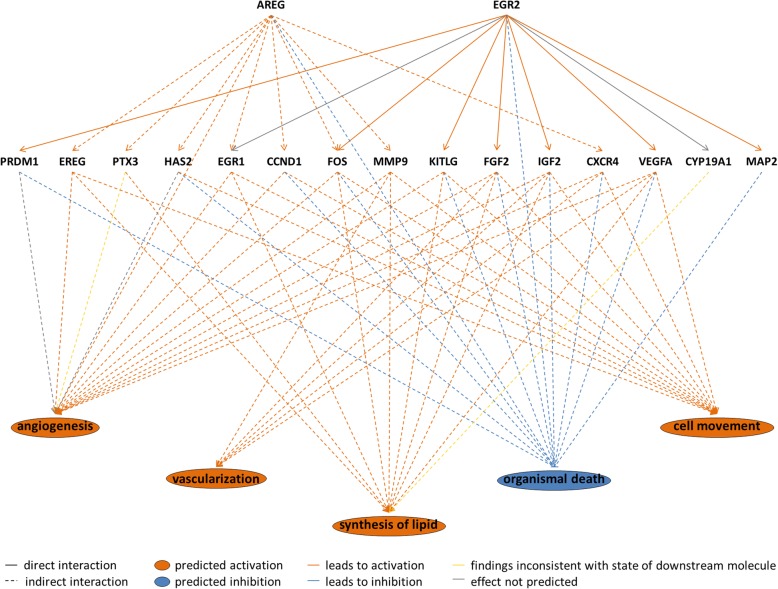
The analysis revealed 487 differentially expressed clusters, representing 461 annotated genes. Of these, 333 (= 318 genes) were identified as up- and 154 (= 143 genes) as down-regulated. As the top up-regulated genes we detected TXNIP, H19 and AHSG as well as our previously established marker transcripts RGS2 and PTX3. The top down-regulated genes included VNN1, SLC27A2 and GFRA1, but also MYC and the GC marker transcript CYP19A1. Pathway analysis with differentially expressed genes indicated "cAMP-mediated signaling" and "Axon guidance signaling" among the most affected pathways. Furthermore, estradiol, progesterone and Vegf were identified as potential upstream regulators. An effector network analysis by IPA provided first hints that processes of "angiogenesis" and "vascularization", but also "cell movement" appeared to be activated, whereas "organismal death" was predicted to be inhibited.
Our data clearly show that L-lactate alters gene expression in cultured bovine GC in a broad, but obviously specific manner. Pathway analysis revealed that the mode of L-lactate action in GC initiates angiogenic processes, but also migratory events like cell movement and axonal guidance signaling, thus supporting the transformation of GC into an early luteal phenotype.
此前,我们已经证明 L-乳酸能够以特定的方式影响培养的牛颗粒细胞(GC),使其向早期排卵前表型转化。在这里,我们研究了 L-乳酸处理后的 GC 的全基因组效应,以进一步阐明导致 L-乳酸诱导转化的潜在机制。用 L-乳酸或对照载体处理培养的雌激素产生 GC,然后进行 mRNA 微阵列分析。
分析显示,有 487 个差异表达簇,代表 461 个注释基因。其中,333 个(= 318 个基因)被鉴定为上调,154 个(= 143 个基因)为下调。作为上调的前 10 个基因,我们检测到 TXNIP、H19 和 AHSG 以及我们之前建立的标记转录物 RGS2 和 PTX3。下调的前 10 个基因包括 VNN1、SLC27A2 和 GFRA1,但也包括 MYC 和 GC 标记转录物 CYP19A1。差异表达基因的通路分析表明,“cAMP 介导的信号转导”和“轴突导向信号转导”是受影响最大的通路之一。此外,还鉴定出雌二醇、孕酮和 Vegf 作为潜在的上游调节剂。IPA 的效应网络分析首次提供了一些线索,表明“血管生成”和“血管化”以及“细胞运动”等过程似乎被激活,而“机体死亡”则被预测被抑制。
我们的数据清楚地表明,L-乳酸以广泛但明显特定的方式改变培养的牛 GC 中的基因表达。通路分析表明,L-乳酸在 GC 中的作用模式引发了血管生成过程,但也引发了细胞运动和轴突导向信号等迁移事件,从而支持 GC 向早期黄体表型的转化。