Heidemann Lene Nyhøj, Gunnarsson Gudjon L, Salzberg C Andrew, Sørensen Jens Ahm, Thomsen Jørn Bo
Department of Plastic- and Reconstructive Surgery, Odense University Hospital, Denmark; Department of Plastic Surgery, Telemark Hospital, Skien, Norway; and Division of Plastic Surgery, Icahn School of Medicine, Mount Sinai Health System, New York, N.Y.
Plast Reconstr Surg Glob Open. 2018 Jan 12;6(1):e1625. doi: 10.1097/GOX.0000000000001625. eCollection 2018 Jan.
Acellular dermal matrix was introduced in breast reconstruction in 2001 and is gradually becoming a standard component for immediate breast reconstruction and nipple-sparing mastectomy. The reconstructive technique allows for improved aesthetic outcomes. However, there seems to be uncertainty regarding complication rates. The aim of this review was to systematically evaluate complication rates related to this method.
This systematic review was conducted according to the recommendations outlined in the Cochrane Handbook for reviews and reported in line with the Preferred Reporting Items for Systematic Reviews and Meta-Analyses statement. Relevant databases were searched for in the literature concerning the use of acellular dermal matrix in implant-based nipple-sparing mastectomy and immediate breast reconstruction. All studies underwent detailed quality assessment. Summarized outcome rates were computed using meta-analysis.
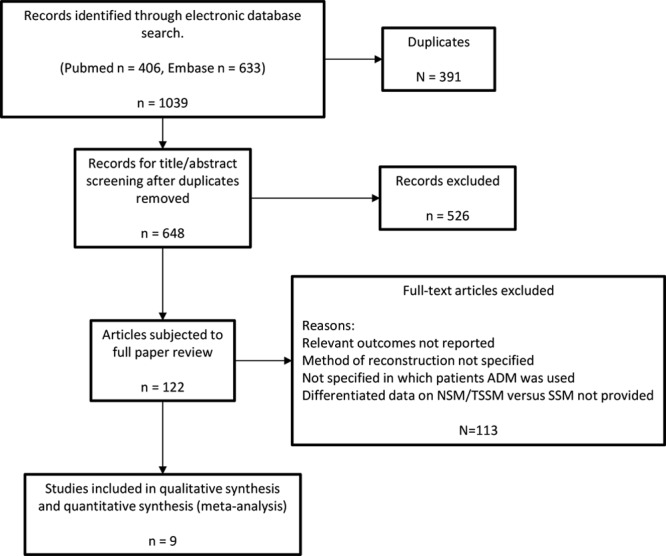
Nine of 1,039 studies were eligible for inclusion yielding 778 procedures. The quality was acceptable for all included studies. The meta-analysis found the rate of skin necrosis to be 11%, nipple necrosis 5%, infection in 12%, hematoma in 1%, treated seroma in 5%, explantation 4%, and unplanned return to the operating room in 9%.
The use of acellular dermal matrix in nipple-sparing mastectomy and implant-based breast reconstruction can be done with acceptable complication rates in selected patients. We recommend future studies to include specific definitions when reporting complication rates. Furthermore, future studies should elaborate on demographic characteristics of the included study samples and include predictor analysis to enhance knowledge of high risk patients.
脱细胞真皮基质于2001年被引入乳房重建领域,并逐渐成为即刻乳房重建和保留乳头乳房切除术的标准组成部分。该重建技术可改善美学效果。然而,并发症发生率似乎存在不确定性。本综述的目的是系统评估与该方法相关的并发症发生率。
本系统综述按照《Cochrane系统评价手册》中概述的建议进行,并根据系统评价和Meta分析的首选报告项目声明进行报告。在相关数据库中检索有关脱细胞真皮基质在基于植入物的保留乳头乳房切除术和即刻乳房重建中的应用的文献。所有研究均进行了详细的质量评估。使用Meta分析计算汇总的结局率。
1039项研究中有9项符合纳入标准,共778例手术。所有纳入研究的质量均可接受。Meta分析发现皮肤坏死率为11%,乳头坏死率为5%,感染率为12%,血肿率为1%,治疗性血清肿率为5%,植入物取出率为4%,计划外返回手术室率为9%。
在保留乳头乳房切除术和基于植入物的乳房重建中使用脱细胞真皮基质,在选定患者中并发症发生率可接受。我们建议未来的研究在报告并发症发生率时应包括具体定义。此外,未来的研究应详细阐述纳入研究样本的人口统计学特征,并进行预测因素分析,以增强对高危患者的了解。