Azuma Ryuichi, Aoki Shimpo, Kuwabara Masahiro, Aizawa Tetsushi, Nagano Hisato, Kiyosawa Tomoharu
Department of Plastic Surgery, National Defense Medical College, Saitama, Japan.
Plast Reconstr Surg Glob Open. 2018 Jan 12;6(1):e1630. doi: 10.1097/GOX.0000000000001630. eCollection 2018 Jan.
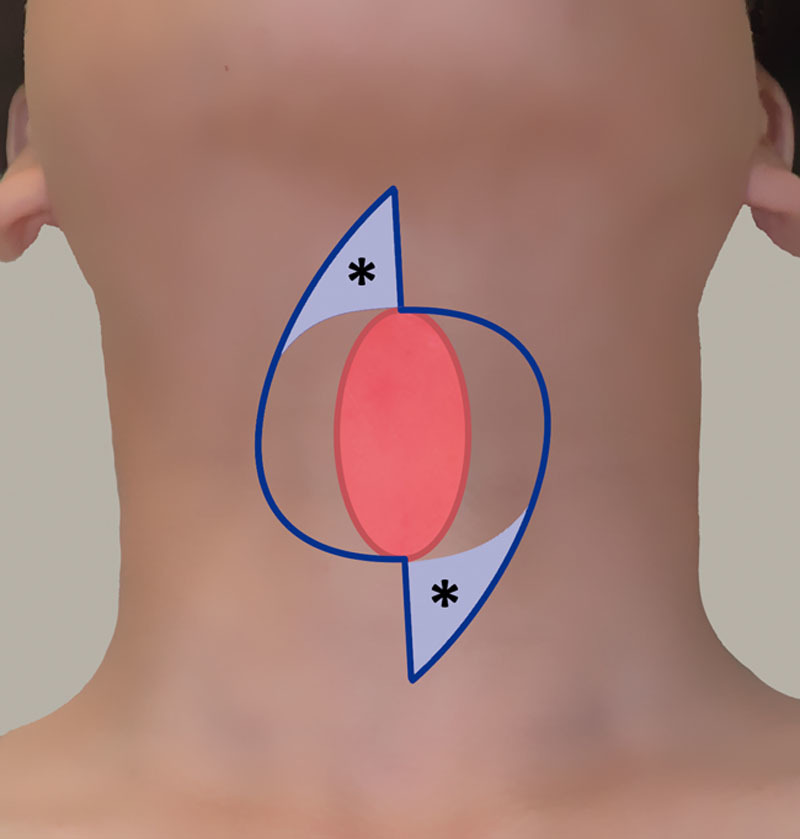
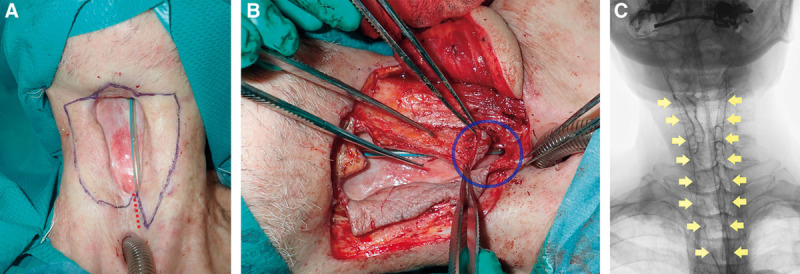
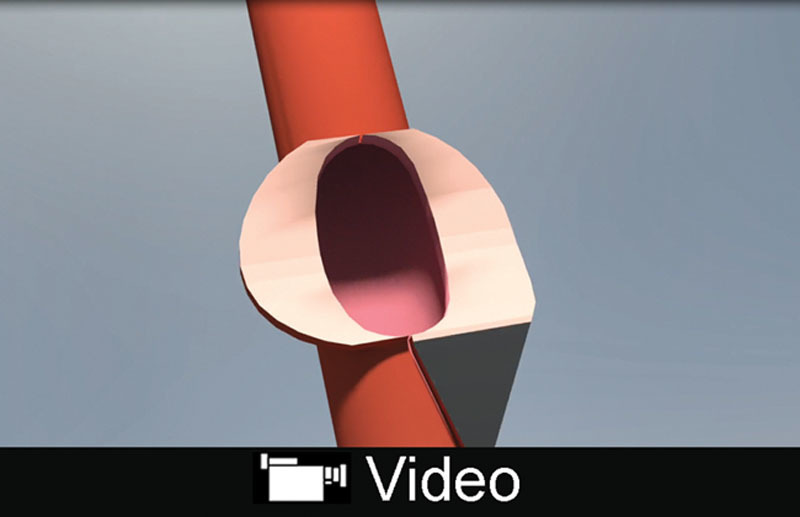
Hinge flaps are commonly used for closure of a pharyngocutaneous fistula (PCF) or laryngocutaneous fistula. These flaps are employed to augment the wall of the pharynx or larynx, but the junction between the reconstructed and native lumens can eventually become narrow and irregular after reconstruction with standard hinge flaps. We devised a method of adding a triangular extension to the end of either or both flaps and used it to treat 3 patients. In 1 patient who developed a PCF (4 × 10 cm) after laryngectomy followed by radiotherapy, the fistula was closed with 2 hinge flaps. One flap had a caudal triangular extension. The residual skin defect was covered by a pedicled latissimus dorsi musculocutaneous flap. Another patient who developed a PCF (2.5 × 3 cm) after laryngectomy underwent 2-stage reconstruction using a buccal mucosal graft with a triangular extension, followed by 2 hinge flaps. A patient who developed an laryngocutaneous fistula (1 × 2 cm) after radiotherapy and subsequent partial laryngectomy underwent reconstruction using 2 hinge flaps, each of which had a triangular extension. The skin defect was covered by another flap. Postoperative CT or video fluoroscopic examination of swallowing showed a smooth lumen with no strictures in all 3 patients. The triangular extension of the hinge flap supplements the pharyngeal/laryngeal wall at the junction between the reconstructed and intact regions, thus avoiding postoperative stricture. Especially with PCF reconstruction, restoration of a smooth luminal surface minimizes dysphagia.
铰链皮瓣常用于闭合咽皮肤瘘(PCF)或喉皮肤瘘。这些皮瓣用于增强咽壁或喉壁,但在使用标准铰链皮瓣重建后,重建管腔与天然管腔之间的连接处最终可能会变窄且不规则。我们设计了一种在一个或两个皮瓣末端添加三角形延伸部分的方法,并用于治疗3例患者。1例患者在喉切除术后接受放疗后出现PCF(4×10 cm),用2个铰链皮瓣闭合瘘口。其中一个皮瓣有一个尾侧三角形延伸部分。残留皮肤缺损用带蒂背阔肌肌皮瓣覆盖。另1例患者在喉切除术后出现PCF(2.5×3 cm),采用带三角形延伸部分的颊黏膜移植,分两期重建,随后使用2个铰链皮瓣。1例患者在放疗及随后的部分喉切除术后出现喉皮肤瘘(1×2 cm),采用2个均带有三角形延伸部分的铰链皮瓣进行重建。皮肤缺损用另一个皮瓣覆盖。术后CT或吞咽视频透视检查显示,所有3例患者的管腔均光滑,无狭窄。铰链皮瓣的三角形延伸部分在重建区域与完整区域之间的连接处对咽/喉壁起到补充作用,从而避免术后狭窄。特别是在PCF重建中,恢复光滑的管腔表面可最大程度减轻吞咽困难。