Division of Pathology, University of Edinburgh, Edinburgh, UK.
MRC Centre for Inflammation Research, University of Edinburgh, Edinburgh, UK.
Histopathology. 2018 Jul;73(1):90-100. doi: 10.1111/his.13499. Epub 2018 Apr 16.
The aim of this study was to determine if elastin content in needle core native liver biopsies was predictive of clinical outcome in patients with chronic hepatitis C virus-related chronic liver disease.
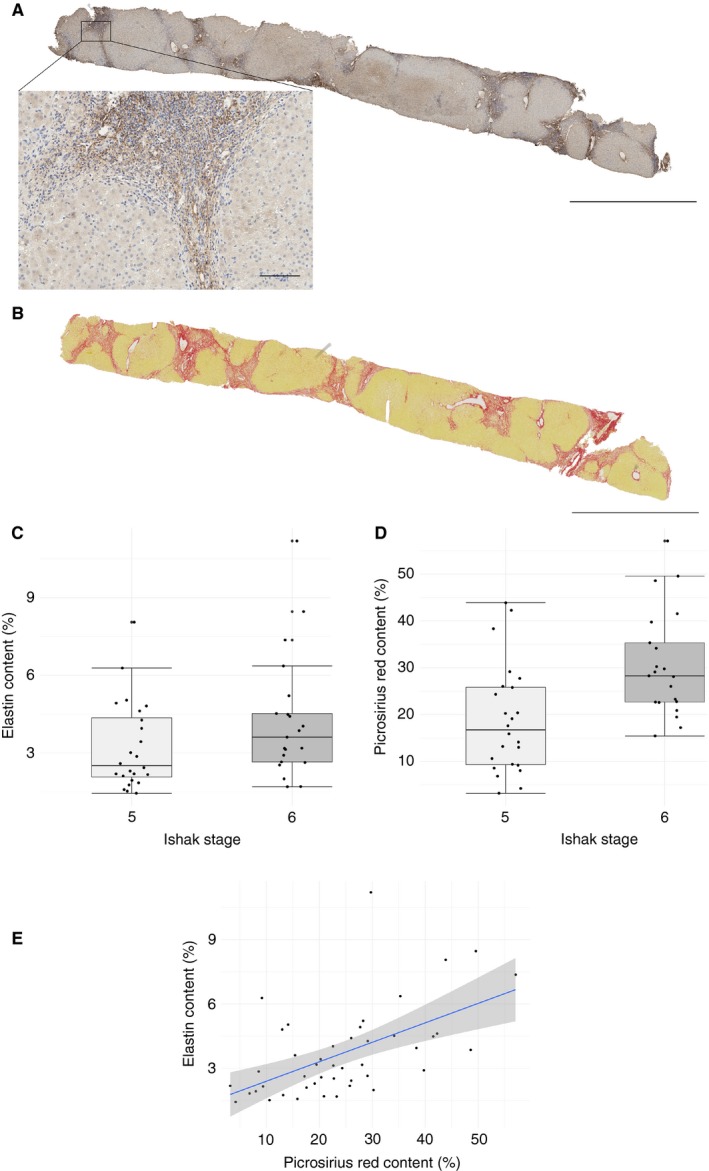
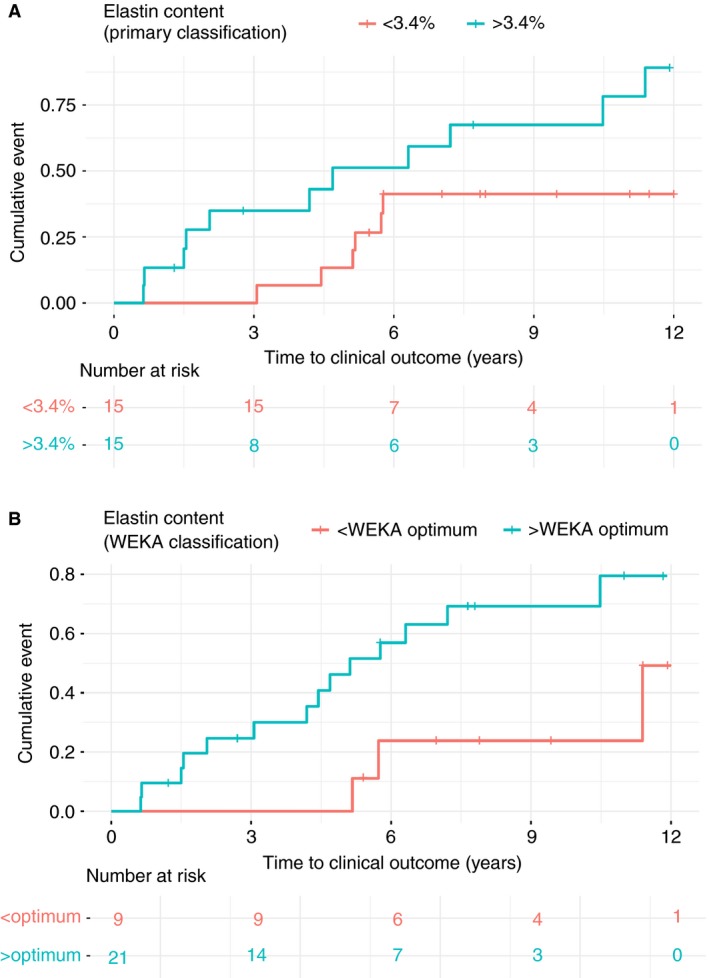
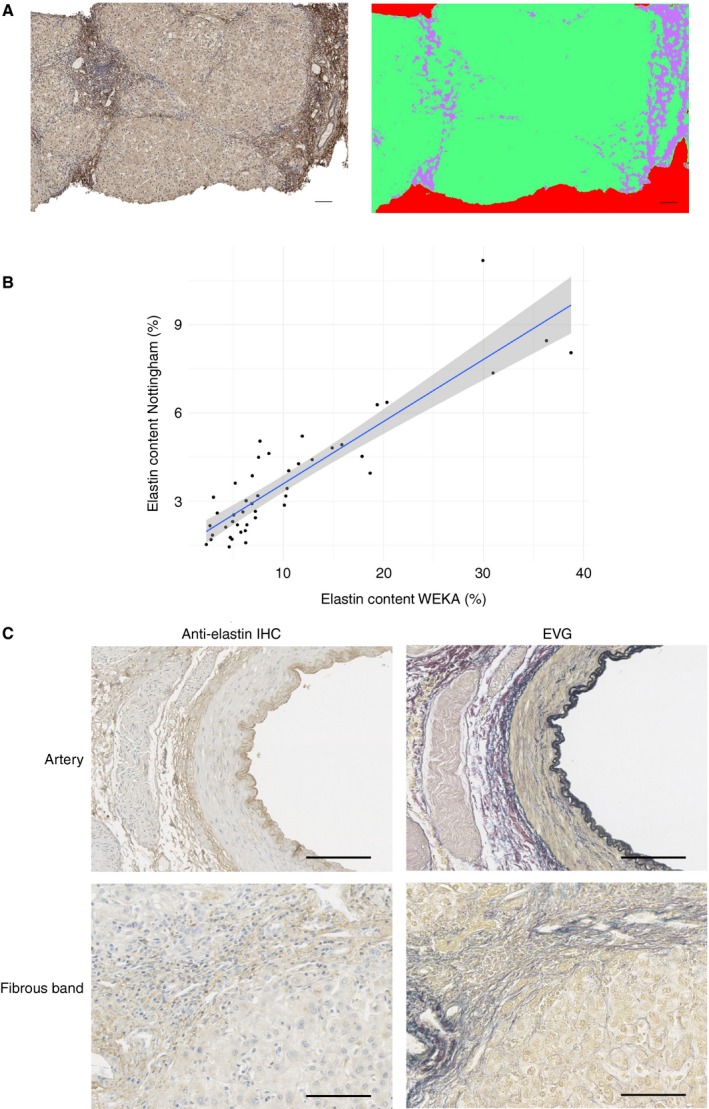
Elastin contents in liver biopsies were determined by image analysis, technically validated in an independent centre, and correlated with outcome in patients with advanced (Ishak stage ≥5) chronic hepatitis C virus-related chronic liver disease. Elastin was robustly quantified in an operator-independent and laboratory-independent manner, with very strong correlation of elastin staining measured with two methods of image classification (r = 0.873, P < 0.00001). Elastin content (but not absolute scar content or Ishak stage) was predictive for future clinical outcomes. In a cohort of patients without sustained virological response, the median hepatic elastin content was 3.4%, and 17 patients (57%) progressed to a liver-related clinical outcome; 11 of the 15 patients (73%) with a hepatic elastin content of >3.4% progressed to a clinical outcome, as compared with only six of 15 (40%) with an elastin content of <3.4%. The difference in time to outcome was significant.
We describe a simple and reproducible method for elastin quantification in liver biopsies that provides potentially valuable prognostic information to inform clinical management.
本研究旨在确定针芯原位肝活检中的弹性蛋白含量是否可预测慢性丙型肝炎病毒相关慢性肝病患者的临床结局。
通过图像分析确定肝活检中的弹性蛋白含量,在独立中心进行技术验证,并与晚期(Ishak 分期≥5)慢性丙型肝炎病毒相关慢性肝病患者的结局相关联。弹性蛋白以非操作者和非实验室依赖的方式进行了稳健的定量,两种图像分类方法测量的弹性蛋白染色具有很强的相关性(r=0.873,P<0.00001)。弹性蛋白含量(而非绝对瘢痕含量或 Ishak 分期)可预测未来的临床结局。在未获得持续病毒学应答的患者队列中,肝弹性蛋白含量的中位数为 3.4%,17 例患者(57%)进展为与肝脏相关的临床结局;15 例弹性蛋白含量>3.4%的患者中有 11 例(73%)进展为临床结局,而弹性蛋白含量<3.4%的 15 例患者中仅有 6 例(40%)进展为临床结局。结局时间的差异具有统计学意义。
我们描述了一种简单且可重复的肝活检中弹性蛋白定量方法,可为临床管理提供有价值的预后信息。