Laboratory of Translational Immunology, University Medical Center Utrecht, Utrecht, The Netherlands.
Laboratory Medicine, Lab. Medical Immunology, Radboud University Medical Center, Nijmegen, The Netherlands.
Am J Transplant. 2018 Sep;18(9):2274-2284. doi: 10.1111/ajt.14709. Epub 2018 Apr 16.
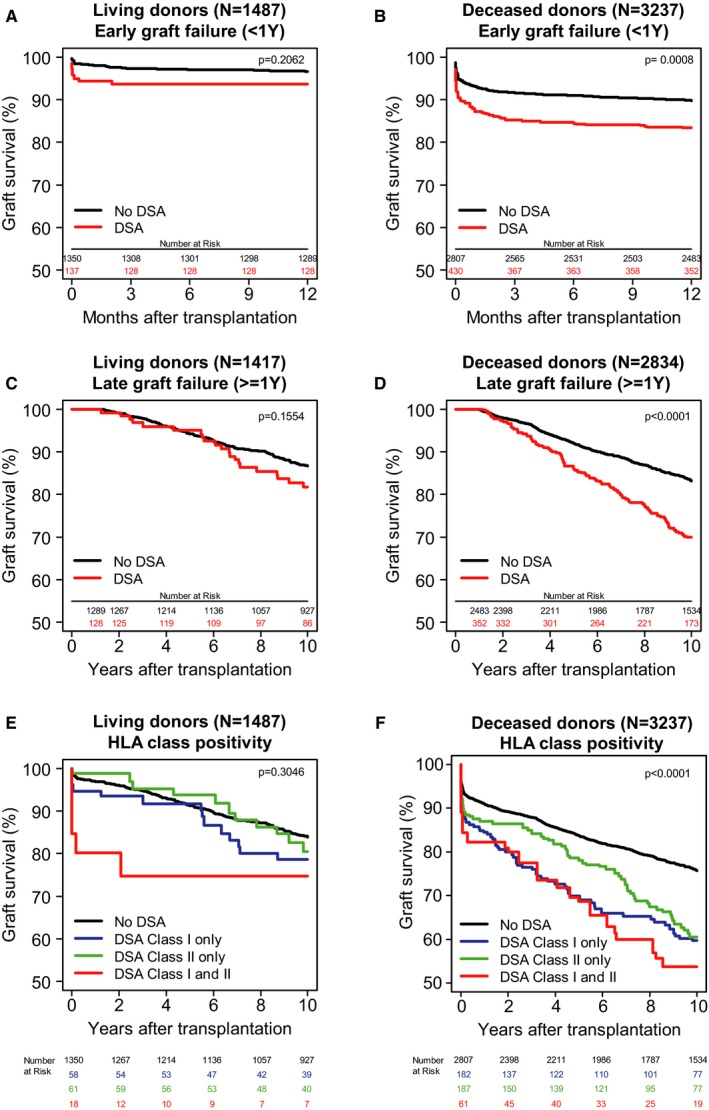
The presence of donor-specific anti-HLA antibodies (DSAs) is associated with increased risk of graft failure after kidney transplant. We hypothesized that DSAs against HLA class I, class II, or both classes indicate a different risk for graft loss between deceased and living donor transplant. In this study, we investigated the impact of pretransplant DSAs, by using single antigen bead assays, on long-term graft survival in 3237 deceased and 1487 living donor kidney transplants with a negative complement-dependent crossmatch. In living donor transplants, we found a limited effect on graft survival of DSAs against class I or II antigens after transplant. Class I and II DSAs combined resulted in decreased 10-year graft survival (84% to 75%). In contrast, after deceased donor transplant, patients with class I or class II DSAs had a 10-year graft survival of 59% and 60%, respectively, both significantly lower than the survival for patients without DSAs (76%). The combination of class I and II DSAs resulted in a 10-year survival of 54% in deceased donor transplants. In conclusion, class I and II DSAs are a clear risk factor for graft loss in deceased donor transplants, while in living donor transplants, class I and II DSAs seem to be associated with an increased risk for graft failure, but this could not be assessed due to their low prevalence.
供者特异性抗 HLA 抗体(DSA)的存在与肾移植后移植物失功的风险增加相关。我们假设针对 HLA Ⅰ类、Ⅱ类或两类抗原的 DSA 表明在尸体和活体供者移植之间,移植物丢失的风险不同。在这项研究中,我们使用单抗原珠检测,调查了移植前 DSA 对 3237 例尸体供者和 1487 例活体供者肾移植中,补体依赖性交叉配型阴性患者的长期移植物存活的影响。在活体供者移植中,我们发现移植后针对Ⅰ类或Ⅱ类抗原的 DSA 对移植物存活的影响有限。Ⅰ类和Ⅱ类 DSA 联合导致 10 年移植物存活率下降(84%降至 75%)。相比之下,在尸体供者移植后,具有Ⅰ类或Ⅱ类 DSA 的患者 10 年移植物存活率分别为 59%和 60%,均显著低于无 DSA 患者的存活率(76%)。Ⅰ类和Ⅱ类 DSA 联合导致 10 年存活率为 54%。总之,Ⅰ类和Ⅱ类 DSA 是尸体供者移植中移植物丢失的明确危险因素,而在活体供者移植中,Ⅰ类和Ⅱ类 DSA 似乎与移植物衰竭风险增加相关,但由于其发生率低,无法评估。