Scalioni Letícia de Paula, Santos Betânia Rodrigues Dos, Spritzer Poli Mara, Villela-Nogueira Cristiane Alves, Laura Lewis-Ximenez Lia, Pollo-Flores Priscila, Bordalo Cathalá Esberard Eliane, Brandão-Mello Carlos Eduardo, Lampe Elisabeth, Villar Livia Melo
Laboratory of Viral Hepatitis, Oswaldo Cruz Institute, FIOCRUZ, Rio de Janeiro Gynecological Endocrinology Unit Division of Endocrinology Porto Alegre Clinical Hospital, Department of Physiology Federal University of Rio Grande do Sul Hepatology Unit, Medical Clinic Department, Clementino Fraga Filho University Hospital, UFRJ Antonio Pedro University Hospital, Federal Fluminense University Gaffree Guinle Hospital, Federal University of Rio de Janeiro State, Rio de Janeiro, Brazil.
Medicine (Baltimore). 2018 Feb;97(8):e9881. doi: 10.1097/MD.0000000000009881.
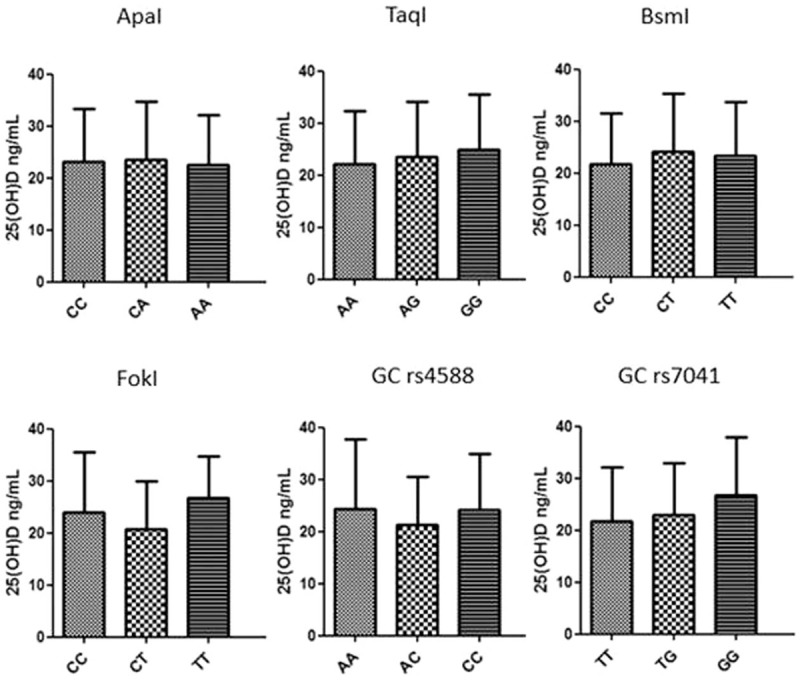
Potential relationship of vitamin D, vitamin D receptor (VDR), and vitamin D binding protein (DBP) have been suggested in the pathophysiology of hepatitis C virus (HCV) infection. The aim of this observational study is to determine vitamin D levels, and VDR and DBP genetic polymorphism according demographic and laboratory data in chronic HCV patients (CHC).A total of 148 CHC patients gave serum samples for testing 25-hydroxyvitamin D (25 (OH)D) level by immunochemiluminometric assay (<20 ng/mL defined as deficient) and donated blood samples to allelic discrimination analysis using TaqMan assays. Analyzed single nucleotide polymorphisms (SNPs) were: VDR-rs7975232 (ApaI) C>A, rs731236 A>G (TaqI), rs1544410 C>T (BsmI), rs10735810 T>C (FokI) and carrier globulin/binding protein (GC)-rs4588 and rs7041 and the haplotype bAt [CCA]. Hepatic fibrosis was assessed using Fib-4 and Forns index.Eighty-two (54.40%) patients demonstrated deficiency of vitamin D and this was associated to AST (P = .019 [CI: 1.003-1.034]), total cholesterol (P = .038 [CI: 1.004-1.164]), fibrosis grade (P < .001 [CI: 0.000-0.844]), and FokI (P = .028) allele T presence. Association was found between VDR polymorphism and fibrosis (BsmI andTaqI), triglycerides (TaqI), and HDL (FokI). DBP polymorphism was associated to HCV genotype (GC rs7041), previous HCV treatment, and GGT (GC rs4588).In conclusion, low frequency of vitamin D deficiency was found, but VDR polymorphisms were frequently associated to fibrosis grade suggesting that they could be used as disease evaluation markers to understand the mechanisms underlying the virus-host interaction.
维生素D、维生素D受体(VDR)和维生素D结合蛋白(DBP)之间的潜在关系已在丙型肝炎病毒(HCV)感染的病理生理学中被提出。这项观察性研究的目的是根据慢性HCV患者(CHC)的人口统计学和实验室数据,确定维生素D水平、VDR和DBP基因多态性。共有148名CHC患者提供血清样本,通过免疫化学发光法检测25-羟基维生素D(25(OH)D)水平(<20 ng/mL定义为缺乏),并捐献血液样本用于使用TaqMan分析法进行等位基因鉴别分析。分析的单核苷酸多态性(SNP)包括:VDR-rs7975232(ApaI)C>A、rs731236 A>G(TaqI)、rs1544410 C>T(BsmI)、rs10735810 T>C(FokI)以及结合球蛋白/结合蛋白(GC)-rs4588和rs7041以及单倍型bAt [CCA]。使用Fib-4和Forns指数评估肝纤维化。82名(54.40%)患者表现出维生素D缺乏,这与谷草转氨酶(P = 0.019 [CI:1.003 - 1.034])、总胆固醇(P = 0.038 [CI:1.004 - 1.164])、纤维化分级(P < 0.001 [CI:0.000 - 0.844])以及FokI(P = 0.028)等位基因T的存在有关。发现VDR多态性与纤维化(BsmI和TaqI)、甘油三酯(TaqI)和高密度脂蛋白(FokI)之间存在关联。DBP多态性与HCV基因型(GC rs7041)、既往HCV治疗以及γ-谷氨酰转肽酶(GC rs4588)有关。总之,发现维生素D缺乏的频率较低,但VDR多态性常与纤维化分级相关,这表明它们可作为疾病评估标志物,以了解病毒 - 宿主相互作用的潜在机制。