Sex Transm Dis. 2018 May;45(5):350-353. doi: 10.1097/OLQ.0000000000000751.
Expedited partner therapy (EPT) is an effective strategy for partner management of sexually transmitted infections. Some states, including Wisconsin, allow EPT prescriptions to be filled without a patient name. This study determined the refusal rates of nameless EPT prescriptions in Milwaukee pharmacies.
In this cross-sectional study, 3 trained research assistants of different age, sex, and race posed as "patients" and visited 50 pharmacy locations from one pharmacy chain in Milwaukee County, WI, to fill nameless EPT prescriptions. A χ test was used to compare demographics of patients, pharmacists, and pharmacies. Multiple logistic regression was used to identify factors associated with prescription refusal.
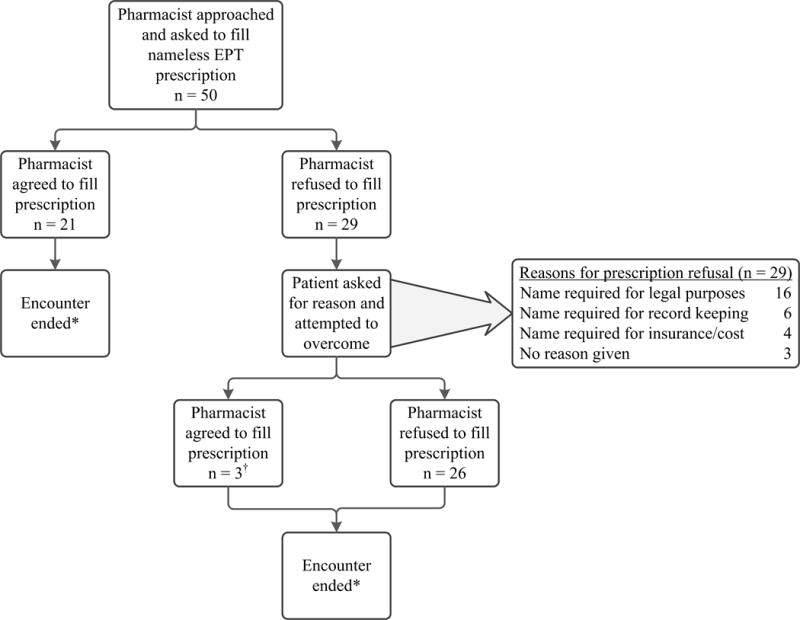
Twenty-nine (58%) of 50 nameless EPT prescriptions were refused. Univariate analysis showed that prescriptions were more likely to be refused if the pharmacy was in the suburbs (77%) compared with Milwaukee city (43%; P = 0.01), if the pharmacist was older than the patient (82%) compared with being younger (46%) or within the same age group (33%; P = 0.01 for both), and if the patient was white (78%) compared with nonwhite (47%; P = 0.03). Multivariable regression revealed significantly higher refusals for pharmacies located in the suburbs compared with the city (odds ratio, 5.3; 95% confidence interval, 1.4-20.3; P = 0.03) and in patients who were white compared with nonwhite (odds ratio: 4.8; 95% confidence interval, 1.2-19.8; P = 0.01).
More than half of nameless EPT prescriptions were refused in Milwaukee county pharmacies, more frequently at suburban pharmacies and for white patients. Increased pharmacist education regarding EPT is essential to help combat the sexually transmitted infection crisis.
快速伴侣治疗(EPT)是管理性传播感染伴侣的有效策略。包括威斯康星州在内的一些州允许在没有患者姓名的情况下填写 EPT 处方。本研究旨在确定密尔沃基市药店拒绝无名 EPT 处方的比例。
在这项横断面研究中,3 名具有不同年龄、性别和种族的训练有素的研究助理分别扮演“患者”,前往威斯康星州密尔沃基县的一家连锁药店的 50 家门店填写无名 EPT 处方。使用卡方检验比较患者、药剂师和药店的人口统计学特征。使用多变量逻辑回归确定与处方拒绝相关的因素。
50 份无名 EPT 处方中有 29 份(58%)被拒绝。单变量分析显示,如果药店位于郊区(77%)而不是密尔沃基市(43%;P = 0.01)、如果药剂师比患者年长(82%)而不是年轻(46%)或同龄(33%);P = 0.01 均为双侧),或者患者是白人(78%)而不是非白人(47%;P = 0.03),则处方更有可能被拒绝。多变量回归显示,与城市相比,位于郊区的药店(优势比,5.3;95%置信区间,1.4-20.3;P = 0.03)和白人患者(优势比:4.8;95%置信区间,1.2-19.8;P = 0.01)的拒绝率明显更高。
在密尔沃基县的药店中,超过一半的无名 EPT 处方被拒绝,在郊区的药店和白人患者中更为常见。加强药剂师对 EPT 的教育对于帮助应对性传播感染危机至关重要。