Maietta Saverio, Russo Teresa, Santis Roberto De, Ronca Dante, Riccardi Filomena, Catauro Michelina, Martorelli Massimo, Gloria Antonio
Department of Industrial Engineering, Fraunhofer JL IDEAS-University of Naples Federico II, P.le Tecchio 80, 80125 Naples, Italy.
Institute of Polymers, Composites and Biomaterials-National Research Council of Italy, V.le J.F. Kennedy 54-Mostra d'Oltremare Pad. 20, 80125 Naples, Italy.
Materials (Basel). 2018 Feb 21;11(2):312. doi: 10.3390/ma11020312.
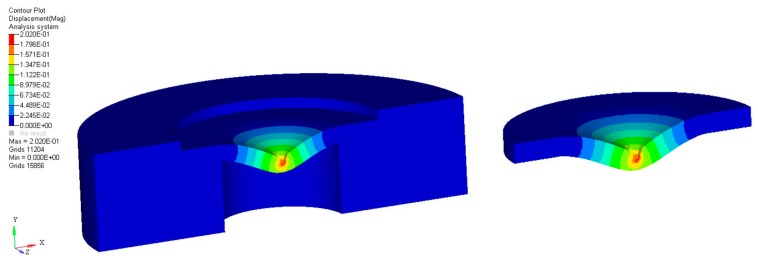
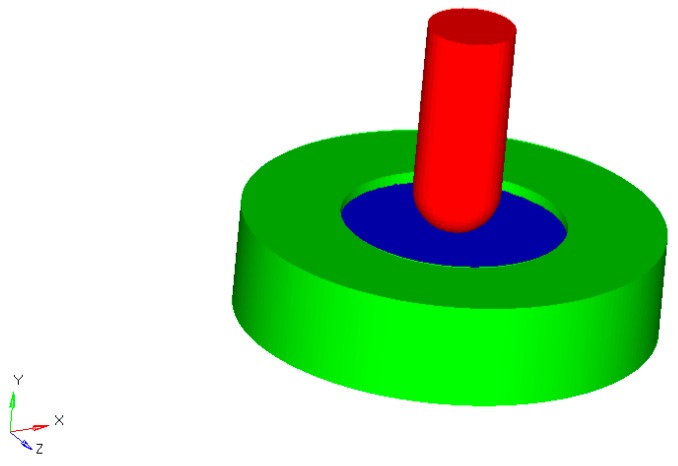
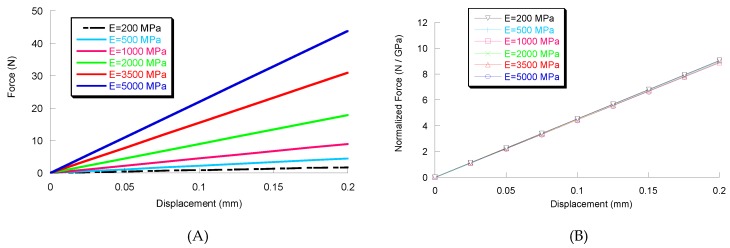
Experimental/theoretical analyses have already been performed on poly(ε-caprolactone) (PCL) loaded with organic-inorganic fillers (PCL/TiO₂ and PCL/ZrO₂) to find a correlation between the results from the small punch test and Young's modulus of the materials. PCL loaded with Ti2 (PCL = 12, TiO₂ = 88 wt %) and Zr2 (PCL = 12, ZrO₂ = 88 wt %) hybrid fillers showed better performances than those obtained for the other particle composition. In this context, the aim of current research is to provide further insight into the mechanical properties of PCL loaded with sol-gel-synthesized organic-inorganic hybrid fillers for bone tissue engineering. For this reason, theoretical analyses were performed by the finite element method. The results from the small punch test and Young's modulus of the materials were newly correlated. The obtained values of Young's modulus (193 MPa for PCL, 378 MPa for PCL/Ti2 and 415 MPa for PCL/Zr2) were higher than those obtained from a previous theoretical modelling (144 MPa for PCL, 282 MPa for PCL/Ti2 and 310 MPa for PCL/Zr2). This correlation will be an important step for the evaluation of Young's modulus, starting from the small punch test data.
已对负载有机-无机填料(聚己内酯/二氧化钛和聚己内酯/二氧化锆)的聚(ε-己内酯)(PCL)进行了实验/理论分析,以找出小冲孔试验结果与材料杨氏模量之间的相关性。负载Ti2(PCL = 12,TiO₂ = 88 wt%)和Zr2(PCL = 12,ZrO₂ = 88 wt%)混合填料的PCL表现出比其他颗粒组成更好的性能。在此背景下,当前研究的目的是进一步深入了解负载溶胶-凝胶合成有机-无机混合填料的PCL在骨组织工程中的力学性能。因此,采用有限元方法进行了理论分析。重新关联了小冲孔试验结果与材料的杨氏模量。所得杨氏模量值(PCL为193 MPa,PCL/Ti2为378 MPa,PCL/Zr2为415 MPa)高于先前理论建模所得值(PCL为144 MPa,PCL/Ti2为282 MPa,PCL/Zr2为310 MPa)。从小冲孔试验数据出发,这种相关性将是评估杨氏模量的重要一步。