Department of Global Public Health and Primary Care, Faculty of Medicine, University of Bergen, Postboks 7804, N-5020, Bergen, Norway.
Department of Obstetrics and Gynaecology, Kilimanjaro Christian Medical Centre, Moshi, Tanzania.
BMC Pregnancy Childbirth. 2018 Feb 21;18(1):56. doi: 10.1186/s12884-018-1687-3.
Preeclampsia is among the leading causes of maternal mortality and morbidity worldwide, occurs in 2-8% of all pregnancies, and is estimated to account for at least 9 % of maternal deaths in Africa. Studies from developed countries show that high pre pregnancy body mass index (BMI) increases the risk of preeclampsia. We examined the association between pre pregnancy BMI and the risk of preeclampsia in Tanzania, a low income country.
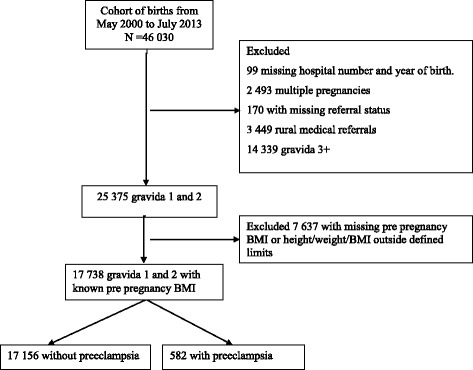
Data from the Kilimanjaro Christian Medical Center (KCMC) Medical Birth Registry recorded between July 2000 and May 2013 were used. We restricted the study population to singleton deliveries among women with no or one previous pregnancy. Pre pregnancy BMI (kg/m was categorized according to the WHO categories of underweight (less than 18.5), normal (18.5 - 24.9), overweight (25.0 - 29.9) and obese (30 or more). Potential confounders were adjusted for in multivariable analyses.
Among the 17,738 singleton births, 6.6% of the mothers were underweight, 62.1% were of normal BMI, 24.0% were overweight, and 7.3% were obese. Five hundred and eighty-two pregnancies (3.3%) were affected by preeclampsia. Compared to those with normal BMI, overweight and obese women had a higher risk of preeclampsia (aOR (95% CI) 1.4 (1.2 - 1.8) and 1.8 (1.3 - 2.4)), respectively, while underweight women had a lower risk (0.7 (0.4-1.1)).
Pre pregnancy maternal overweight and obesity were associated with an increased risk of preeclampsia in Tanzania. Risks were similar to those reported in high income countries.
子痫前期是全球孕产妇死亡和发病的主要原因之一,在所有妊娠中占 2-8%,据估计至少占非洲孕产妇死亡的 9%。来自发达国家的研究表明,怀孕前较高的体重指数(BMI)会增加子痫前期的风险。我们在坦桑尼亚这个低收入国家,研究了怀孕前 BMI 与子痫前期风险之间的关系。
我们使用了 2000 年 7 月至 2013 年 5 月期间 Kilimanjaro Christian Medical Center (KCMC) 医疗出生登记处的数据。我们将研究人群限定为单胎分娩且既往无妊娠或仅有一次妊娠的妇女。怀孕前 BMI(kg/m)根据世界卫生组织的分类标准分为消瘦(<18.5)、正常(18.5-24.9)、超重(25.0-29.9)和肥胖(30 或以上)。在多变量分析中调整了潜在的混杂因素。
在 17738 例单胎分娩中,有 6.6%的母亲消瘦,62.1%的母亲正常 BMI,24.0%超重,7.3%肥胖。有 582 例(3.3%)妊娠患有子痫前期。与正常 BMI 的妇女相比,超重和肥胖妇女患子痫前期的风险更高(aOR(95%CI)为 1.4(1.2-1.8)和 1.8(1.3-2.4)),而消瘦妇女的风险较低(0.7(0.4-1.1))。
在坦桑尼亚,怀孕前的母亲超重和肥胖与子痫前期的风险增加有关。风险与高收入国家报道的风险相似。