Sato Yukihiro, Tsuboya Toru, Watt Richard G, Aida Jun, Osaka Ken
Department of International and Community Oral Health, Tohoku University Graduate School of Dentistry, 4-1, Seiryo-machi, Aoba-ku, Sendai, Miyagi, Japan.
Department of Epidemiology and Public Health, University College London, Gower Street, London, WC1E 6BT, UK.
BMC Oral Health. 2018 Feb 21;18(1):26. doi: 10.1186/s12903-018-0488-4.
Temporary employment leads to psychological distress and higher mortality, but data on its associations with oral health is limited. We examined whether having the experience of temporary employment was associated with tooth loss among working adults in Japan.
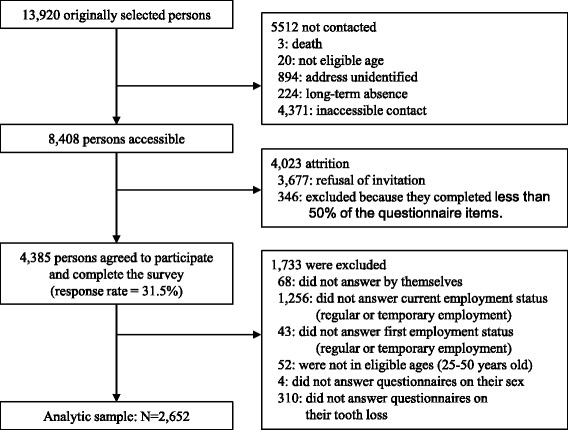
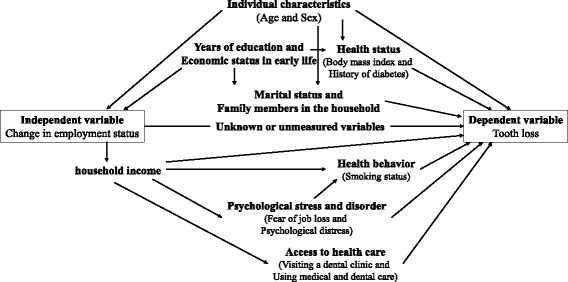
We conducted a cross-sectional study from the 2010-2011 Japanese Study on Stratification, Health, Income, and Neighborhood study that analyzed 2652 participants aged 25-50 years (men = 1394; women = 1258). Independent variable was changes in employment status (continuous regular employment and the experience of temporary employment). Dependent variable was self-reported tooth loss (none, 1 tooth, 2 teeth, 3 teeth, 4 teeth, and more than 4 teeth). Covariates were sex, age, years of education, self-rated household economic status in early life at 5 years old, marital status, number of family members in the household, history of diabetes, and body mass index. We conducted a negative binomial regression analysis to estimate prevalence rate ratios (PRRs) and 95% confidence intervals (95%CIs) for tooth loss. We also confirmed the interaction term between changes in employment status and sex.
The median age of the participants was 37 years. The percentages of men and women who experienced temporary employment were 14.5% and 61.3%, respectively. Compared with continuous regular employment, the experience of temporary employment was significantly associated with tooth loss in both sexes after adjusting for the covariates (men: PRR = 1.50 [95%CI = 1.13, 2.00]; women: PRR = 1.42 [95%CI = 1.14, 1.76]). The interaction term between employment status and sex was not significant (p = 0.71).
Temporary employment is adversely associated with oral health.
临时工作会导致心理困扰和更高的死亡率,但关于其与口腔健康关联的数据有限。我们研究了在日本工作的成年人中,有临时工作经历是否与牙齿脱落有关。
我们对2010 - 2011年日本分层、健康、收入和邻里研究进行了横断面研究,分析了2652名年龄在25 - 50岁的参与者(男性 = 1394人;女性 = 1258人)。自变量是就业状况的变化(持续的固定工作和临时工作经历)。因变量是自我报告的牙齿脱落情况(无、1颗牙、2颗牙、3颗牙、4颗牙以及超过4颗牙)。协变量包括性别、年龄、受教育年限、5岁时自评的早年家庭经济状况、婚姻状况、家庭中的家庭成员数量、糖尿病史和体重指数。我们进行了负二项回归分析,以估计牙齿脱落的患病率比(PRR)和95%置信区间(95%CI)。我们还确认了就业状况变化与性别的交互项。
参与者的年龄中位数为37岁。经历过临时工作的男性和女性比例分别为14.5%和61.3%。在调整协变量后,与持续的固定工作相比,临时工作经历在两性中均与牙齿脱落显著相关(男性:PRR = 1.50 [95%CI = 1.13, 2.00];女性:PRR = 1.42 [95%CI = 1.14, 1.76])。就业状况与性别的交互项不显著(p = 0.71)。
临时工作与口腔健康存在不良关联。