Li Yong-Bo, Yang Ting, Wang Jin-Xing, Zhao Xiao-Fan
Shandong Provincial Key Laboratory of Animal Cells and Developmental Biology, School of Life Sciences, Shandong University, Jinan, China.
Front Endocrinol (Lausanne). 2018 Feb 7;9:28. doi: 10.3389/fendo.2018.00028. eCollection 2018.
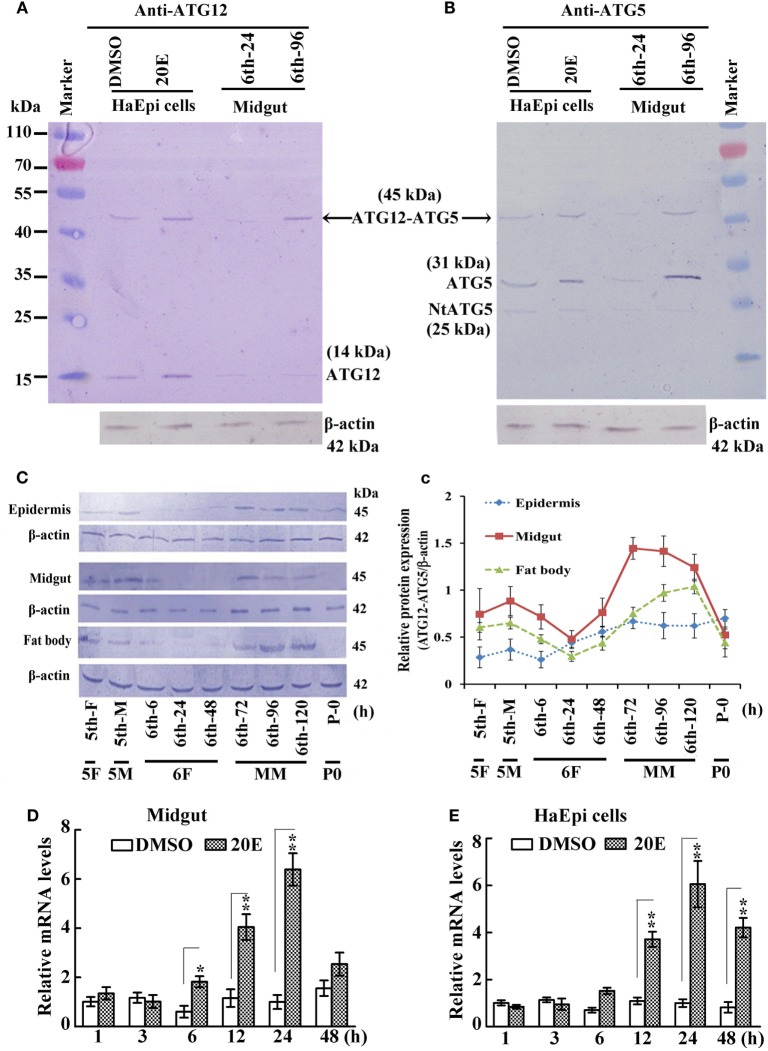
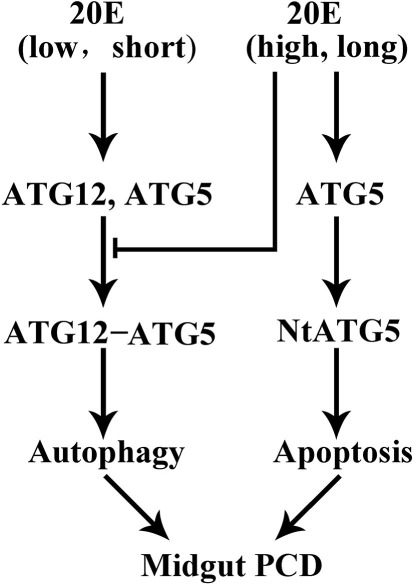
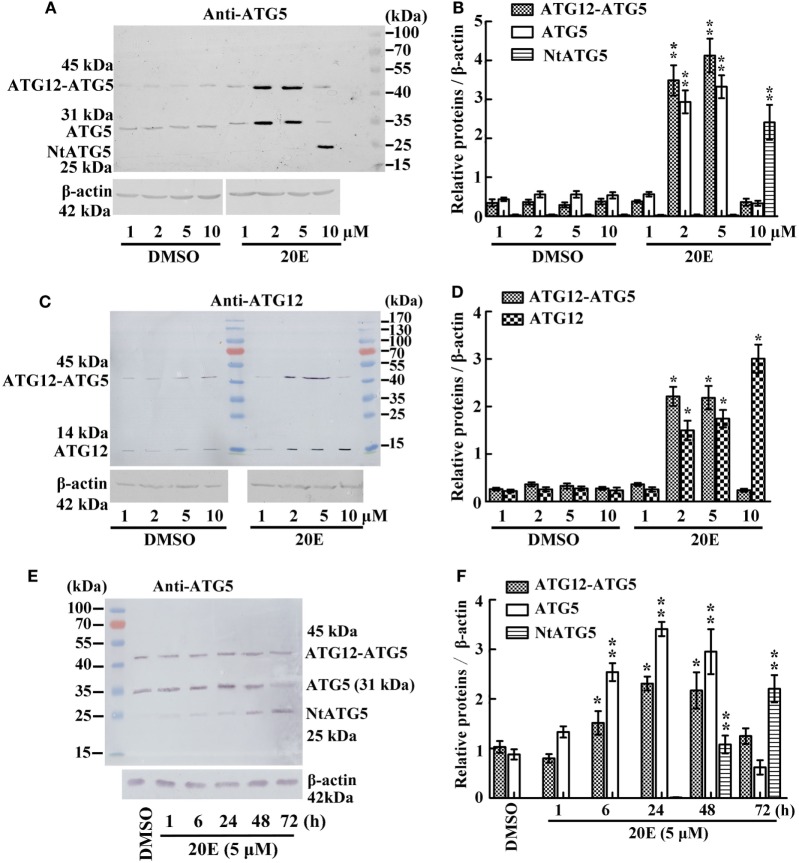
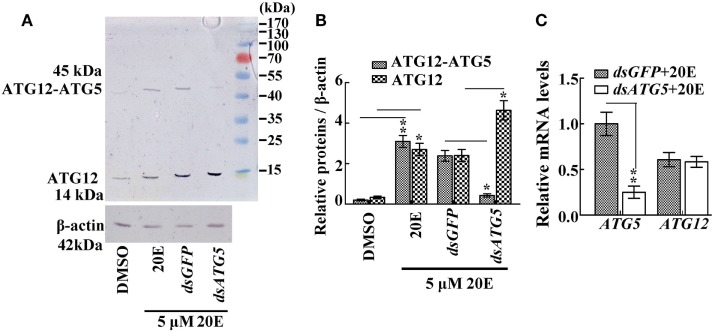
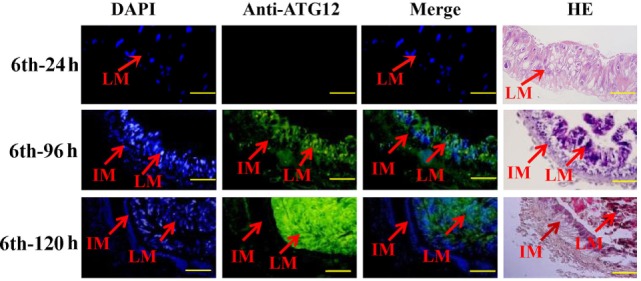
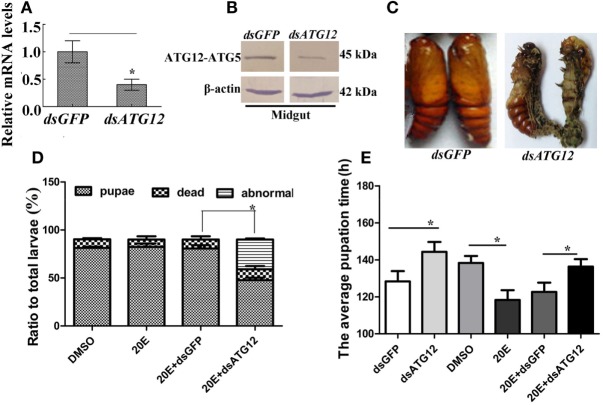
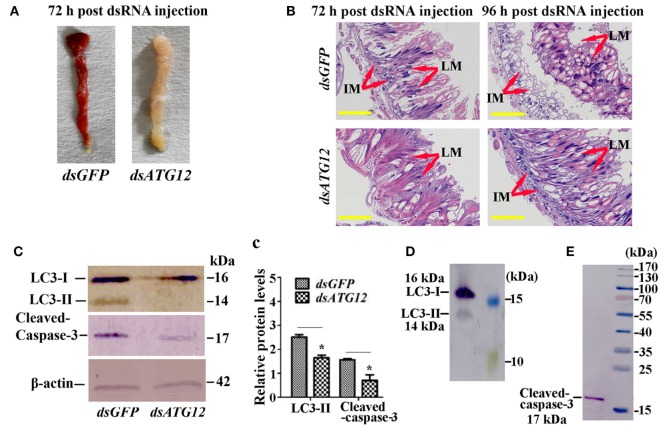
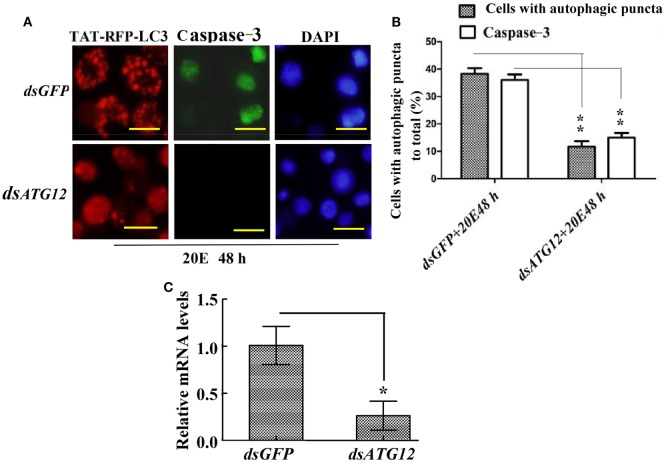
Autophagy requires the conjugation of autophagy-related protein 12 (ATG12) to autophagy-related protein 5 (ATG5) through covalent attachment. However, the signals regulating ATG12-ATG5 conjugation are unclear. The larval midgut of lepidopteran insects performs autophagy and apoptosis sequentially during the transition of larvae to pupae under regulation by the steroid hormone 20-hydroxyecdysone (20E), thus representing a model to study steroid hormone regulation of ATG12-ATG5 conjugation. In the present study, using the lepidopteran insect as a model, we report that 20E regulates the conjugation of ATG12-ATG5 in a concentration and time-dependent manner. The ATG12-ATG5 conjugate was abundant in the epidermis, midgut, and fat body during metamorphosis from the larvae to the pupae; however, the ATG12-ATG5 conjugate level decreased at the time of pupation. At low concentrations (2-5 µM) over a short time course (1-48 h), 20E promoted the conjugation of ATG12-ATG5; however, at 10 µM and 72 h, 20E repressed the conjugation of ATG12-ATG5. ATG12 was localized in the larval midgut during metamorphosis. Knockdown of in larvae caused death with delayed pupation, postponed the process of midgut programmed cell death (PCD), and repressed ATG8 (also called LC3-I) transformation to LC3-II and the cleavage of caspase-3; therefore, knockdown of in larvae blocked both autophagy and apoptosis. Knockdown of in epidermis cell line cells also repressed 20E-induced autophagosome formation and caspase-3 activation. The results suggested that 20E plays key role in the regulation of ATG12-ATG5 conjugation in a concentration and time-dependent manner for autophagy or apoptosis, and that ATG12 is necessary by both autophagy and apoptosis during insect midgut PCD.
自噬需要自噬相关蛋白12(ATG12)通过共价连接与自噬相关蛋白5(ATG5)结合。然而,调节ATG12-ATG5结合的信号尚不清楚。鳞翅目昆虫幼虫的中肠在类固醇激素20-羟基蜕皮激素(20E)的调节下,在幼虫向蛹转变的过程中依次进行自噬和凋亡,因此是研究类固醇激素对ATG12-ATG5结合调节的一个模型。在本研究中,以鳞翅目昆虫为模型,我们报道20E以浓度和时间依赖的方式调节ATG12-ATG5的结合。在幼虫向蛹变态期间,ATG12-ATG5结合物在表皮、中肠和脂肪体中丰富;然而,在化蛹时ATG12-ATG5结合物水平下降。在短时间过程(1-48小时)内低浓度(2-5μM)时,20E促进ATG12-ATG5的结合;然而,在10μM和72小时时,20E抑制ATG12-ATG5的结合。在变态期间,ATG12定位于幼虫中肠。幼虫中该蛋白的敲低导致化蛹延迟而死亡,推迟了中肠程序性细胞死亡(PCD)的过程,并抑制了ATG8(也称为LC3-I)向LC3-II的转化以及caspase-3的裂解;因此,幼虫中该蛋白的敲低阻断了自噬和凋亡。表皮细胞系细胞中该蛋白的敲低也抑制了20E诱导的自噬体形成和caspase-3激活。结果表明,20E在以浓度和时间依赖的方式调节自噬或凋亡的ATG12-ATG5结合中起关键作用,并且在昆虫中肠PCD期间自噬和凋亡都需要ATG12。