Himmelsbach Kiyoshi, Hildt Eberhard
Department of Virology, Paul-Ehrlich-Institut, Langen 63225, Germany.
World J Virol. 2018 Feb 12;7(1):10-20. doi: 10.5501/wjv.v7.i1.10.
To identify cell culture models supportive for Zika virus (ZIKV) replication.
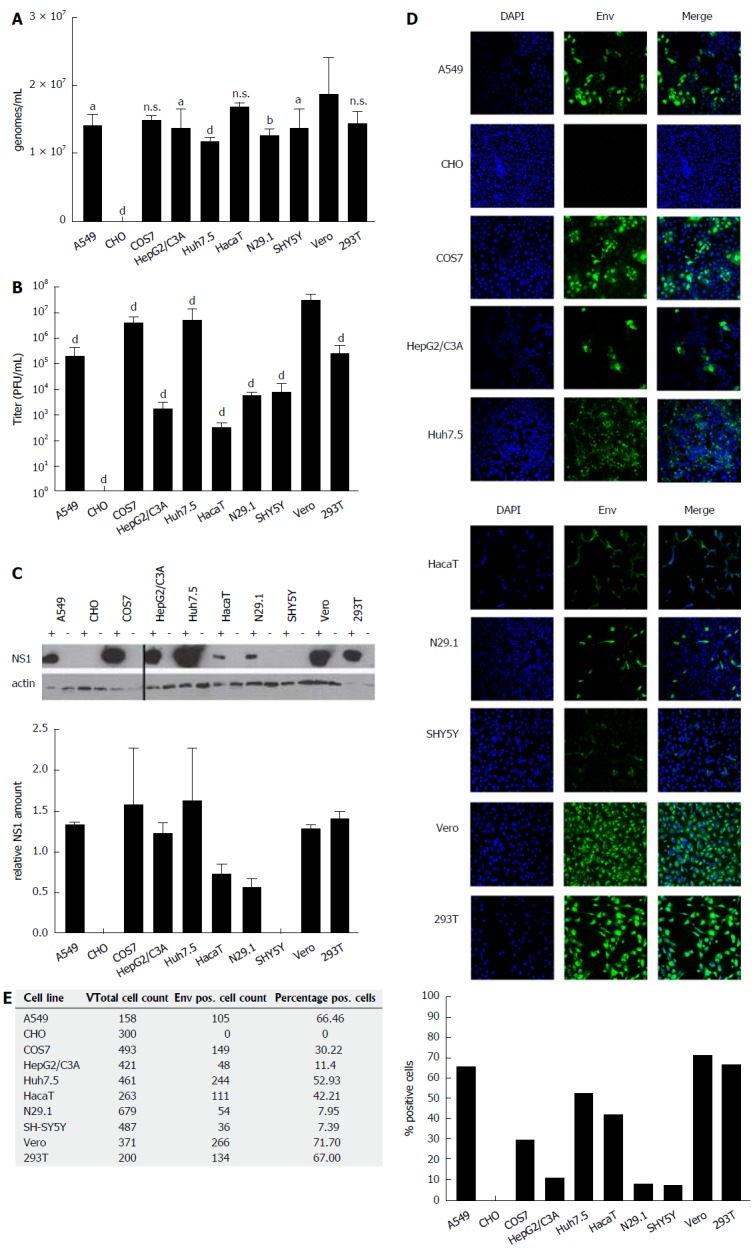
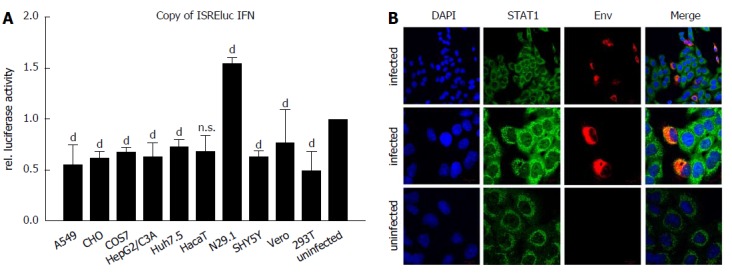
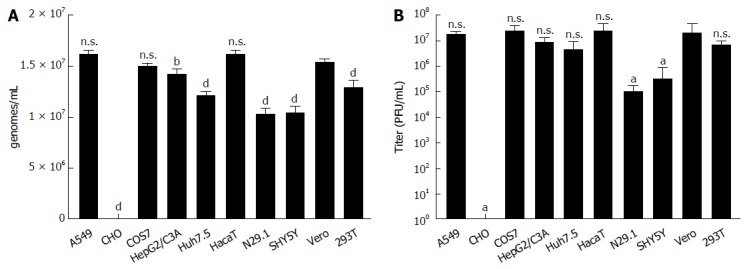
Various human and non-human cell lines were infected with a defined amount of ZIKV Polynesia strain. Cells were analyzed 48 h post infection for the amount of intracellular and extracellular viral genomes and infectious viral particles by quantitative real-time PCR and virus titration assay. The extent of replication was monitored by immunofluorescence and western blot analysis by using Env and NS1 specific antibodies. Innate immunity was assayed by luciferase reporter assay and immunofluorescence analysis.
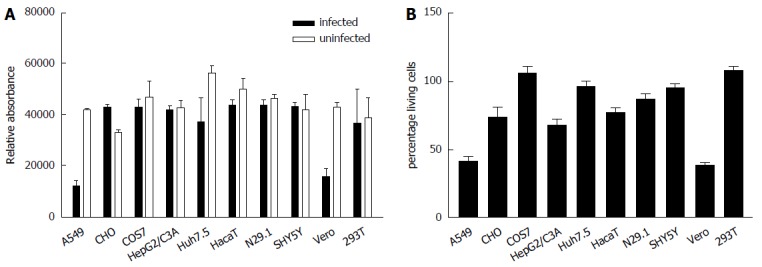
All investigated cell lines except CHO cells supported infection, replication and release of ZIKV. While in infected A549 and Vero cells a pronounced cytopathic effect was observed COS7, 293T and Huh7.5 cells were most resistant. Although the analyzed cell lines released comparable amounts of viral genomes to the supernatant significant differences were found for the number of infectious viral particles. The neuronal cell lines N29.1 and SH-SY5Y released 100 times less infectious viral particles than Vero-, A549- or 293T-cells. However there is no strict correlation between the amount of produced viral particles and the induction of an interferon response in the analyzed cell lines.
The investigated cell lines with their different tissue origins and diverging ZIKV susceptibility display a toolbox for ZIKV research.
鉴定支持寨卡病毒(ZIKV)复制的细胞培养模型。
用一定量的寨卡病毒波利尼西亚株感染各种人类和非人类细胞系。感染后48小时,通过定量实时PCR和病毒滴定试验分析细胞内和细胞外病毒基因组及感染性病毒颗粒的数量。通过免疫荧光和使用Env和NS1特异性抗体的蛋白质印迹分析监测复制程度。通过荧光素酶报告基因检测和免疫荧光分析检测天然免疫。
除CHO细胞外,所有研究的细胞系均支持寨卡病毒的感染、复制和释放。在感染的A549和Vero细胞中观察到明显的细胞病变效应,而COS7、293T和Huh7.5细胞最具抗性。虽然分析的细胞系向上清液中释放的病毒基因组数量相当,但在感染性病毒颗粒数量上发现了显著差异。神经元细胞系N29.1和SH-SY5Y释放的感染性病毒颗粒比Vero、A549或293T细胞少100倍。然而,在所分析的细胞系中,产生的病毒颗粒数量与干扰素反应的诱导之间没有严格的相关性。
所研究的具有不同组织来源和不同寨卡病毒易感性的细胞系为寨卡病毒研究提供了一个工具库。