Yale University, P.O. Box 208048, New Haven, CT, 06520-8048, USA.
Columbia University, New York, NY, USA.
Mol Imaging Biol. 2018 Oct;20(5):835-845. doi: 10.1007/s11307-018-1170-6.
Previous studies demonstrated the utility of [F]fluoropropyl-(+)-dihydrotetrabenazine ([F]FP-(+)-DTBZ) as a positron emission tomography (PET) radiotracer for the vesicular monoamine transporter type 2 (VMAT2) to quantify beta cell mass in healthy control (HC) and type 1 diabetes mellitus (T1DM) groups. Quantification of specific binding requires measurement of non-displaceable uptake. Our goal was to identify a reference tissue (renal cortex or spleen) to quantify pancreatic non-specific binding of [F]FP-(+)-DTBZ with the inactive enantiomer, [F]FP-(-)-DTBZ. This was the first human study of [F]FP-(-)-DTBZ.
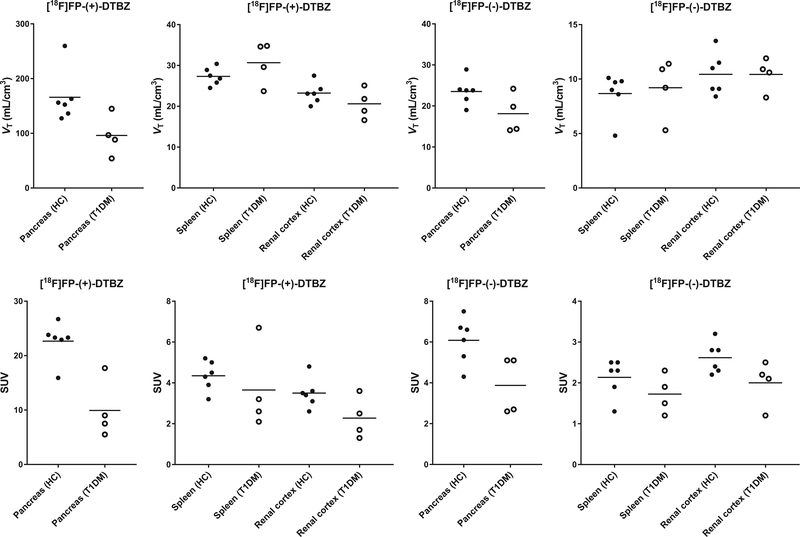
Six HCs and four T1DM patients were scanned on separate days after injection of [F]FP-(+)-DTBZ or [F]FP-(-)-DTBZ. Distribution volumes (V) and standardized uptake values (SUVs) were compared between groups. Three methods for calculation of non-displaceable uptake (V) or reference SUV were applied: (1) use of [F]FP-(+)-DTBZ reference V as V, assuming V is uniform across organs; (2) use of [F]FP-(-)-DTBZ pancreatic V as V, assuming that V is uniform between enantiomers in the pancreas; and (3) use of a scaled [F]FP-(+)-DTBZ reference V as V, assuming that a ratio of non-displaceable uptake between organs is uniform between enantiomers. Group differences in V (or SUV), binding potential (BP), or SUV ratio (SUVR) were estimated using these three methods.
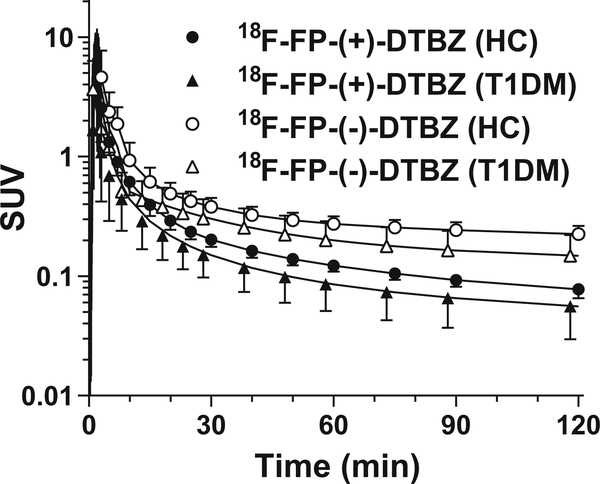
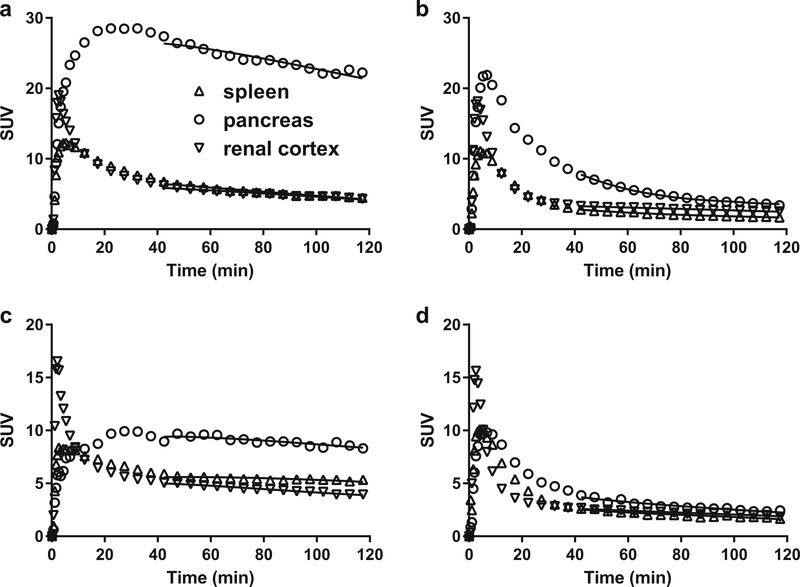
[F]FP-(-)-DTBZ V values were different among organs, and V(+) and V(-) were also different in the renal cortex and spleen. Method 3 with the spleen to estimate V (or reference SUV) gave the highest non-displaceable uptake and the largest HC vs. T1DM group differences. Significant group differences were also observed in V (or SUV) with method 1 using spleen. SUV was affected by differences in the input function between groups and between enantiomers.
Non-displaceable uptake was different among organs and between enantiomers. Use of scaled spleen V values for V is a suitable method for quantification of VMAT2 in the pancreas.
先前的研究表明,[F]氟丙基-(+)-二氢四苯并嗪([F]FP-(+)-DTBZ)作为正电子发射断层扫描(PET)示踪剂用于检测囊泡单胺转运体 2(VMAT2),以定量健康对照组(HC)和 1 型糖尿病(T1DM)组的β细胞量。特异性结合的定量需要测量不可置换的摄取。我们的目标是确定参考组织(肾皮质或脾脏)来量化[F]FP-(+)-DTBZ 与无活性对映体[F]FP-(-)-DTBZ 在胰腺中的非特异性结合。这是[F]FP-(-)-DTBZ 的首次人体研究。
在注射[F]FP-(+)-DTBZ 或[F]FP-(-)-DTBZ 后,六名 HC 和四名 T1DM 患者在不同的日子进行扫描。比较组间分布容积(V)和标准化摄取值(SUV)。应用三种方法计算不可置换摄取(V)或参考 SUV:(1)使用[F]FP-(+)-DTBZ 参考 V 作为 V,假设 V 在器官之间均匀;(2)使用[F]FP-(-)-DTBZ 胰腺 V 作为 V,假设 V 在胰腺中两种对映体之间均匀;(3)使用比例[F]FP-(+)-DTBZ 参考 V 作为 V,假设器官之间非置换摄取的比值在两种对映体之间均匀。使用这三种方法估计 V(或 SUV)、结合潜力(BP)或 SUV 比值(SUVR)在组间的差异。
[F]FP-(-)-DTBZ 的 V 值在器官之间不同,肾皮质和脾脏中的 V(+)和 V(-)也不同。使用脾脏估算 V(或参考 SUV)的方法 3 给出了最高的不可置换摄取和最大的 HC 与 T1DM 组间差异。使用脾脏的方法 1 也观察到 V(或 SUV)的显著组间差异。SUV 受到组间和两种对映体之间输入函数差异的影响。
不可置换摄取在器官之间和两种对映体之间不同。使用比例脾脏 V 值进行 V 是定量胰腺 VMAT2 的合适方法。