Department of Orthopaedics and Sports Medicine, University of Washington, Seattle, WA, USA.
Clin Orthop Relat Res. 2018 May;476(5):1031-1040. doi: 10.1007/s11999.0000000000000167.
Primary shoulder hemiarthroplasty is used to address a range of glenohumeral disorders, including fracture, arthritis, avascular necrosis, and capsulorrhaphy arthropathy; some patients with hemiarthroplasties undergo revision surgery for persistent pain or residual shoulder dysfunction. The literature does not clarify the features of the hemiarthroplasties having repeat surgery in a way that can guide surgeons' efforts to minimize the need for revision. To help address this gap, we analyzed the characteristics of patients from our region for whom we performed surgical revision of a prior humeral hemiarthroplasty QUESTIONS/PURPOSES: (1) What are the common characteristics of shoulder hemiarthroplasties having a revision? (2) What are the common characteristics of the subset of revised shoulder hemiarthroplasties that were performed for fracture? (3) What are characteristics of the subset of all revised hemiarthroplasties that were associated with glenoid bone erosion?
Data for 983 patients for whom we performed a surgical revision of any type of shoulder arthroplasty between January 1991 and January 2017 were identified in our longitudinally maintained institutional arthroplasty revision database. In each case, revision had been elected by shared patient and surgeon decision-making after consideration of the disorder, degree of compromised comfort and function, treatment alternatives, and the risks of surgery. Of these 983 patients, 359 (37%) had a revision of a prior primary hemiarthroplasty; these patients were the subjects of this investigation. In this group of patients, we investigated the patient demographics, shoulder characteristics, prerevision radiographic findings, and findings at revision surgery. No patients were excluded. The patients having revision of primary hemiarthroplasties had severe loss of self-assessed shoulder comfort and function, with Simple Shoulder Test (SST) scores averaging 2.2 ± 2.2 of the maximum score of 12. The majority of these patients (81%) were women. The medical records of these 359 patients were abstracted to determine the diagnosis for the index primary hemiarthroplasty, clinical characteristics before surgery, and findings at surgical revision. One hundred twelve of the arthroplasties had been performed for fracture-related diagnoses; a subgroup analysis was performed on these patients. Two hundred seventy-three of the 359 patients (76%) had plain radiographs performed within 3 months before revision surgery that were adequate for assessing the radiographic characteristics of the glenoid, humerus, humeral component, and glenohumeral relationships; a subgroup analysis was performed on these patients. The degree of glenoid erosion was measured by a single observer in accordance with established criteria: Grade 1 is no erosion, Grade 2 is erosion limited to subchondral bone, Grade 3 is moderate erosion with medialization, and Grade 4 is medialization beyond the coracoid base. Some patients were included in both of these subgroups.
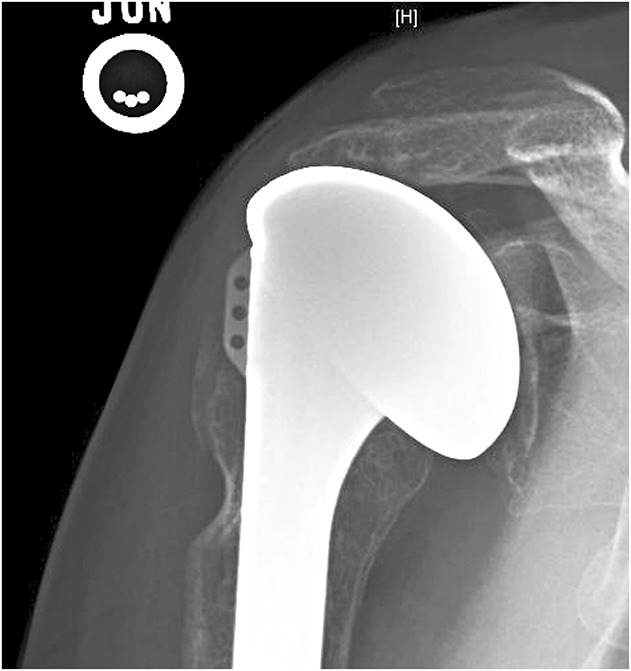
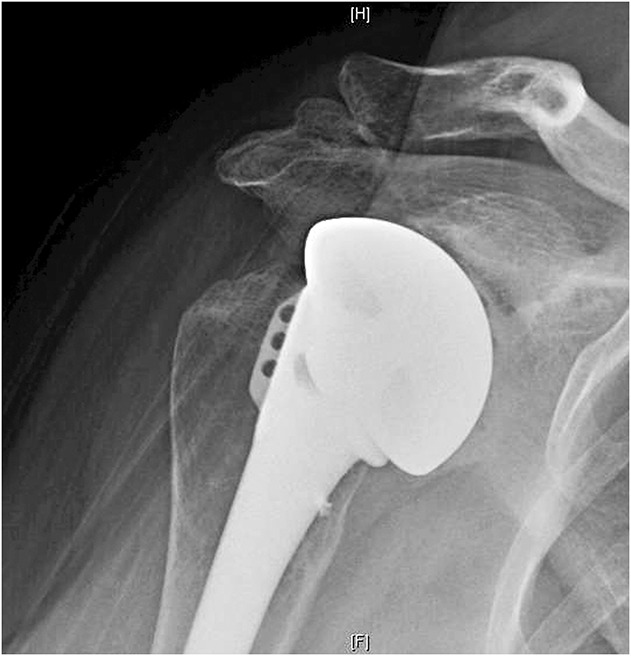
Common characteristics of the revised hemiarthroplasties included female sex (81%), rotator cuff (89 of 359; 25%) or subscapularis (81 of 359; 23%) failure, problems related to prior fracture (154 of 359; 43%), glenoid erosion 125 of 359; 35%), and component malposition (89 of 359; 25%). Hemiarthroplasties performed for fracture-related problems often were associated with tuberosity malunion or nonunion (58 of 79; 73%) and decentering of the humeral component on the glenoid surface (45 of 71; 63%). Major erosion of the bony glenoid (Grade 3 or 4) was more common in decentered hemiarthroplasties (42 of 102; 41%) than for centered hemiarthroplasties (36 of 146; 25%) (Fisher's exact p = 0.008) and more common for hemiarthroplasties positioned in valgus (28 of 50; 56%) than for those positioned in neutral or varus (40 of 188; 21%) (Fishers' exact p < 0.0001).
These findings suggest that some revisions of primary hemiarthroplasties may be avoided by surgical techniques directed at centering the prosthetic humeral articular surface on the glenoid concavity using proper humeral component positioning and soft tissue balance, by avoiding valgus positioning of the humeral component, and by managing glenoid disorders with a primary glenohumeral arthroplasty rather than a hemiarthroplasty alone. When durable security of the subscapularis, rotator cuff, and tuberosities is in question, the surgeon may consider a reverse total shoulder arthroplasty.
Level III, therapeutic study.
肩峰成形术用于治疗多种盂肱关节疾病,包括骨折、关节炎、缺血性坏死和囊切开术性关节病;一些接受肩峰成形术的患者因持续性疼痛或残留肩部功能障碍而接受翻修手术。文献并未明确指出哪些肩峰成形术需要再次手术,以及这些特征如何指导外科医生努力减少翻修的需要。为了帮助解决这一差距,我们分析了我们地区因先前肱骨头半关节成形术而进行手术翻修的患者的特征。
问题/目的:(1) 再次手术的肩峰成形术有哪些常见特征?(2) 翻修的肩峰成形术中有哪些常见特征与骨折有关?(3) 所有翻修的半关节成形术中,与肩胛盂骨侵蚀有关的特征是什么?
在我们的纵向维持机构关节翻修数据库中,确定了 1991 年 1 月至 2017 年 1 月期间我们对任何类型的肩关节进行手术翻修的 983 名患者的数据。在每种情况下,在考虑疾病、舒适度和功能受损程度、治疗选择以及手术风险后,经患者和外科医生共同决策,决定进行翻修。在这 983 名患者中,359 名(37%)接受了先前初次半关节成形术的翻修;这些患者是本研究的对象。在这组患者中,我们研究了患者的人口统计学特征、肩部特征、术前放射学发现以及翻修手术时的发现。没有排除任何患者。接受初次半关节成形术翻修的患者肩部舒适度和功能严重丧失,简单肩部测试(SST)评分平均为 12 分中的 2.2±2.2。这些患者中的大多数(81%)为女性。从这些 359 名患者的病历中提取信息,以确定索引初次半关节成形术的诊断、术前临床特征和手术翻修时的发现。112 例关节置换术是因与骨折相关的诊断而进行的;对这些患者进行了亚组分析。273 名 359 名患者中的 273 名(76%)在翻修手术前 3 个月内进行了足够评估肩胛盂、肱骨、肱骨组件和盂肱关系的放射学特征的平片检查;对这些患者进行了亚组分析。按照既定标准,由一名观察者测量肩胛盂侵蚀的程度:Grade 1 无侵蚀,Grade 2 侵蚀仅限于软骨下骨,Grade 3 为中度侵蚀伴内侧化,Grade 4 为内侧化超过喙突基底。一些患者同时包括在这两个亚组中。
翻修的半关节成形术的常见特征包括女性(81%)、肩袖(359 例中的 89 例;25%)或肩胛下肌(359 例中的 81 例;23%)失败、与先前骨折相关的问题(359 例中的 154 例;43%)、肩胛盂侵蚀(359 例中的 125 例;35%)和组件位置不当(359 例中的 89 例;25%)。因骨折相关问题而进行的半关节成形术通常与结节愈合不良或不愈合(79 例中的 58 例;73%)和肱骨组件在肩胛盂表面偏心(71 例中的 45 例;63%)有关。偏心的半关节成形术(Grade 3 或 4)的骨肩胛盂严重侵蚀更为常见(42 例中的 102 例;41%),而中心的半关节成形术(36 例中的 146 例;25%)更为常见(Fisher 精确检验,p = 0.008),并且在外侧(28 例中的 50 例;56%)的半关节成形术比在中立或内侧(40 例中的 188 例;21%)的半关节成形术更为常见(Fisher 精确检验,p < 0.0001)。
这些发现表明,通过使用适当的肱骨组件定位和软组织平衡使假体肱骨头关节表面在肩胛盂凹面中心化、避免肱骨组件的外侧位置以及通过初次盂肱关节置换术而不是单独的半关节成形术来治疗肩胛盂疾病,一些初次半关节成形术的翻修可能可以避免。当肩胛下肌、肩袖和结节的稳定性受到质疑时,外科医生可能会考虑反向全肩关节置换术。
三级,治疗性研究。