Kidholm Christina Lund, Beck Hans Christian, Madsen Julie Bukh, Palstrøm Nikolai Bjødstrup, Lindholt Jes Sanddal, Rasmussen Lars Melholt
Centre of Individualized Medicine in Arterial Disease (CIMA), Odense University Hospital, Odense, Denmark.
Department of Clinical Biochemistry and Pharmacology, Odense University Hospital, Odense, Denmark.
PLoS One. 2018 Feb 22;13(2):e0192957. doi: 10.1371/journal.pone.0192957. eCollection 2018.
The pathogenesis of abdominal aortic aneurysms (AAA) involves a disturbed balance of breakdown and buildup of arterial proteins. We envision that individuals with AAA carry generalized arterial protein alterations either because of effects of genetically or environmental AAA risk factors or because of compensatory changes due to signaling molecules released from the affected aneurysmal tissue.
Protein extraction and quantitative proteome analysis by LC-MS/MS (liquid chromatography-mass spectrometry) was done on individual samples from the internal mammary artery from 11 individuals with AAA and 33 sex- and age-matched controls without AAA. Samples were selected from a biobank of leftover internal mammary arterial tissue gathered at coronary by-pass operations.
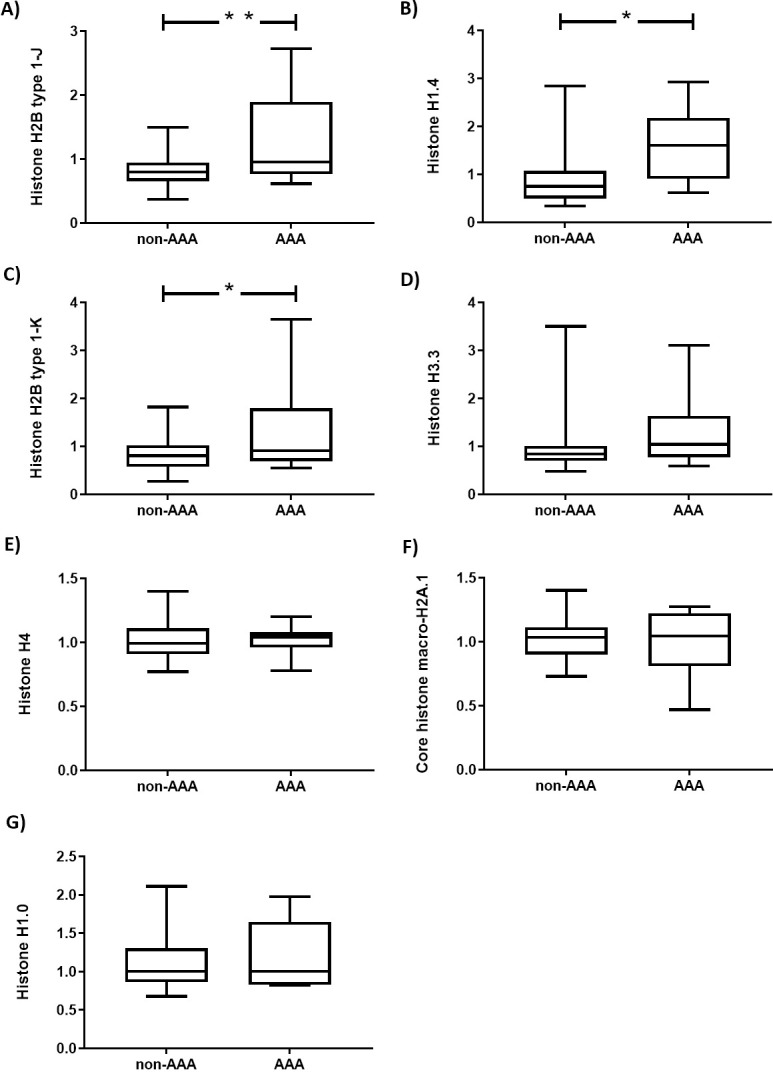
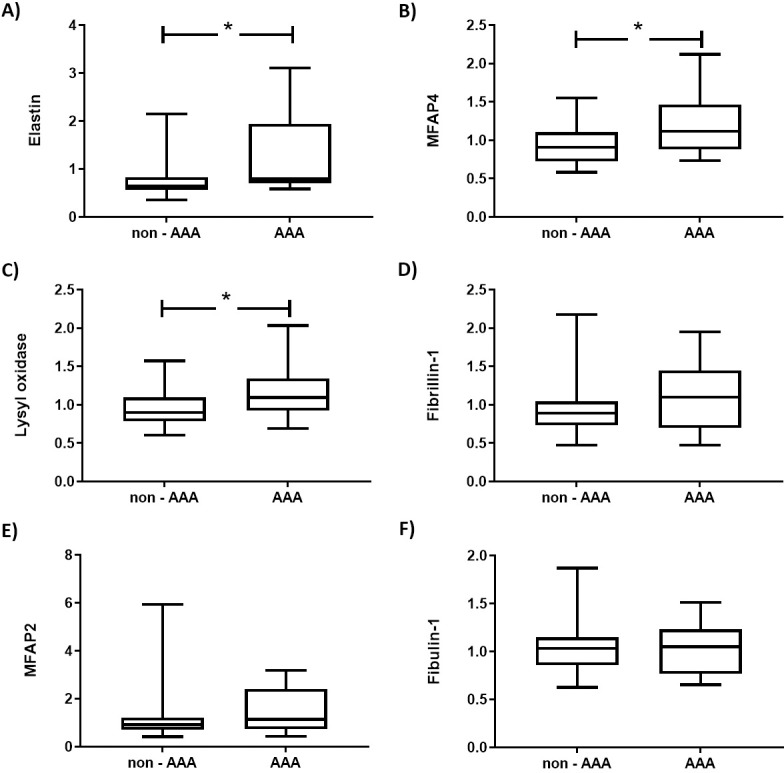
We identified and quantitated 877 proteins, of which 44 were differentially expressed between the two groups (nominal p-values without correction for multiple testing). Some proteins related to the extracellular matrix displayed altered concentrations in the AAA group, particularly among elastin-related molecules [elastin, microfibrillar-associated protein 4 (MFAP4), lysyl oxidase]. In addition, several histones e.g. (e.g. HIST1H1E, HIST1H2BB) and other vascular cell proteins (e.g. versican, type VI collagen) were altered.
Our results support the notion that generalized alterations occur in the arterial tree in patients with AAA. Elastin-related proteins and histones seem to be part of such changes, however these preliminary results require replication in an independent set of specimens and validation by functional studies.
腹主动脉瘤(AAA)的发病机制涉及动脉蛋白分解与合成平衡的紊乱。我们推测,AAA患者存在全身性动脉蛋白改变,这可能是由于遗传或环境性AAA危险因素的影响,也可能是由于受影响的动脉瘤组织释放的信号分子引起的代偿性变化。
对11例AAA患者和33例年龄及性别匹配的非AAA对照者的乳内动脉单个样本进行蛋白质提取,并通过液相色谱-质谱联用(LC-MS/MS)进行定量蛋白质组分析。样本选自冠状动脉搭桥手术中收集的剩余乳内动脉组织生物样本库。
我们鉴定并定量了877种蛋白质,其中44种在两组之间存在差异表达(未进行多重检验校正的名义p值)。一些与细胞外基质相关的蛋白质在AAA组中的浓度发生了变化,特别是在弹性蛋白相关分子[弹性蛋白、微原纤维相关蛋白4(MFAP4)、赖氨酰氧化酶]中。此外,几种组蛋白[例如HIST1H1E、HIST1H2BB]和其他血管细胞蛋白(例如多功能蛋白聚糖、VI型胶原)也发生了改变。
我们的结果支持AAA患者动脉树中存在全身性改变的观点。弹性蛋白相关蛋白和组蛋白似乎是这些变化的一部分,然而这些初步结果需要在独立的样本集中进行重复,并通过功能研究进行验证。