van den Akker Peter C, Pasmooij Anna M G, Joenje Hans, Hofstra Robert M W, Te Meerman Gerard J, Jonkman Marcel F
University of Groningen, University Medical Center Groningen, Department of Genetics, Groningen, the Netherlands.
University of Groningen, University Medical Center Groningen, Department of Dermatology, Groningen, the Netherlands.
PLoS One. 2018 Feb 22;13(2):e0192994. doi: 10.1371/journal.pone.0192994. eCollection 2018.
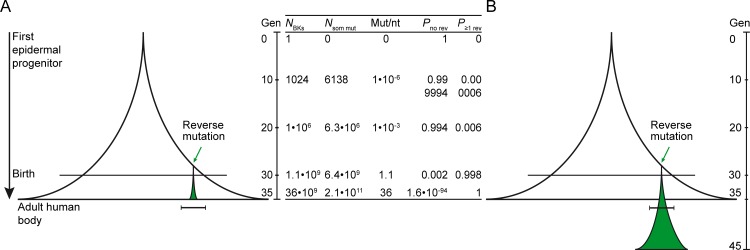
Revertant mosaicism, or "natural gene therapy", is the phenomenon in which germline mutations are corrected by somatic events. In recent years, revertant mosaicism has been identified in all major types of epidermolysis bullosa, the group of heritable blistering disorders caused by mutations in the genes encoding epidermal adhesion proteins. Moreover, revertant mosaicism appears to be present in all patients with a specific subtype of recessive epidermolysis bullosa. We therefore hypothesized that revertant mosaicism should be expected at least in all patients with recessive forms of epidermolysis bullosa. Naturally corrected, patient-own cells are of extreme interest for their promising therapeutic potential, and their presence in all patients would open exciting, new treatment perspectives to those patients. To test our hypothesis, we determined the probability that single nucleotide reversions occur in patients' skin using a mathematical developmental model. According to our model, reverse mutations are expected to occur frequently (estimated 216x) in each patient's skin. Reverse mutations should, however, occur early in embryogenesis to be able to drive the emergence of recognizable revertant patches, which is expected to occur in only one per ~10,000 patients. This underestimate, compared to our clinical observations, can be explained by the "late-but-fitter revertant cell" hypothesis: reverse mutations arise at later stages of development, but provide revertant cells with a selective growth advantage in vivo that drives the development of recognizable healthy skin patches. Our results can be extrapolated to any other organ with stem cell division numbers comparable to skin, which may offer novel future therapeutic options for other genetic conditions if these revertant cells can be identified and isolated.
回复性嵌合体,即“自然基因疗法”,是指生殖系突变通过体细胞事件得到纠正的现象。近年来,在所有主要类型的大疱性表皮松解症中均发现了回复性嵌合体,这是一组由编码表皮黏附蛋白的基因突变引起的遗传性水疱性疾病。此外,回复性嵌合体似乎存在于所有隐性大疱性表皮松解症特定亚型的患者中。因此,我们推测至少在所有隐性形式的大疱性表皮松解症患者中都应该会出现回复性嵌合体。自然纠正的患者自身细胞因其具有潜在的治疗价值而备受关注,并且它们在所有患者中的存在将为这些患者开启令人兴奋的新治疗前景。为了验证我们的假设,我们使用数学发育模型确定了患者皮肤中发生单核苷酸回复的概率。根据我们的模型,预计每个患者的皮肤中会频繁发生回复突变(估计为216倍)。然而,回复突变应该在胚胎发育早期发生,才能促使可识别的回复斑块出现,预计每10000名患者中只有1人会出现这种情况。与我们的临床观察结果相比,这种低估可以用“后期但更具适应性的回复细胞”假说来解释:回复突变发生在发育后期,但为回复细胞提供了体内选择性生长优势,从而推动了可识别的健康皮肤斑块的形成。我们的结果可以外推到任何其他干细胞分裂数量与皮肤相当的器官,如果能够识别和分离这些回复细胞,可能为其他遗传疾病提供新的未来治疗选择。