Department of Cardiology, VU University Medical Center, De Boelelaan 1117, 1081 HV, Amsterdam, The Netherlands.
Department of Radiology & Nuclear Medicine, VU University Medical Center, Amsterdam, The Netherlands.
Eur J Nucl Med Mol Imaging. 2018 Jul;45(7):1091-1100. doi: 10.1007/s00259-018-3951-1. Epub 2018 Feb 22.
Traditionally, interpretation of myocardial perfusion imaging (MPI) is based on visual assessment. Computer-based automated analysis might be a simple alternative obviating the need for extensive reading experience. Therefore, the aim of the present study was to compare the diagnostic performance of automated analysis with that of expert visual reading for the detection of obstructive coronary artery disease (CAD).
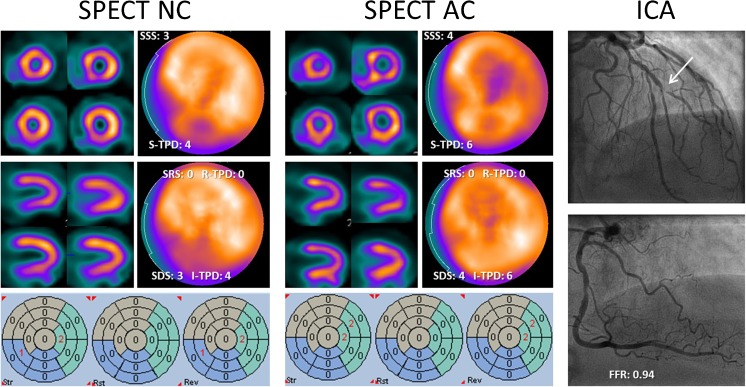
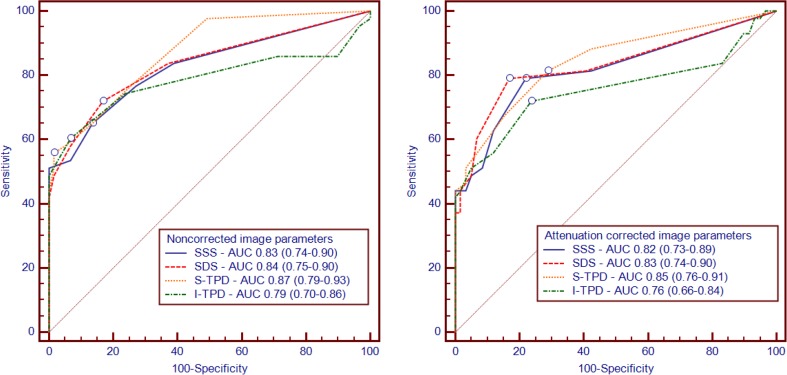
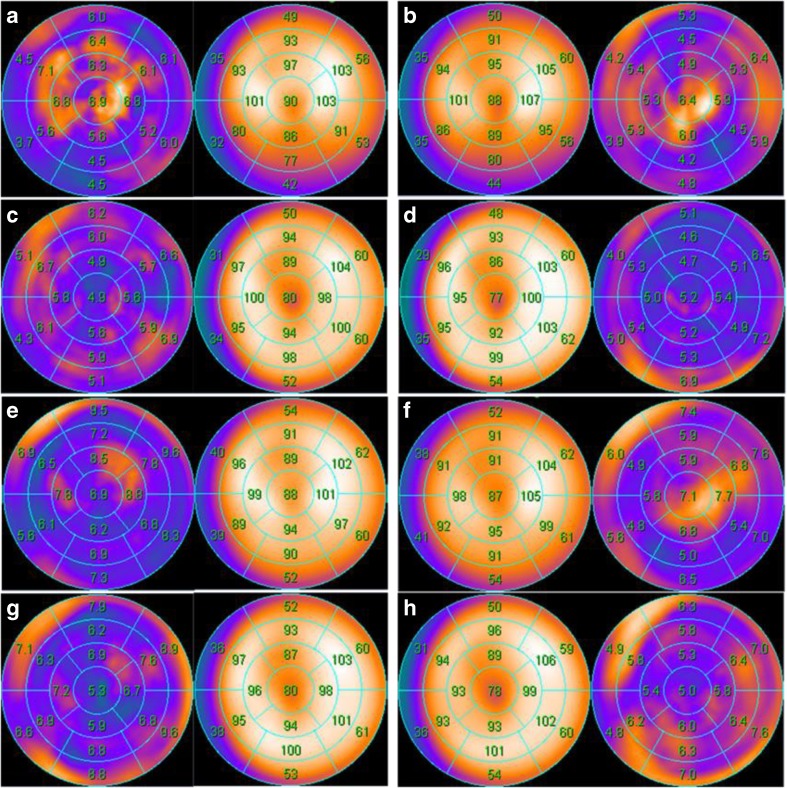
206 Patients (64% men, age 58.2 ± 8.7 years) with suspected CAD were included prospectively. All patients underwent Tc-tetrofosmin single-photon emission computed tomography (SPECT) and invasive coronary angiography with fractional flow reserve (FFR) measurements. Non-corrected (NC) and attenuation-corrected (AC) SPECT images were analyzed both visually as well as automatically by commercially available SPECT software. Automated analysis comprised a segmental summed stress score (SSS), summed difference score (SDS), stress total perfusion deficit (S-TPD), and ischemic total perfusion deficit (I-TPD), representing the extent and severity of hypoperfused myocardium. Subsequently, software was optimized with an institutional normal database and thresholds. Diagnostic performances of automated and visual analysis were compared taking FFR as a reference.
Sensitivity did not differ significantly between visual reading and most automated scoring parameters, except for SDS, which was significantly higher than visual assessment (p < 0.001). Specificity, however, was significantly higher for visual reading than for any of the automated scores (p < 0.001 for all). Diagnostic accuracy was significantly higher for visual scoring (77.2%) than for all NC images scores (p < 0.05), but not compared with SSS AC and S-TPD AC (69.8% and 71.2%, p = 0.063 and p = 0.134). After optimization of the automated software, diagnostic accuracies were similar for visual (73.8%) and automated analysis. Among the automated parameters, S-TPD AC showed the highest accuracy (73.5%).
Automated analysis of myocardial perfusion SPECT can be as accurate as visual interpretation by an expert reader in detecting significant CAD defined by FFR.
传统上,心肌灌注成像(MPI)的解读基于视觉评估。基于计算机的自动分析可能是一种简单的替代方法,可以避免对广泛阅读经验的需求。因此,本研究的目的是比较自动分析与专家视觉阅读在检测阻塞性冠状动脉疾病(CAD)方面的诊断性能。
前瞻性纳入 206 例疑似 CAD 的患者(64%为男性,年龄 58.2±8.7 岁)。所有患者均接受 Tc-四氮甲烷单光子发射计算机断层扫描(SPECT)和有血流储备分数(FFR)测量的有创冠状动脉造影。非校正(NC)和校正衰减(AC)SPECT 图像均通过商业可用的 SPECT 软件进行视觉和自动分析。自动分析包括节段总和应激评分(SSS)、总和差异评分(SDS)、应激总灌注缺损(S-TPD)和缺血总灌注缺损(I-TPD),代表灌注不足心肌的范围和严重程度。随后,使用机构正常数据库和阈值对软件进行优化。以 FFR 为参考,比较自动分析和视觉分析的诊断性能。
视觉阅读和大多数自动评分参数之间的敏感性没有显著差异,除了 SDS,其显著高于视觉评估(p<0.001)。然而,特异性显著高于任何自动评分(所有 p<0.001)。视觉评分的诊断准确性显著高于 NC 图像评分(p<0.05,所有 p 值均<0.001),但与 SSS AC 和 S-TPD AC 相比则没有差异(69.8%和 71.2%,p=0.063 和 p=0.134)。在自动软件优化后,视觉(73.8%)和自动分析的诊断准确性相似。在自动参数中,S-TPD AC 的准确性最高(73.5%)。
在检测由 FFR 定义的有意义的 CAD 方面,心肌灌注 SPECT 的自动分析可以与专家读者的视觉解释一样准确。