Department of Biomedical Engineering, Case Western Reserve University, School of Engineering, 2071 MLK Jr. Drive, Wickenden Bldg, Cleveland, OH 44106, USA; Advanced Platform Technology Center, L. Stokes Cleveland VA Medical Center, Rehab. R&D, 10701 East Blvd. Mail Stop 151 AW/APT, Cleveland, OH 44106, USA.
Department of Biomedical Engineering, Case Western Reserve University, School of Engineering, 2071 MLK Jr. Drive, Wickenden Bldg, Cleveland, OH 44106, USA.
Biomaterials. 2018 May;163:163-173. doi: 10.1016/j.biomaterials.2018.02.014. Epub 2018 Feb 13.
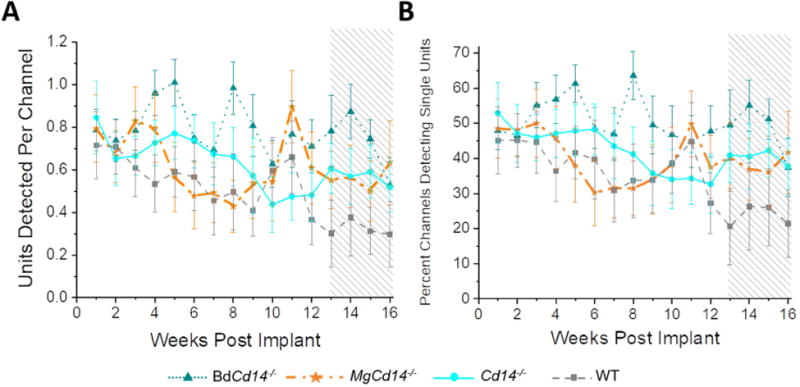
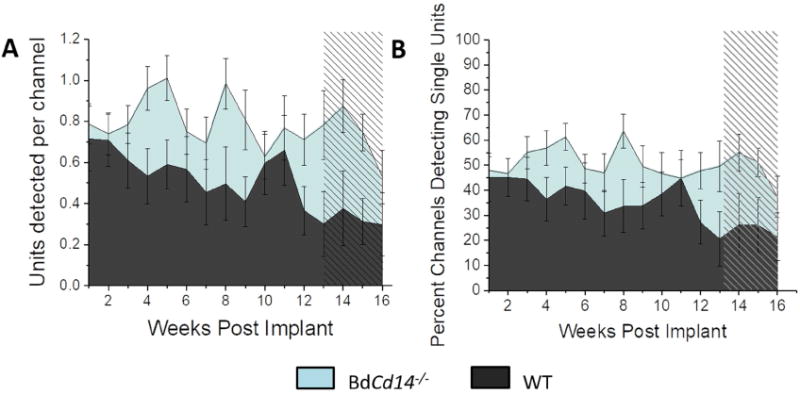
Intracortical microelectrodes afford researchers an effective tool to precisely monitor neural spiking activity. Additionally, intracortical microelectrodes have the ability to return function to individuals with paralysis as part of a brain computer interface. Unfortunately, the neural signals recorded by these electrodes degrade over time. Many strategies which target the biological and/or materials mediating failure modes of this decline of function are currently under investigation. The goal of this study is to identify a precise cellular target for future intervention to sustain chronic intracortical microelectrode performance. Previous work from our lab has indicated that the Cluster of Differentiation 14/Toll-like receptor pathway (CD14/TLR) is a viable target to improve chronic laminar, silicon intracortical microelectrode recordings. Here, we use a mouse bone marrow chimera model to selectively knockout CD14, an innate immune receptor, from either brain resident microglia or blood-derived macrophages, in order to understand the most effective targets for future therapeutic options. Using single-unit recordings we demonstrate that inhibiting CD14 from the blood-derived macrophages improves recording quality over the 16 week long study. We conclude that targeting CD14 in blood-derived cells should be part of the strategy to improve the performance of intracortical microelectrodes, and that the daunting task of delivering therapeutics across the blood-brain barrier may not be needed to increase intracortical microelectrode performance.
皮层内微电极为研究人员提供了一种有效的工具,可以精确监测神经尖峰活动。此外,皮层内微电极还有能力作为脑机接口的一部分,为瘫痪患者恢复功能。不幸的是,这些电极记录的神经信号会随着时间的推移而退化。目前有许多针对生物和/或材料的策略正在研究中,这些策略旨在解决功能下降的失效模式。本研究的目的是确定一个精确的细胞靶点,以便未来进行干预,维持慢性皮层内微电极的性能。我们实验室之前的工作表明,分化群 14/ Toll 样受体途径(CD14/TLR)是改善慢性层状、硅皮层内微电极记录的可行靶点。在这里,我们使用小鼠骨髓嵌合体模型,选择性地从大脑驻留的小胶质细胞或血液衍生的巨噬细胞中敲除先天免疫受体 CD14,以了解未来治疗选择的最有效靶点。使用单细胞记录,我们证明从血液衍生的细胞中抑制 CD14 可以提高 16 周研究期间的记录质量。我们得出结论,针对血液衍生细胞中的 CD14 应该是改善皮层内微电极性能的策略的一部分,而且跨越血脑屏障输送治疗药物的艰巨任务可能不是提高皮层内微电极性能所必需的。