Ganesan Purushothaman, Schmiedge Jason, Manchaiah Vinaya, Swapna Simham, Dhandayutham Subhashini, Kothandaraman Purushothaman Pavanjur
Expert Hearing Solutions, Wall Street Audiology Group Inc., Saskatoon, Canada.
Department of Speech and Hearing Sciences, Lamar University, Beaumont, TX, USA.
J Audiol Otol. 2018 Apr;22(2):59-68. doi: 10.7874/jao.2017.00360. Epub 2018 Feb 26.
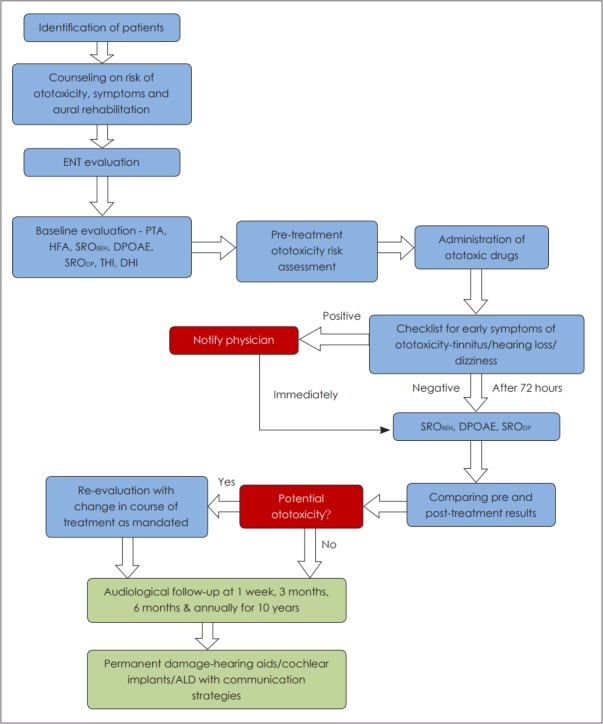
Ototoxicity is the pharmacological adverse reaction affecting the inner ear or auditory nerve, characterized by cochlear or vestibular dysfunction. The panorama of drug-induced hearing loss has widened over last few decades. Although ototoxic medications play an imperative role in modern medicine, they have the capacity to cause harm and lead to significant morbidity. Evidence has shown early detection of toxicity through prospective ototoxicity monitoring allows for consideration of treatment modifications to minimize or prevent permanent hearing loss and balance impairment. Although many ototoxicity monitoring protocols exist, their practicality is questionable due to several factors. Even though the existing protocols have proven to be effective, certain lacunae in practice have been encountered due to discrepancies among recommended protocols. Implementation of these protocols is mostly held back due to the incapacitated status of the patient. The choice of early ototoxicity identification techniques is still debatable due to variables such as high degree of sensitivity, specificity and reliability, less time consumption and less labour-intensive to the patient. Hence, the diagnosis and effective treatment of ototoxicity is challenging, even today. A stringent protocol with more practicality encompassing all elements aimed at profiling the effects of ototoxicity is greatly needed. This review describes an efficient application of ototoxicity monitoring and treatment protocol as an attempt to reduce the challenges in diagnosis and management of ototoxicity.
耳毒性是一种影响内耳或听神经的药物不良反应,其特征为耳蜗或前庭功能障碍。在过去几十年中,药物性听力损失的范围有所扩大。尽管耳毒性药物在现代医学中发挥着至关重要的作用,但它们有造成损害并导致严重发病的可能。有证据表明,通过前瞻性耳毒性监测早期发现毒性,有助于考虑调整治疗方案,以尽量减少或预防永久性听力损失和平衡功能损害。尽管存在许多耳毒性监测方案,但由于多种因素,其实用性存疑。即使现有方案已被证明有效,但由于推荐方案之间存在差异,在实践中仍遇到了一些漏洞。这些方案的实施大多因患者身体状况不佳而受阻。由于诸如高灵敏度、高特异性和高可靠性、耗时少以及对患者劳动强度低等变量,早期耳毒性识别技术的选择仍存在争议。因此,即使在今天,耳毒性的诊断和有效治疗仍具有挑战性。非常需要一个更具实用性的严格方案,涵盖所有旨在剖析耳毒性影响的要素。本综述描述了耳毒性监测和治疗方案的有效应用,试图减少耳毒性诊断和管理中的挑战。