Smith David R M, Dolk F Christiaan K, Smieszek Timo, Robotham Julie V, Pouwels Koen B
Modelling and Economics Unit, National Infection Service, Public Health England, London, UK.
PharmacoTherapy, Epidemiology & Economics, Department of Pharmacy, University of Groningen, Groningen, Netherlands.
BMJ Open. 2018 Feb 22;8(2):e020203. doi: 10.1136/bmjopen-2017-020203.
To explore the causes of the gender gap in antibiotic prescribing, and to determine whether women are more likely than men to receive an antibiotic prescription per consultation.
Cross-sectional analysis of routinely collected electronic medical records from The Health Improvement Network (THIN).
English primary care.
Patients who consulted general practices registered with THIN between 2013 and 2015.
Total antibiotic prescribing was measured in children (<19 years), adults (19-64 years) and the elderly (65+ years). For 12 common conditions, the number of adult consultations was measured, and the relative risk (RR) of being prescribed antibiotics when consulting as female or with comorbidity was estimated.
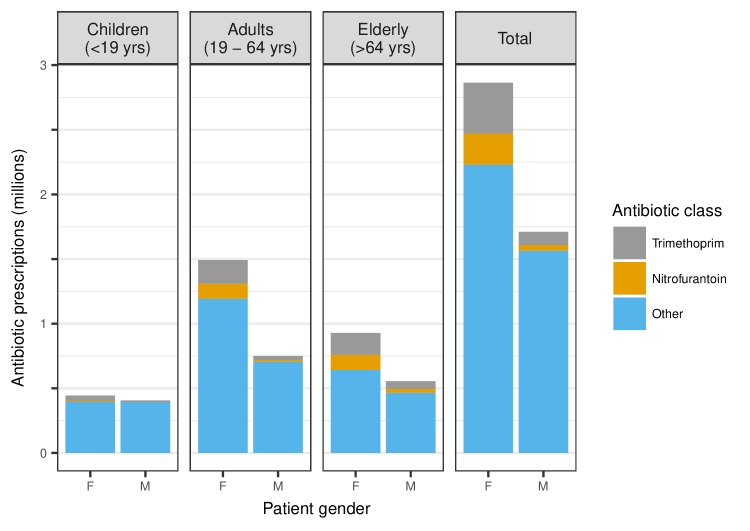
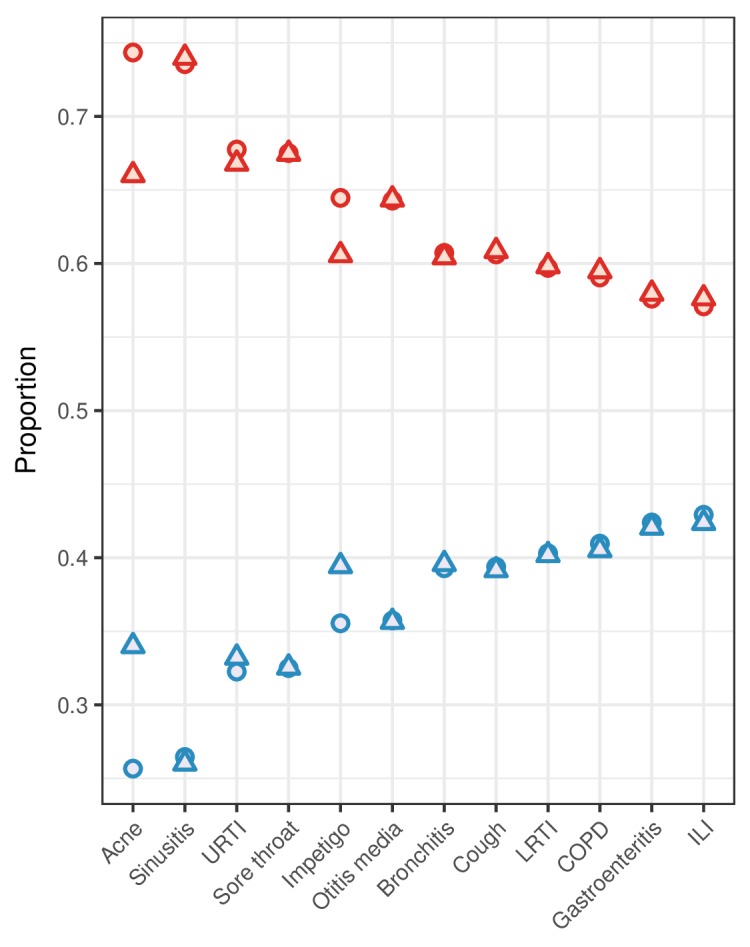
Among 4.57 million antibiotic prescriptions observed in the data, female patients received 67% more prescriptions than male patients, and 43% more when excluding antibiotics used to treat urinary tract infection (UTI). These gaps were more pronounced in adult women (99% more prescriptions than men; 69% more when excluding UTI) than in children (9%; 0%) or the elderly (67%; 38%). Among adults, women accounted for 64% of consultations (62% among patients with comorbidity), but were not substantially more likely than men to receive an antibiotic prescription when consulting with common conditions such as cough (RR 1.01; 95% CI 1.00 to 1.02), sore throat (RR 1.01, 95% CI 1.00 to 1.01) and lower respiratory tract infection (RR 1.00, 95% CI 1.00 to 1.01). Exceptions were skin conditions: women were less likely to be prescribed antibiotics when consulting with acne (RR 0.67, 95% CI 0.66 to 0.69) or impetigo (RR 0.85, 95% CI 0.81 to 0.88).
The gender gap in antibiotic prescribing can largely be explained by consultation behaviour. Although in most cases adult men and women are equally likely to be prescribed an antibiotic when consulting primary care, it is unclear whether or not they are equally indicated for antibiotic therapy.
探讨抗生素处方中性别差异的原因,并确定每次就诊时女性是否比男性更有可能获得抗生素处方。
对从健康改善网络(THIN)常规收集的电子病历进行横断面分析。
英国初级医疗保健。
2013年至2015年间在THIN注册的全科诊所就诊的患者。
测量儿童(<19岁)、成年人(19 - 64岁)和老年人(65岁及以上)的抗生素总处方量。对于12种常见病症,测量成人就诊次数,并估计女性就诊或合并症患者就诊时开具抗生素的相对风险(RR)。
在数据中观察到的457万份抗生素处方中,女性患者比男性患者多收到67%的处方,排除用于治疗尿路感染(UTI)的抗生素后多43%。这些差异在成年女性中(比男性多99%的处方;排除UTI后多69%)比在儿童中(9%;0%)或老年人中(67%;38%)更为明显。在成年人中,女性占就诊人数的64%(合并症患者中占62%),但在因咳嗽(RR 1.01;95%CI 1.00至1.02)、喉咙痛(RR 1.01,95%CI 1.00至1.01)和下呼吸道感染(RR 1.00,95%CI 1.00至1.01)等常见病症就诊时,女性获得抗生素处方的可能性并不比男性高很多。例外情况是皮肤病:女性因痤疮就诊时开具抗生素的可能性较小(RR 0.67,95%CI 0.66至0.69),因脓疱病就诊时开具抗生素的可能性较小(RR 0.85,95%CI 0.81至0.88)。
抗生素处方中的性别差异很大程度上可以由就诊行为来解释。虽然在大多数情况下,成年男性和女性在初级医疗保健就诊时开具抗生素的可能性相同,但尚不清楚他们是否同样适合接受抗生素治疗。