Department of Diabetes, Nutrition and Metabolic Diseases, Carol Davila University of Medicine and Pharmacy, Bucharest, Romania.
National Institute of Diabetes, Nutrition and Metabolic Diseases, "NC Paulescu", Bucharest, Romania.
Diabetes Obes Metab. 2018 Jul;20(7):1602-1614. doi: 10.1111/dom.13266. Epub 2018 Mar 25.
To compare the efficacy and safety of adding the glucagon-like peptide-1 receptor agonist exenatide once weekly (QW) 2 mg or placebo among patients with type 2 diabetes who were inadequately controlled despite titrated insulin glargine (IG) ± metformin.
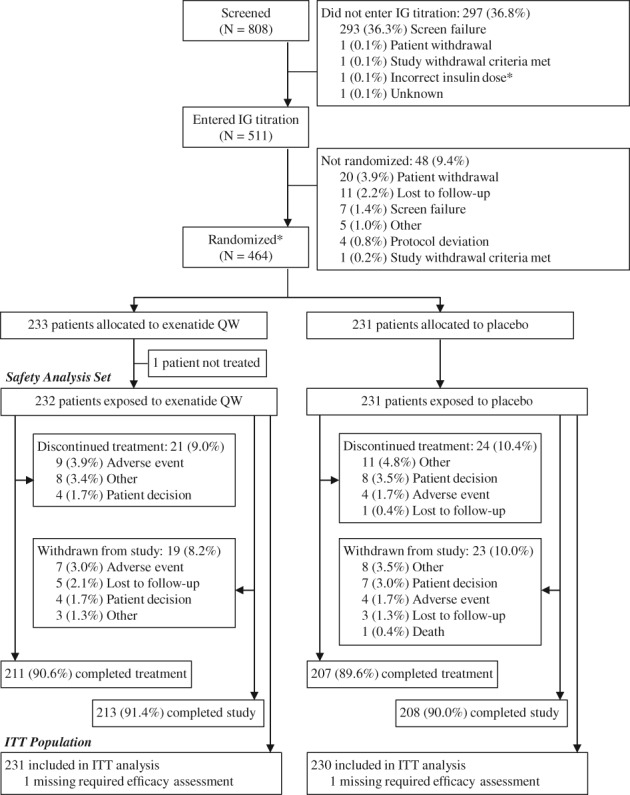
This multicentre, double-blind study (ClinicalTrials.gov identifier: NCT02229383) randomized (1:1) patients with persistent hyperglycaemia after an 8-week titration phase (glycated haemoglobin [HbA1c] 7.0%-10.5% [53-91 mmol/mol]) to exenatide QW or placebo. The primary endpoint was HbA1c change from baseline to week 28. Secondary endpoints included body weight, 2-hour postprandial glucose, and mean daily IG dose.
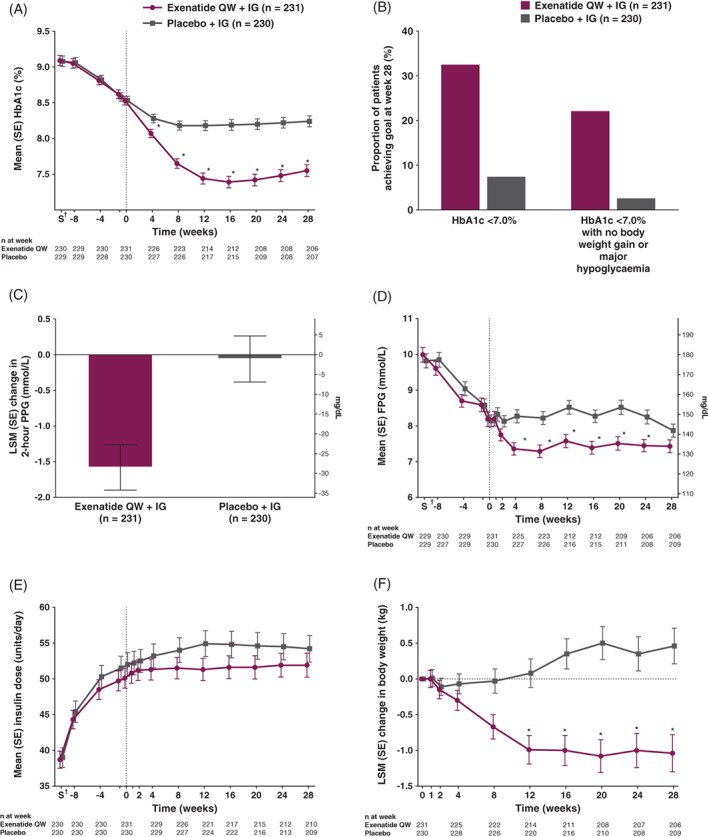
Of 464 randomized patients (mean: age, 58 years; HbA1c, 8.5% [69 mmol/mol]; diabetes duration, 11.3 years), 91% completed 28 weeks. Exenatide QW + IG vs placebo + IG significantly reduced HbA1c (least-squares mean difference, -0.73% [-8.0 mmol/mol]; 95% confidence interval, -0.93%, -0.53% [-10.2, -5.8 mmol/mol]; P < .001; final HbA1c, 7.55% [59 mmol/mol] and 8.24% [67 mmol/mol], respectively); body weight (-1.50 kg; -2.17, -0.84; P < .001); and 2-hour postprandial glucose (-1.52 mmol/L [-27.5 mg/dL]; -2.15, -0.90 [-38.7, -16.2]; P < .001). Significantly more exenatide QW + IG-treated patients vs placebo + IG-treated patients reached HbA1c <7.0% (<53 mmol/mol) (32.5% vs 7.4%; P < .001); daily IG dose increased by 2 and 4 units, respectively. Gastrointestinal and injection-site adverse events were more frequent with exenatide QW + IG (15.1% and 7.8%, respectively) than with placebo + IG (10.8% and 3.0%, respectively); hypoglycaemia incidence was similar between the exenatide QW + IG (29.7%) and placebo + IG (29.0%) groups, with no major hypoglycaemic events.
Among patients with inadequate glycaemic control, exenatide QW significantly improved glucose control and decreased body weight, without increased hypoglycaemia or unexpected safety findings.
比较每周一次(QW)给予 2mg 胰高血糖素样肽-1 受体激动剂艾塞那肽或安慰剂对血糖控制不佳的 2 型糖尿病患者的疗效和安全性,这些患者在经过胰岛素甘精 0.5mg 滴定后血糖仍控制不佳,且联合二甲双胍治疗。
这是一项多中心、双盲研究(ClinicalTrials.gov 标识符:NCT02229383),将持续高血糖(糖化血红蛋白 [HbA1c] 7.0%-10.5% [53-91mmol/mol])的患者随机(1:1)分为艾塞那肽 QW 或安慰剂组。主要终点为基线至 28 周时 HbA1c 的变化。次要终点包括体重、餐后 2 小时血糖和平均每日甘精胰岛素剂量。
在 464 名随机患者中(平均年龄:58 岁;HbA1c:8.5% [69mmol/mol];糖尿病病程:11.3 年),91%的患者完成了 28 周的治疗。艾塞那肽 QW+IG 与安慰剂+IG 相比,HbA1c 显著降低(最小二乘均值差,-0.73% [-8.0mmol/mol];95%置信区间,-0.93%,-0.53% [-10.2,-5.8mmol/mol];P<0.001;最终 HbA1c 分别为 7.55% [59mmol/mol]和 8.24% [67mmol/mol]);体重(-1.50kg;-2.17,-0.84;P<0.001);和餐后 2 小时血糖(-1.52mmol/L [-27.5mg/dL];-2.15,-0.90 [-38.7,-16.2];P<0.001)。与安慰剂+IG 组相比,艾塞那肽 QW+IG 治疗组达到 HbA1c<7.0%(<53mmol/mol)的患者比例更高(32.5% vs. 7.4%;P<0.001);甘精胰岛素日剂量分别增加了 2 和 4 个单位。与安慰剂+IG 组(分别为 10.8%和 3.0%)相比,艾塞那肽 QW+IG 组更常发生胃肠道和注射部位不良事件(分别为 15.1%和 7.8%);低血糖发生率在艾塞那肽 QW+IG 组(29.7%)和安慰剂+IG 组(29.0%)之间相似,无严重低血糖事件。
在血糖控制不佳的患者中,每周一次给予艾塞那肽 QW 可显著改善血糖控制并降低体重,且不增加低血糖或出现意外的安全性问题。