British Heart Foundation Centre on Population Approaches for NCD Prevention, Nuffield Department of Population Health, University of Oxford, Oxford, United Kingdom.
Health Library, Nuffield Department of Population Health, University of Oxford, Oxford, United Kingdom.
PLoS One. 2018 Feb 23;13(2):e0193378. doi: 10.1371/journal.pone.0193378. eCollection 2018.
Non-communicable diseases (NCDs) disproportionately affect low- and lower-middle income countries (LLMICs) where 80% of global NCD related deaths occur. LLMICs are the primary focus of interventions to address development and poverty indicators. We aimed to synthesise the evidence of these interventions' impact on the four primary NCDs (cardiovascular disease, diabetes, chronic respiratory disease and cancer) and their common behavioural risk factors (unhealthy diets, physical inactivity, tobacco and alcohol use).
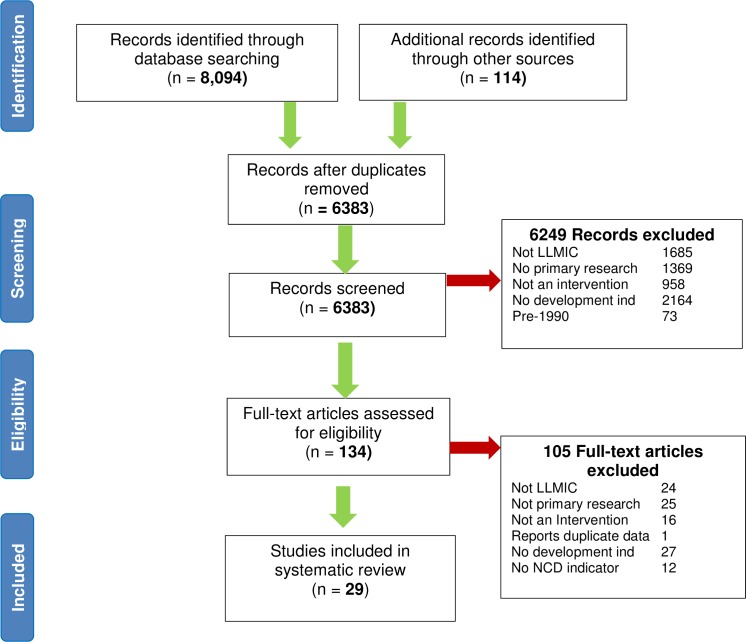
We systematically searched four online databases (Medline, Embase, Web of Science and Global Health) for primary research conducted in LLMICS, published between January 1st 1990 and February 15th 2016. Studies involved development or poverty interventions which reported on outcomes relating to NCDs. We extracted summary level data on study design, population, health outcomes and potential confounders.
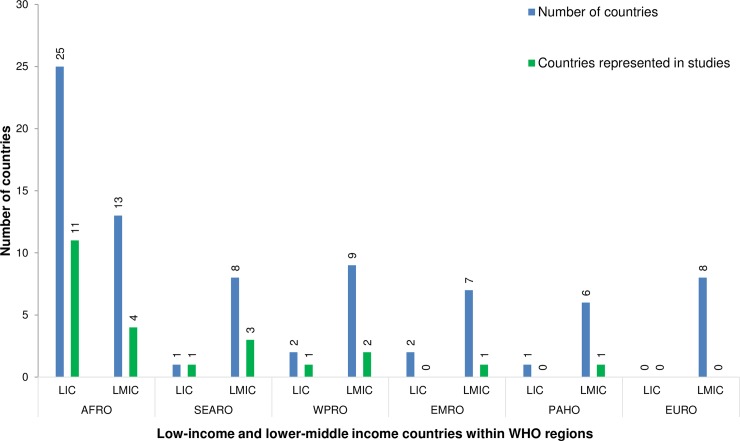
From 6383 search results, 29 studies from 24 LLMICs published between 1999 and 2015 met our inclusion criteria. The quality of included studies was limited and heterogeneity of outcome measures required narrative synthesis. One study measured impact on NCD prevalence, one physical activity and 27 dietary components. The majority of papers (23), involved agricultural interventions. Primary outcome measures tended to focus on undernutrition. Intensive agricultural interventions were associated with improved calorie, vitamin, fruit and vegetable intake. However, positive impacts were reliant on participant's land ownership, infection status and limited in generalisability. Just three studies measured adult obesity; two indicated increased income and consequential food affordability had the potential to increase obesity. Overall, there was poor alignment between included studies outcome measures and the key policy options and objectives of the Global Action Plan on NCDs.
Though many interventions addressing poverty and development have great potential to impact on NCD prevalence and risk, most fail to measure or report these outcomes. Current evidence is limited to behavioural risk factors, namely diet and suggests a positive impact of agricultural-based food security programmes on dietary indicators. However, studies investigating the impact of improved income on obesity tend to show an increased risk. Embedding NCD impact evaluation into development programmes is crucial in the context of the Sustainable Development Goals and the rapid epidemiological transitions facing LLMICs.
非传染性疾病(NCDs)在低收入和中下收入国家(LMICs)中不成比例地影响,这些国家占全球与 NCD 相关死亡人数的 80%。LMICs 是解决发展和贫困指标的干预措施的主要关注点。我们旨在综合这些干预措施对四大主要 NCD(心血管疾病、糖尿病、慢性呼吸道疾病和癌症)及其共同的行为风险因素(不健康饮食、身体活动不足、烟草和酒精使用)的影响的证据。
我们系统地检索了四个在线数据库(Medline、Embase、Web of Science 和 Global Health),以查找 1990 年 1 月 1 日至 2016 年 2 月 15 日期间在 LLMICs 进行的主要研究。研究涉及发展或减贫干预措施,报告了与 NCD 相关的结果。我们提取了关于研究设计、人群、健康结果和潜在混杂因素的汇总数据。
从 6383 个搜索结果中,有 29 项来自 24 个 LLMICs 的研究符合我们的纳入标准,这些研究发表于 1999 年至 2015 年期间。纳入研究的质量有限,结果衡量标准的异质性需要进行叙述性综合。一项研究测量了 NCD 患病率的影响,一项研究测量了身体活动,27 项研究测量了饮食成分。大多数论文(23 项)涉及农业干预措施。主要的结果衡量标准往往侧重于营养不良。密集的农业干预措施与改善热量、维生素、水果和蔬菜摄入有关。然而,积极的影响取决于参与者的土地所有权、感染状况和普遍性有限。只有三项研究测量了成人肥胖症;其中两项表明,收入增加和随之而来的食品可负担性有可能增加肥胖症。总体而言,纳入研究的结果衡量标准与全球非传染性疾病行动计划的主要政策选择和目标之间存在不一致。
虽然许多解决贫困和发展问题的干预措施对 NCD 患病率和风险有很大的影响潜力,但大多数都未能测量或报告这些结果。目前的证据仅限于行为风险因素,即饮食,并表明以农业为基础的粮食安全方案对饮食指标有积极影响。然而,研究改善收入对肥胖症的影响的研究往往表明风险增加。在可持续发展目标和 LLMICs 面临快速的流行病学转变的背景下,将 NCD 影响评估纳入发展方案至关重要。