Division of Endocrinology, Diabetes and Medical Genetics, Department of Medicine, Medical University of South Carolina, Charleston, United States of America.
Ralph H. Johnson Veterans Affairs Medical Center, Charleston, United States of America.
PLoS One. 2018 Feb 23;13(2):e0193343. doi: 10.1371/journal.pone.0193343. eCollection 2018.
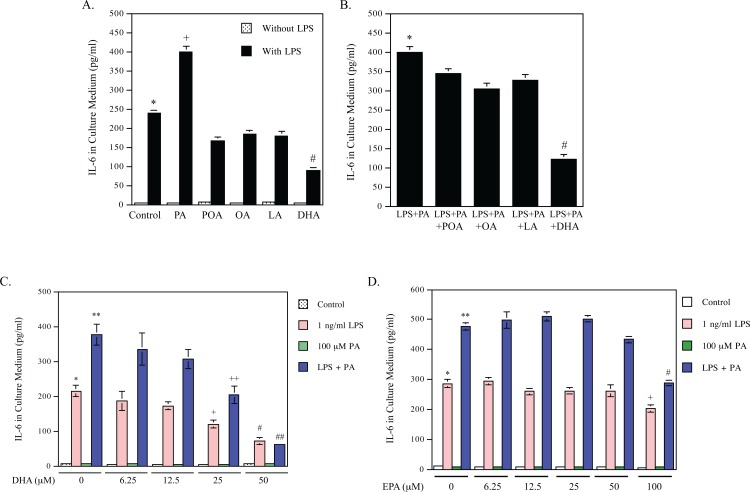
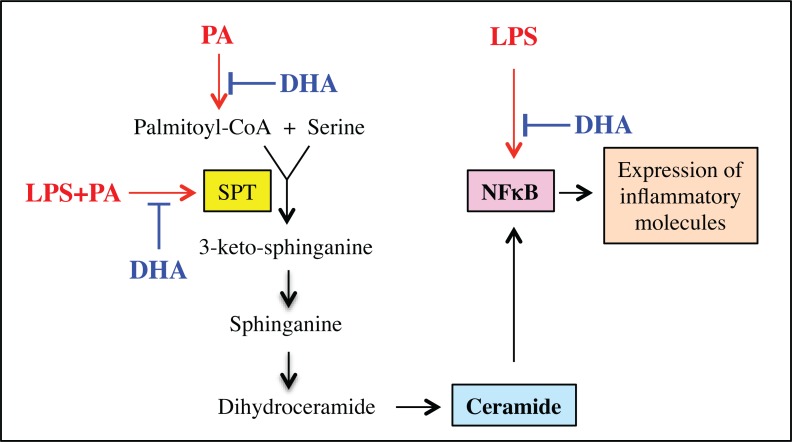
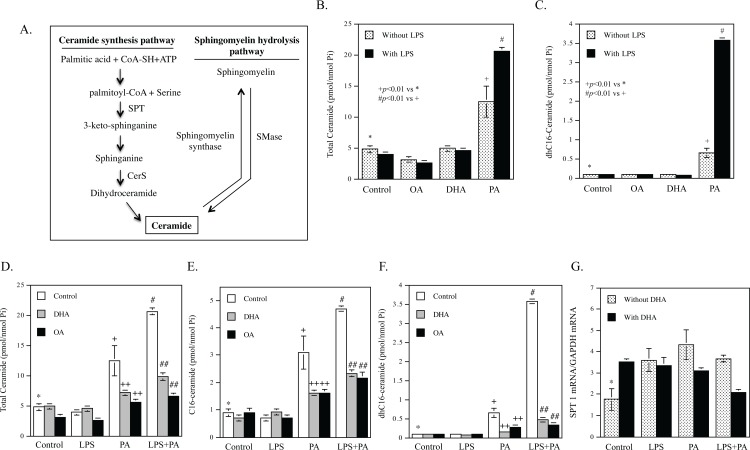
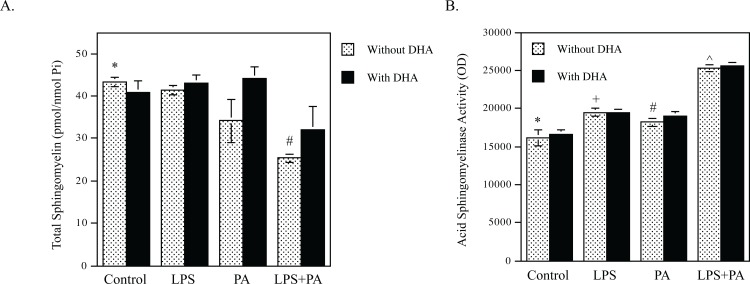
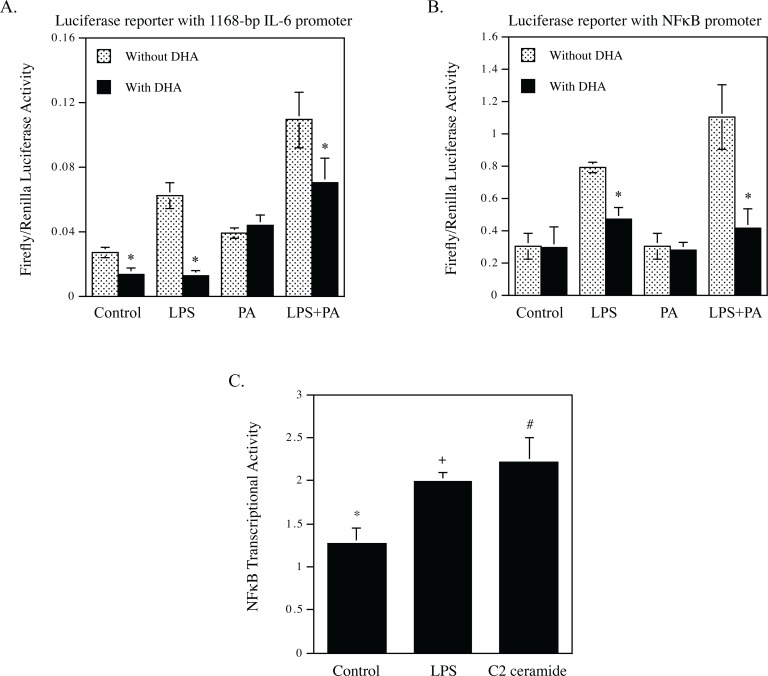
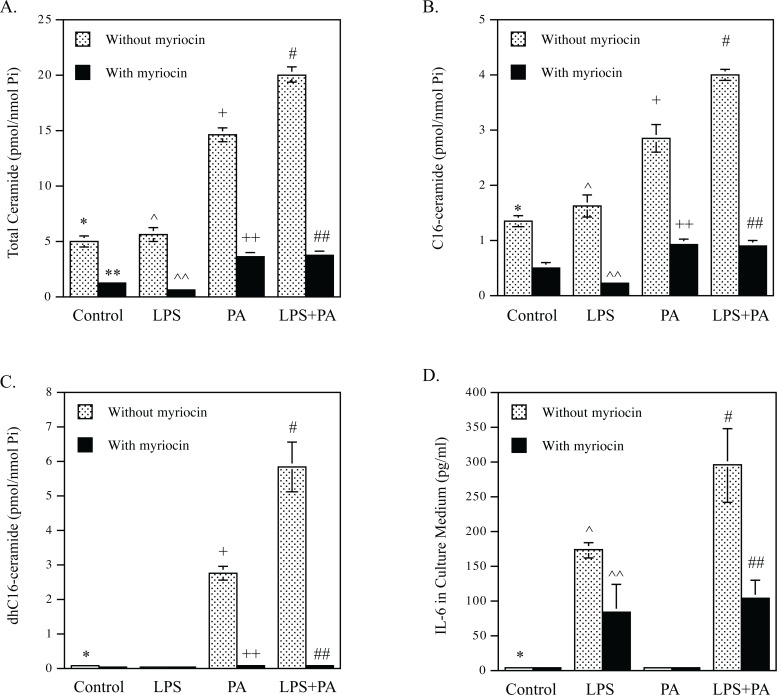
It is well known that saturated fatty acids (SFAs) and unsaturated fatty acid, in particular omega-3 polyunsaturated fatty acids (n-3 PUFAs), have different effects on inflammatory signaling: SFAs are pro-inflammatory but n-3 PUFAs have strong anti-inflammatory properties. We have reported that palmitic acid (PA), a saturated fatty acid, robustly amplifies lipopolysaccharide (LPS) signaling to upregulate proinflammatory gene expression in macrophages. We also reported that the increased production of ceramide (CER) via sphingomyelin (SM) hydrolysis and CER de novo synthesis plays a key role in the synergistic effect of LPS and PA on proinflammatory gene expression. However, it remains unclear if n-3 PUFAs are capable of antagonizing the synergistic effect of LPS and PA on gene expression and CER production. In this study, we employed the above macrophage culture system and lipidomical analysis to assess the effect of n-3 PUFAs on proinflammatory gene expression and CER production stimulated by LPS and PA. Results showed that DHA strongly inhibited the synergistic effect of LPS and PA on proinflammatory gene expression by targeting nuclear factor kappa B (NFκB)-dependent gene transcription. Results also showed that DHA inhibited the cooperative effect of LPS and PA on CER production by targeting CER de novo synthesis, but not SM hydrolysis. Furthermore, results showed that myriocin, a specific inhibitor of serine palmitoyltransferase, strongly inhibited both LPS-PA-stimulated CER synthesis and proinflammatory gene expression, indicating that CER synthesis is associated with proinflammatory gene expression and that inhibition of CER synthesis contributes to DHA-inhibited proinflammatory gene expression. Taken together, this study demonstrates that DHA antagonizes the boosting effect of PA on LPS signaling on proinflammatory gene expression by targeting both NFκB-dependent transcription and CER de novo synthesis in macrophages.
众所周知,饱和脂肪酸(SFAs)和不饱和脂肪酸,特别是ω-3 多不饱和脂肪酸(n-3 PUFAs),对炎症信号有不同的影响:SFAs 具有促炎作用,而 n-3 PUFAs 具有很强的抗炎特性。我们已经报道过,饱和脂肪酸棕榈酸(PA)可强烈放大脂多糖(LPS)信号,上调巨噬细胞中促炎基因的表达。我们还报道过,通过鞘磷脂(SM)水解和从头合成的神经酰胺(CER)的增加产生在 LPS 和 PA 对促炎基因表达的协同作用中起着关键作用。然而,目前尚不清楚 n-3 PUFAs 是否能够拮抗 LPS 和 PA 对基因表达和 CER 产生的协同作用。在这项研究中,我们采用了上述巨噬细胞培养系统和脂质组学分析来评估 n-3 PUFAs 对 LPS 和 PA 刺激的促炎基因表达和 CER 产生的影响。结果表明,DHA 通过靶向核因子 kappa B(NFκB)依赖性基因转录强烈抑制了 LPS 和 PA 对促炎基因表达的协同作用。结果还表明,DHA 通过靶向 CER 从头合成而非 SM 水解抑制了 LPS 和 PA 的协同作用对 CER 产生的影响。此外,结果表明,丝氨酸棕榈酰转移酶的特异性抑制剂——米诺环素强烈抑制了 LPS-PA 刺激的 CER 合成和促炎基因表达,表明 CER 合成与促炎基因表达有关,抑制 CER 合成有助于 DHA 抑制促炎基因表达。综上所述,本研究表明,DHA 通过靶向 NFκB 依赖性转录和巨噬细胞中的 CER 从头合成,拮抗 PA 对 LPS 信号转导对促炎基因表达的增强作用。