Mastboom Monique Josephine, Planje Rosa, van de Sande Michiel Adreanus
Department of Orthopedics, Leiden University Medical Center, University of Leiden, Leiden, Netherlands.
Interact J Med Res. 2018 Feb 23;7(1):e4. doi: 10.2196/ijmr.9325.
Tenosynovial giant cell tumor (TGCT) is a rare, benign lesion affecting the synovial lining of joints, bursae, and tendon sheaths. It is generally characterized as a locally aggressive and often recurring tumor. A distinction is made between localized- and diffuse-type. The impact of TGCT on daily living is currently ill-described.
The aim of this crowdsourcing study was to evaluate the impact of TGCT on physical function, daily activities, societal participation (work, sports, and hobbies), and overall quality of life from a patient perspective. The secondary aim was to define risk factors for deteriorated outcome in TGCT.
Members of the largest known TGCT Facebook community, PVNS is Pants!!, were invited to an e-survey, partially consisting of validated questionnaires, for 6 months. To confirm disease presence and TGCT-type, patients were requested to share histological or radiological proof of TGCT. Unpaired t tests and chi-square tests were used to compare groups with and without proof and to define risk factors for deteriorated outcome.
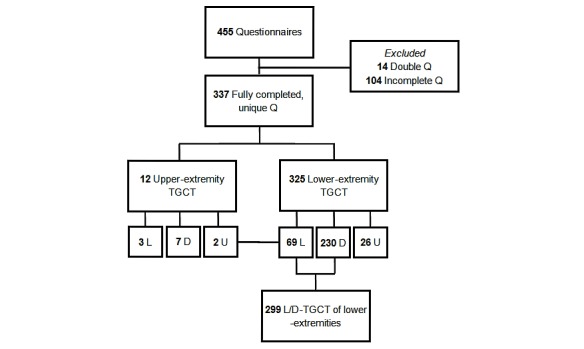
Three hundred thirty-seven questionnaires, originating from 30 countries, were completed. Median age at diagnosis was 33 (interquartile range [IQR]=25-42) years, majority was female (79.8% [269/337]), diffuse TGCT (70.3% [237/337]), and affected lower extremities (knee 70.9% [239/337] and hip 9.5% [32/337]). In 299 lower-extremity TGCT patients (32.4% [97/299]) with disease confirmation, recurrence rate was 36% and 69.5% in localized and diffuse type, respectively. For both types, pain and swelling decreased after treatment; in contrast, stiffness and range of motion worsened. Patients were limited in their employment (localized 13% [8/61]; diffuse 11.0% [21/191]) and sport-activities (localized 58% [40/69]; diffuse 63.9% [147/230]). Compared with general US population, all patients showed lower Patient-Reported Outcomes Measurements Information System-Physical Function (PROMIS-PF), Short Form-12 (SF-12), and EuroQoL 5 Dimensions 5 Levels (EQ5D-5L) scores, considered clinically relevant, according to estimated minimal important difference (MID). Diffuse versus localized type scored almost 0.5 standard deviation lower for PROMIS-PF (P<.001) and demonstrated a utility score of 5% lower for EQ-5D-5L (P=.03). In localized TGCT, recurrent disease and ≥2 surgeries negatively influenced scores of Visual Analog Scale (VAS)-pain/stiffness, SF-12, and EQ-5D-5L (P<.05). In diffuse type, recurrence resulted in lower score for VAS, PROMIS-PF, SF-12, and EQ-5D-5L (P<.05). In both types, patients with treatment ≤1year had significantly lower SF-12.
TGCT has a major impact on daily living in a relatively young and working population. Patients with diffuse type, recurrent disease, and ≥2 surgeries represent lowest functional and quality of life outcomes. Physicians should be aware that TGCT patients frequently continue to experience declined health-related quality of life and physical function and often remain limited in daily life, even after treatment(s).
腱鞘巨细胞瘤(TGCT)是一种罕见的良性病变,影响关节、滑囊和腱鞘的滑膜衬里。它通常被认为是一种局部侵袭性且常复发的肿瘤。可分为局限性和弥漫性两种类型。目前关于TGCT对日常生活影响的描述较少。
这项众包研究的目的是从患者角度评估TGCT对身体功能、日常活动、社会参与(工作、运动和爱好)以及总体生活质量的影响。次要目的是确定TGCT预后恶化的危险因素。
邀请最大的已知TGCT脸书社区“PVNS是裤子!!”的成员参加一项为期6个月的电子调查,部分内容包括经过验证的问卷。为确认疾病的存在和TGCT类型,要求患者分享TGCT的组织学或放射学证据。采用非配对t检验和卡方检验比较有证据和无证据的组,并确定预后恶化的危险因素。
共完成了来自30个国家的337份问卷。诊断时的中位年龄为33岁(四分位间距[IQR]=25-42岁),大多数为女性(79.8%[269/337]),弥漫性TGCT(70.3%[237/337]),且累及下肢(膝关节70.9%[239/337],髋关节9.5%[32/337])。在299例经疾病确认的下肢TGCT患者中(32.4%[97/299]),局限性和弥漫性类型的复发率分别为36%和69.5%。对于两种类型,治疗后疼痛和肿胀均减轻;相反,僵硬和活动范围恶化。患者在就业(局限性13%[8/61];弥漫性11.0%[21/191])和体育活动(局限性58%[40/69];弥漫性63.9%[147/230])方面受到限制。与美国普通人群相比,根据估计的最小重要差异(MID),所有患者的患者报告结局测量信息系统-身体功能(PROMIS-PF)、简明健康调查问卷12项(SF-12)和欧洲五维健康量表5级(EQ5D-5L)得分均较低,具有临床相关性。弥漫性与局限性类型相比,PROMIS-PF得分低近0.5个标准差(P<.001),EQ-5D-5L效用得分低5%(P=.03)。在局限性TGCT中,复发性疾病和≥2次手术对视觉模拟量表(VAS)-疼痛/僵硬、SF-12和EQ-5D-5L得分有负面影响(P<.05)。在弥漫性类型中,复发导致VAS、PROMIS-PF、SF-12和EQ-5D-5L得分降低(P<.05)。在两种类型中,治疗≤1年的患者SF-12得分显著较低。
TGCT对相对年轻且有工作的人群的日常生活有重大影响。弥漫性类型、复发性疾病和≥2次手术的患者功能和生活质量最差。医生应意识到,TGCT患者即使在治疗后,仍经常经历与健康相关的生活质量下降和身体功能受限,且日常生活往往仍然受到限制。
