Mastboom Monique J L, Verspoor Floortje G M, Verschoor Arjan J, Uittenbogaard Daniël, Nemeth Banne, Mastboom Walter J B, Bovée Judith V M G, Dijkstra P D Sander, Schreuder H W Bart, Gelderblom Hans, Van de Sande Michiel A J
a Orthopedic Surgery , Leiden University Medical Center , Leiden.
b Orthopedic Surgery , Radboud University Medical Center , Nijmegen.
Acta Orthop. 2017 Dec;88(6):688-694. doi: 10.1080/17453674.2017.1361126. Epub 2017 Aug 8.
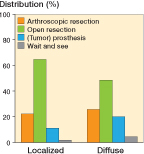
Background and purpose - Tenosynovial giant cell tumors (TGCT) are rare, benign tumors, arising in synovial lining of joints, tendon sheaths, or bursae. 2 types are distinguished: localized, either digits or extremity, and diffuse lesions. Current TGCT incidence is based on 1 single US-county study in 1980, with an incidence of 9 and 2 per million person-years in localized (including digits) and diffuse TGCT, respectively. We aim to determine nationwide and worldwide incidence rates (IR) in TGCT affecting digits, localized-extremity TGCT and diffuse-type TGCT. Material and methods - Over a 5-year period, the Dutch Pathology Registry (PALGA) identified 4,503 pathology reports on TGCT. Reports affecting digits were solely used for IR calculations. Reports affecting extremities were clinically evaluated. Dutch IRs were converted to world population IRs. Results - 2,815 (68%) digits, 933 (23%) localized-extremity and 390 (9%) diffuse-type TGCT were identified. Dutch IR in digits, localized-extremity, and diffuse-type TGCT was 34, 11 and 5 per million person-years, respectively. All 3 groups showed a female predilection and highest number of new cases in age category 40-59 years. The knee joint was most often affected: localized-extremity (46%) and diffuse-type (64%) TGCT, mostly treated with open resection: localized (65%) and diffuse (49%). Reoperation rate due to local recurrence for localized-extremity was 9%, and diffuse TGCT 23%. Interpretation - This first nationwide study and detailed analyses of IRs in TGCT estimated a worldwide IR in digits, localized-extremity and diffuse TGCT of 29, 10, and 4 per million person-years, respectively. Recurrence rate in diffuse type is 2.6 times higher, compared with localized extremity. TGCT is still considered a rare disease; however, it is more common than previously understood.
背景与目的——腱鞘巨细胞瘤(TGCT)是一种罕见的良性肿瘤,起源于关节、腱鞘或滑囊的滑膜衬里。可分为2种类型:局限性,累及手指或四肢,以及弥漫性病变。目前TGCT的发病率基于1980年美国一个县的单一研究,局限性(包括手指)和弥漫性TGCT的发病率分别为每百万人年9例和2例。我们旨在确定影响手指、局限性四肢TGCT和弥漫型TGCT的全国和全球发病率(IR)。材料与方法——在5年期间,荷兰病理登记处(PALGA)识别出4503份关于TGCT的病理报告。仅将影响手指的报告用于发病率计算。对影响四肢的报告进行临床评估。将荷兰的发病率转换为世界人口发病率。结果——共识别出2815例(68%)手指、933例(23%)局限性四肢和390例(9%)弥漫型TGCT。荷兰手指、局限性四肢和弥漫型TGCT的发病率分别为每百万人年34例、11例和5例。所有3组均表现出女性偏好,且40 - 59岁年龄组的新发病例数最多。膝关节最常受累:局限性四肢(46%)和弥漫型(64%)TGCT,大多采用开放切除治疗:局限性(65%)和弥漫性(49%)。局限性四肢TGCT因局部复发的再次手术率为9%,弥漫性TGCT为23%。解读——这项首次全国性研究及对TGCT发病率的详细分析估计,全球手指、局限性四肢和弥漫型TGCT的发病率分别为每百万人年29例、10例和4例。弥漫型的复发率比局限性四肢高2.6倍。TGCT仍被认为是一种罕见疾病;然而,它比之前认为的更为常见。