Vascular Biology Immunopharmacology Group, Department of Physiology, Anatomy and Microbiology, La Trobe University, Bundoora, VIC, 3083, Australia.
Cardiovascular Disease Program, Department of Pharmacology, Biomedicine Discovery Institute, Monash University, Clayton, VIC, 3800, Australia.
Neuromolecular Med. 2018 Mar;20(1):147-159. doi: 10.1007/s12017-018-8484-z. Epub 2018 Feb 23.
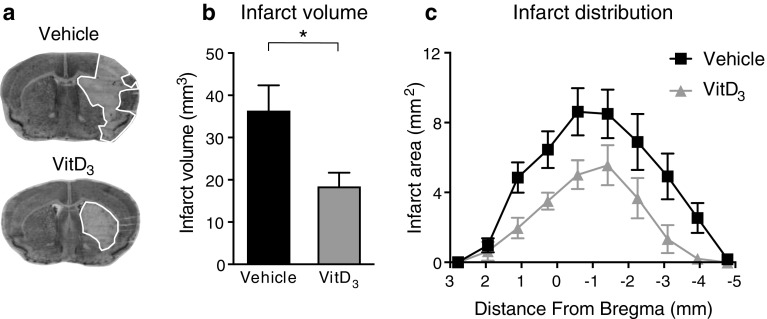
Acute inflammation can exacerbate brain injury after ischemic stroke. Beyond its well-characterized role in calcium metabolism, it is becoming increasingly appreciated that the active form of vitamin D, 1,25-dihydroxyvitamin D (1,25-VitD), has potent immunomodulatory properties. Here, we aimed to determine whether 1,25-VitD supplementation could reduce subsequent brain injury and associated inflammation after ischemic stroke. Male C57Bl6 mice were randomly assigned to be administered either 1,25-VitD (100 ng/kg/day) or vehicle i.p. for 5 day prior to stroke. Stroke was induced via middle cerebral artery occlusion for 1 h followed by 23 h reperfusion. At 24 h post-stroke, we assessed infarct volume, functional deficit, expression of inflammatory mediators and numbers of infiltrating immune cells. Supplementation with 1,25-VitD reduced infarct volume by 50% compared to vehicle. Expression of pro-inflammatory mediators IL-6, IL-1β, IL-23a, TGF-β and NADPH oxidase-2 was reduced in brains of mice that received 1,25-VitD versus vehicle. Brain expression of the T regulatory cell marker, Foxp3, was higher in mice supplemented with 1,25-VitD versus vehicle, while expression of the transcription factor, ROR-γ, was decreased, suggestive of a reduced Th17/γδ T cell response. Immunohistochemistry indicated that similar numbers of neutrophils and T cells were present in the ischemic hemispheres of 1,25-VitD- and vehicle-supplemented mice. At this early time point, there were also no differences in the impairment of motor function. These data indicate that prior administration of exogenous vitamin D, even to vitamin D-replete mice, can attenuate infarct development and exert acute anti-inflammatory actions in the ischemic and reperfused brain.
急性炎症会加重缺血性中风后的脑损伤。除了其在钙代谢中的作用外,人们越来越认识到活性形式的维生素 D,1,25-二羟维生素 D(1,25-VitD),具有强大的免疫调节作用。在这里,我们旨在确定 1,25-VitD 补充是否可以减少缺血性中风后的后续脑损伤和相关炎症。雄性 C57Bl6 小鼠被随机分配接受 1,25-VitD(100ng/kg/天)或载体腹腔注射 5 天,然后进行中风。通过大脑中动脉闭塞诱导中风 1 小时,然后再进行 23 小时再灌注。在中风后 24 小时,我们评估了梗塞体积、功能缺陷、炎症介质表达和浸润免疫细胞数量。与载体相比,1,25-VitD 补充可使梗塞体积减少 50%。接受 1,25-VitD 治疗的小鼠大脑中促炎介质 IL-6、IL-1β、IL-23a、TGF-β 和 NADPH 氧化酶-2 的表达减少。与载体相比,1,25-VitD 补充的小鼠大脑中 T 调节细胞标记物 Foxp3 的表达更高,而转录因子 ROR-γ 的表达降低,提示 Th17/γδ T 细胞反应减少。免疫组织化学表明,1,25-VitD 和载体补充的小鼠缺血半球中存在相似数量的中性粒细胞和 T 细胞。在这个早期时间点,运动功能的损伤也没有差异。这些数据表明,即使给维生素 D 充足的小鼠预先给予外源性维生素 D,也可以减轻梗塞的发展,并在缺血和再灌注的大脑中发挥急性抗炎作用。