Department of Comparative Genetics and Refinement, Biomedical Primate Research Centre, Lange Kleiweg 161, 2288 GJ, Rijswijk, The Netherlands.
Institut de Transplantation Urologie-Nephrologie (ITUN), UMR1064, Institut National de la Sante et de la Recherche Medicale (INSERM), 30 Bd Jean Monnet, 44093, Nantes, France.
Immunogenetics. 2018 Jul;70(7):439-448. doi: 10.1007/s00251-018-1053-7. Epub 2018 Feb 24.
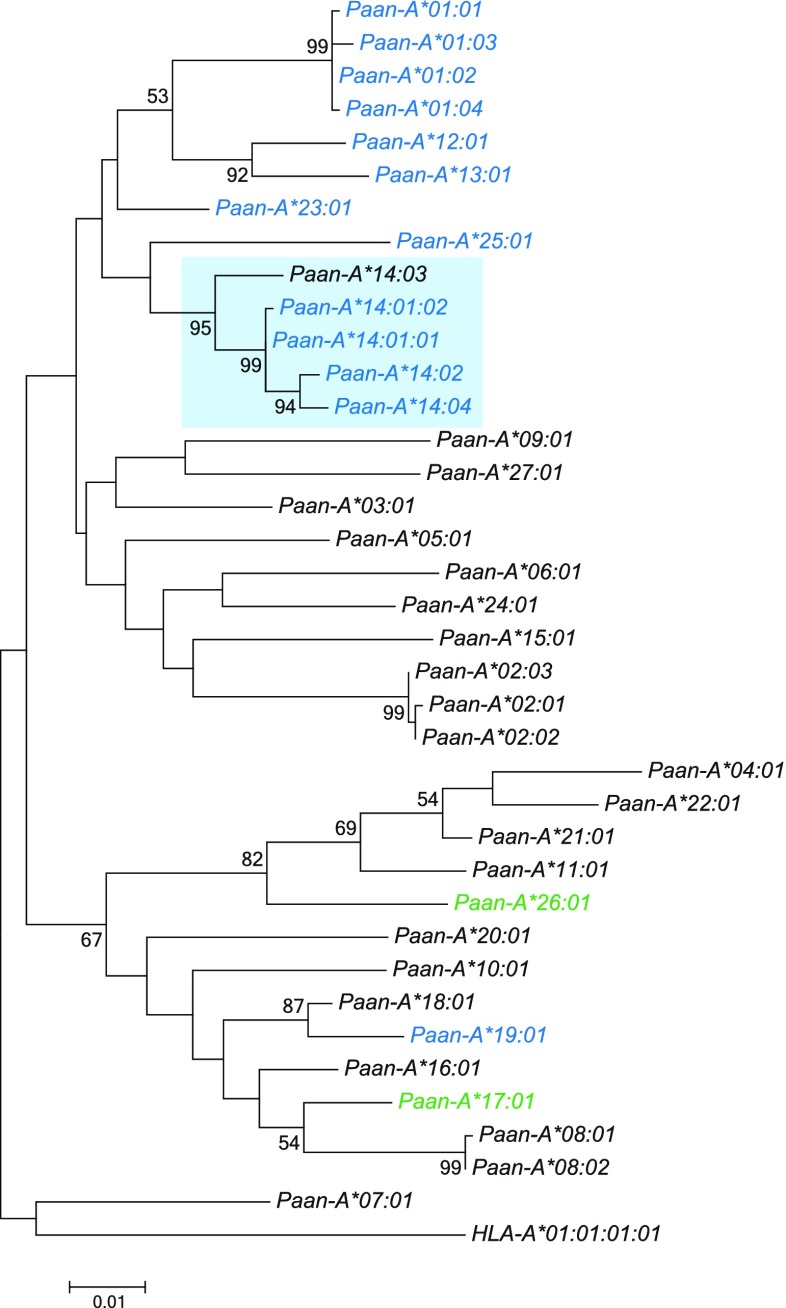
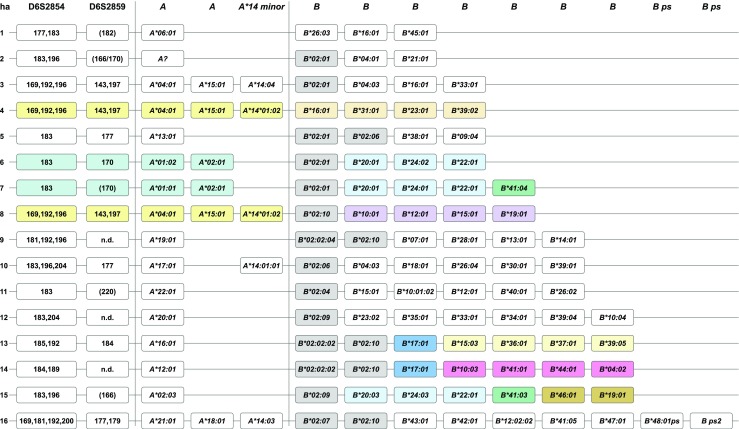
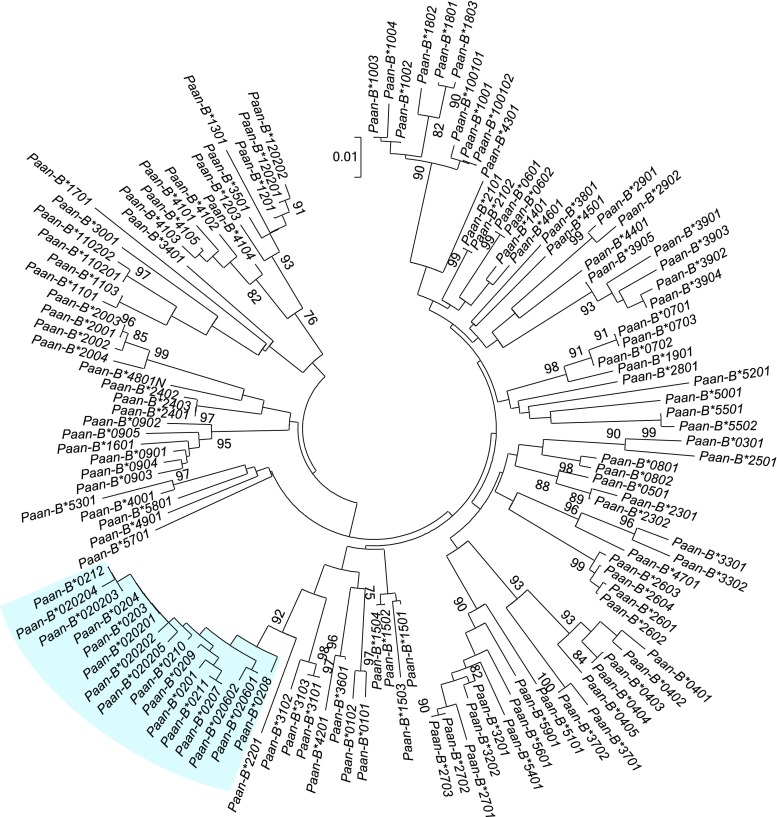
The olive baboon represents an important model system to study various aspects of human biology and health, including the origin and diversity of the major histocompatibility complex. After screening of a group of related animals for polymorphisms associated with a well-defined microsatellite marker, subsequent MHC class I typing of a selected population of 24 animals was performed on two distinct next-generation sequencing (NGS) platforms. A substantial number of 21 A and 80 B transcripts were discovered, about half of which had not been previously reported. Per animal, from one to four highly transcribed A alleles (majors) were observed, in addition to ones characterised by low transcripion levels (minors), such as members of the A14 lineage. Furthermore, in one animal, up to 13 B alleles with differential transcription level profiles may be present. Based on segregation profiles, 16 Paan-AB haplotypes were defined. A haplotype encodes in general one or two major A and three to seven B transcripts, respectively. A further peculiarity is the presence of at least one copy of a B02 lineage on nearly every haplotype, which indicates that B*02 represents a separate locus with probably a specialistic function. Haplotypes appear to be generated by recombination-like events, and the breakpoints map not only between the A and B regions but also within the B region itself. Therefore, the genetic makeup of the olive baboon MHC class I region appears to have been subject to a similar or even more complex expansion process than the one documented for macaque species.
橄榄狒狒是研究人类生物学和健康的重要模式生物,可用于研究主要组织相容性复合体的起源和多样性等方面。在对一组相关动物进行与一个明确微卫星标记相关的多态性筛选后,对 24 只动物的一个选定群体进行了两种不同的下一代测序 (NGS) 平台的 MHC 类 I 型分型。发现了大量的 21 个 A 和 80 个 B 转录本,其中约有一半以前没有报道过。每个动物除了具有低转录水平的 A14 等位基因(次要等位基因)外,还观察到一个到四个高转录 A 等位基因(主要等位基因)。此外,在一只动物中,可能存在多达 13 个具有不同转录水平谱的 B 等位基因。根据分离谱,定义了 16 个 Paan-AB 单倍型。一个单倍型通常编码一个或两个主要 A 和三个到七个 B 转录本。另一个特点是几乎每个单倍型上都存在至少一个 B02 等位基因,这表明 B*02 代表一个单独的基因座,可能具有特殊的功能。单倍型似乎是由类似重组的事件产生的,并且断点不仅位于 A 和 B 区域之间,而且还位于 B 区域本身内。因此,橄榄狒狒 MHC 类 I 区的遗传组成似乎经历了与猕猴物种记录的类似甚至更复杂的扩展过程。