Stroke Research Group, University of Cambridge, Department of Clinical Neurosciences, Cambridge, UK.
Stroke Research Group, University of Cambridge, Department of Clinical Neurosciences, Cambridge, UK.
J Affect Disord. 2018 May;232:116-121. doi: 10.1016/j.jad.2018.02.006. Epub 2018 Feb 15.
Apathy is a common yet under-recognised feature of cerebral small vessel disease (SVD), but its underlying neurobiological basis is not yet understood. We hypothesized that damage to the reward network is associated with an increase of apathy in patients with SVD.
In 114 participants with symptomatic SVD, defined as a magnetic resonance imaging confirmed lacunar stroke and confluent white matter hyperintensities, we used diffusion tensor imaging tractography to derive structural brain networks and graph theory to determine network efficiency. We determined which parts of the network correlated with apathy symptoms. We tested whether apathy was selectively associated with involvement of the reward network, compared with two "control networks" (visual and motor).
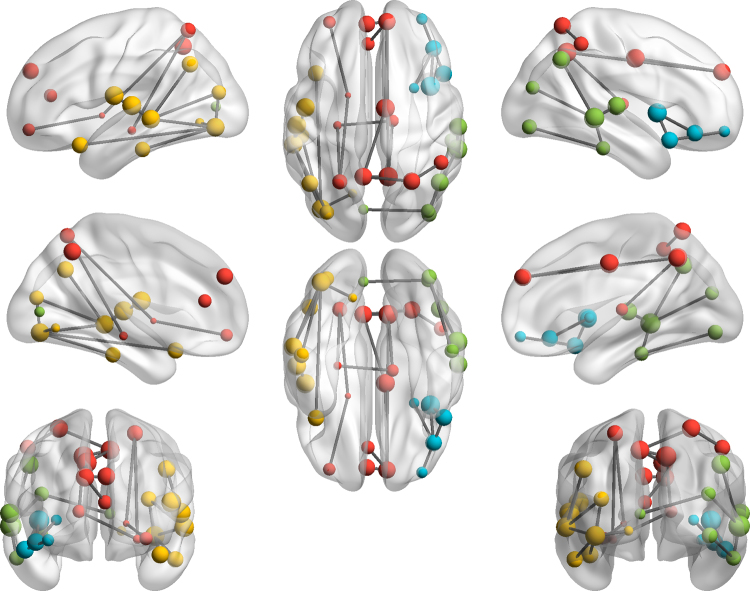
Apathy symptoms negatively correlated with connectivity in network clusters encompassing numerous areas of the brain. Network efficiencies within the reward network correlated negatively with apathy scores; (r = - 0.344, p < 0.001), and remained significantly correlated after co-varying for the two control networks. Of the three networks tested, only variability in the reward network independently explained variance in apathetic symptoms, whereas this was not observed for the motor or visual networks.
The analysis refers only to cerebrum and not cerebellum. The apathy measure is derivative of depression measure.
Our results suggest that reduced neural efficiency, particularly in the reward network, is associated with increased apathy in patients with SVD. Treatments which improve connectivity in this network may improve apathy in SVD, which in turn may improve psychiatric outcome after stroke.
冷漠是脑小血管病(SVD)的常见但未被充分认识的特征,但它的潜在神经生物学基础尚不清楚。我们假设,奖励网络的损伤与 SVD 患者冷漠的增加有关。
在 114 名有症状的 SVD 患者中,定义为磁共振成像证实的腔隙性卒中及弥漫性脑白质高信号,我们使用弥散张量成像追踪来得出结构脑网络,并使用图论来确定网络效率。我们确定了与冷漠症状相关的网络的哪些部分。我们测试了冷漠是否与奖励网络的参与,而不是两个“对照网络”(视觉和运动)的参与有选择性地相关。
冷漠症状与包括大脑许多区域的网络簇的连通性呈负相关。奖励网络内的网络效率与冷漠评分呈负相关;(r = -0.344,p < 0.001),并且在共变两个对照网络后仍然显著相关。在测试的三个网络中,只有奖励网络的可变性独立地解释了冷漠症状的方差,而在运动或视觉网络中则没有观察到这种情况。
分析仅指大脑,而不包括小脑。冷漠的测量是从抑郁的测量中衍生出来的。
我们的结果表明,神经效率的降低,特别是在奖励网络中,与 SVD 患者的冷漠增加有关。改善该网络连通性的治疗方法可能会改善 SVD 患者的冷漠,进而可能改善中风后的精神结局。