Biancari Fausto, Anttila Vesa, Dell'Aquila Angelo M, Airaksinen Juhani K E, Brascia Debora
Department of Surgery, University of Turku, Turku, Finland.
Department of Surgery, University of Oulu, Oulu, Finland.
J Cardiothorac Surg. 2018 Feb 27;13(1):24. doi: 10.1186/s13019-018-0710-0.
Perioperative myocardial ischemia (PMI) in patients undergoing coronary artery bypass grafting (CABG) is associated with poor outcome. The aim of this study was to pool the available data on the outcome after control angiography and repeat revascularization in patients with perioperative myocardial ischemia (PMI) after coronary artery bypass grafting (CABG).
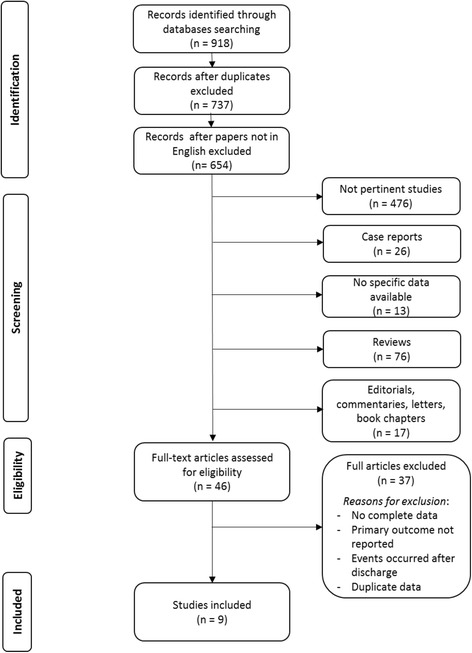
A literature review was performed through PubMed, Scopus, ScienceDirect and Google Scholar to identify studies published since 1990 evaluating the outcome of PMI after CABG.
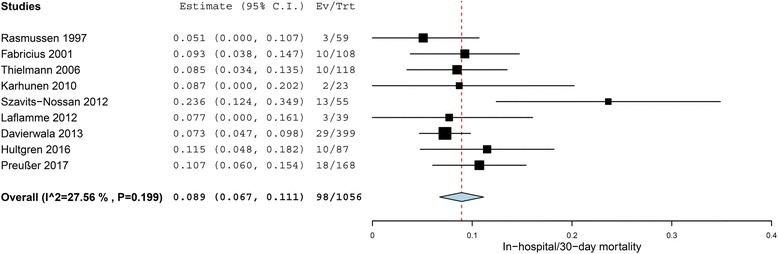
Nine studies included 1104 patients with PMI after CABG and 1056 of them underwent control angiography early after CABG. Pooled early mortality after reoperation for PMI without control angiography was 43.6% (95%CI 29.7-57.6%) and 79.8% of them (95%CI 64.4-95.2%) had an acute graft failure detected at reoperation. Among patients who underwent control angiography for PMI, 31.7% had a negative finding at angiography (95%CI 25.6-37.8%) and 62.1% had an acute graft failure (95%CI 56.6-67.6%). Repeat revascularization was performed after early control angiography in 46.3% of patients (95%CI 39.9-52.6%; 54.2% underwent repeat surgical revascularization; 45.8% underwent percutaneous coronary intervention). Pooled early mortality after control angiography with or without repeat revascularization was 8.9% (95%CI 6.7-11.1%). Three studies reported on early mortality rates which did not differ between repeat surgical revascularization and PCI (11.7% vs. 9.2%, respectively; risk ratio 1.45, 95%CI 0.67-3.11). In these three series, early mortality after conservative treatment was 5.9% (95%CI 3.6-8.2%).
Control angiography seems to be a valid life-saving strategy to guide repeat revascularization in hemodynamically stable patients suffering PMI after CABG.
冠状动脉旁路移植术(CABG)患者围手术期心肌缺血(PMI)与不良预后相关。本研究的目的是汇总冠状动脉旁路移植术(CABG)后围手术期心肌缺血(PMI)患者进行对照血管造影和再次血运重建后的现有结局数据。
通过PubMed、Scopus、ScienceDirect和谷歌学术进行文献综述,以确定自1990年以来发表的评估CABG后PMI结局的研究。
9项研究纳入了1104例CABG后发生PMI的患者,其中1056例在CABG后早期进行了对照血管造影。未进行对照血管造影的PMI再次手术后的汇总早期死亡率为43.6%(95%CI 29.7 - 57.6%),其中79.8%(95%CI 64.4 - 95.2%)在再次手术时检测到急性移植物失败。在因PMI接受对照血管造影的患者中,31.7%血管造影结果为阴性(95%CI 25.6 - 37.8%),62.1%发生急性移植物失败(95%CI 56.6 - 67.6%)。46.3%的患者(95%CI 39.9 - 52.6%)在早期对照血管造影后进行了再次血运重建;54.2%接受了再次手术血运重建;45.8%接受了经皮冠状动脉介入治疗。进行或未进行再次血运重建的对照血管造影后的汇总早期死亡率为8.9%(95%CI 6.7 - 11.1%)。三项研究报告了再次手术血运重建和PCI之间早期死亡率无差异(分别为11.7%和9.2%;风险比1.45,95%CI 0.67 - 3.11)。在这三个系列中,保守治疗后的早期死亡率为5.9%(95%CI 3.6 - 8.2%)。
对照血管造影似乎是一种有效的挽救生命策略,可指导血流动力学稳定的CABG后发生PMI的患者进行再次血运重建。