Department of Cardiology, General Hospital of Shenyang Military Region, Shenyang, Liaoning 110016, China.
Department of Cardiology, People's Liberation Army 463 Hospital, Shenyang, Liaoning 110000, China.
Chin Med J (Engl). 2018 Mar 5;131(5):508-515. doi: 10.4103/0366-6999.226064.
High platelet reactivity (HPR) during clopidogrel treatment predicts postpercutaneous coronary intervention (PCI) ischemic events strongly and independently. Tongxinluo capsules (TCs) are a traditional Chinese medicine formulation used as antiplatelet treatment. However, its efficacy against HPR is not known. The aim of the present study was to evaluate the effects of TCs in acute coronary syndrome (ACS) patients with HPR.
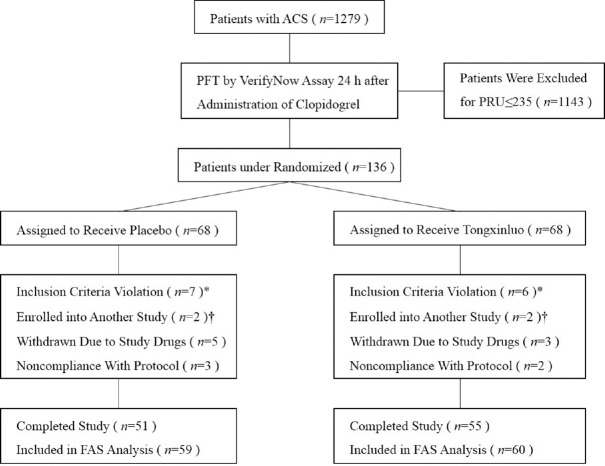
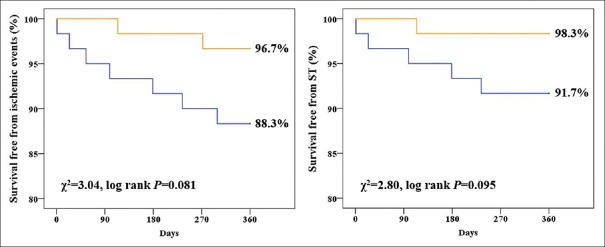
This multicenter, randomized, double-blind, placebo-controlled study prospectively analyzed 136 ACS patients with HPR who underwent PCI. The patients were enrolled from November 2013 to May 2014 and randomized to receive placebo or TCs in addition to standard dual antiplatelet therapy (DAPT) with aspirin and clopidogrel. The primary end points were the prevalence of HPR at 30 days and the mean change in P2Yreaction units (PRUs) between baseline and 30 days. Survival curves were constructed with Kaplan-Meier estimates and compared by log-rank tests between the two groups.
Both groups had a significantly reduced prevalence of HPR at 30 days versus baseline, but the TC group, compared with the placebo group, had greater reduction (15.8% vs. 24.8%, P = 0.013), especially among patients with one cytochrome P450 2C19 loss of function (LOF) allele (χ = 2.931, P = 0.047). The TC group also had a lower prevalence of HPR (33.3% vs. 54.2%, t = 5.284, P = 0.022) and superior performance in light transmittance aggregometry and higher levels of high-sensitivity C-reactive protein (hsCRP), but the composite prevalence of ischemic events did not differ significantly (χ = 1.587, P = 0.208).
In addition to standard DAPT with aspirin and clopidogrel, TCs further reduce PRU and hsCRP levels, especially in patients carrying only one LOF allele. The data suggest that TCs could be used in combination therapy for ACS patients with HPR undergoing PCI.
氯吡格雷治疗期间的高血小板反应性(HPR)强烈且独立地预测经皮冠状动脉介入治疗(PCI)后的缺血事件。通心络胶囊(TCs)是一种用于抗血小板治疗的中药制剂。然而,其对 HPR 的疗效尚不清楚。本研究旨在评估 TCs 在伴有 HPR 的急性冠状动脉综合征(ACS)患者中的作用。
这是一项多中心、随机、双盲、安慰剂对照研究,前瞻性分析了 136 例接受 PCI 的伴有 HPR 的 ACS 患者。这些患者于 2013 年 11 月至 2014 年 5 月入组,并随机接受安慰剂或 TCs 治疗,同时接受阿司匹林和氯吡格雷的标准双联抗血小板治疗(DAPT)。主要终点为 30 天时 HPR 的发生率和基线至 30 天时 P2Y 反应单位(PRUs)的平均变化。通过 Kaplan-Meier 估计绘制生存曲线,并通过对数秩检验比较两组之间的差异。
两组在 30 天时 HPR 的发生率均较基线时显著降低,但与安慰剂组相比,TC 组的降低更为显著(15.8%比 24.8%,P = 0.013),尤其是在携带一个细胞色素 P450 2C19 失活(LOF)等位基因的患者中(χ = 2.931,P = 0.047)。TC 组 HPR 的发生率也较低(33.3%比 54.2%,t = 5.284,P = 0.022),透光比浊法和高敏 C 反应蛋白(hsCRP)水平较高,但缺血事件的复合发生率无显著差异(χ = 1.587,P = 0.208)。
除了阿司匹林和氯吡格雷的标准 DAPT 之外,TCs 还进一步降低了 PRU 和 hsCRP 水平,尤其是在仅携带一个 LOF 等位基因的患者中。数据表明,TCs 可用于伴有 HPR 的 PCI 术后 ACS 患者的联合治疗。