Key Laboratory of Animal Models and Human Disease Mechanisms of the Chinese Academy of Sciences and Yunnan Province, Kunming Institute of Zoology, Chinese Academy of Sciences, Kunming, Yunnan, 650223, China.
Kunming College of Life Science, University of Chinese Academy of Sciences, Kunming, 650204, China.
Nat Commun. 2018 Feb 26;9(1):838. doi: 10.1038/s41467-018-03247-3.
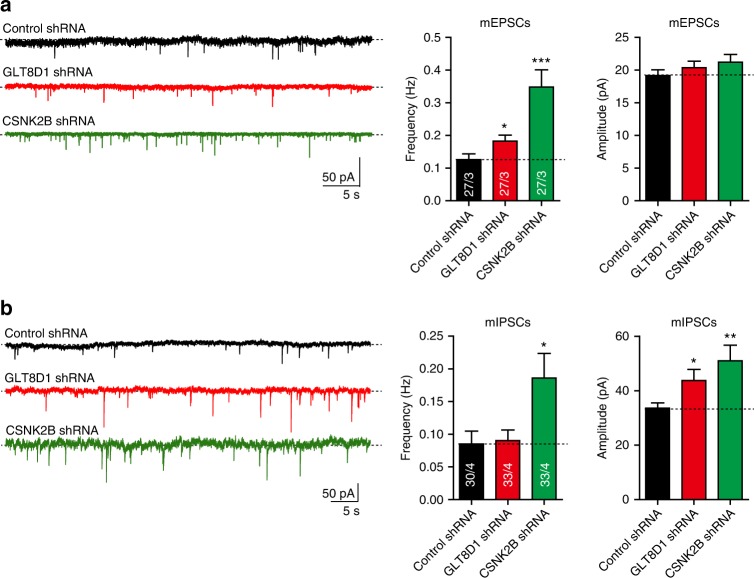
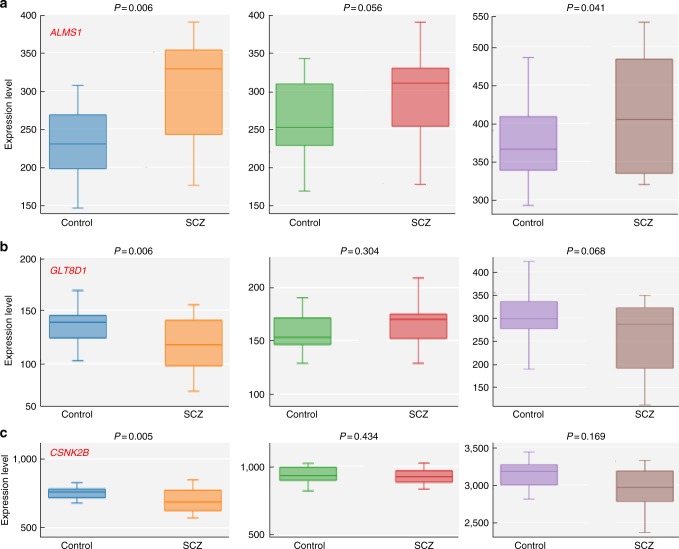
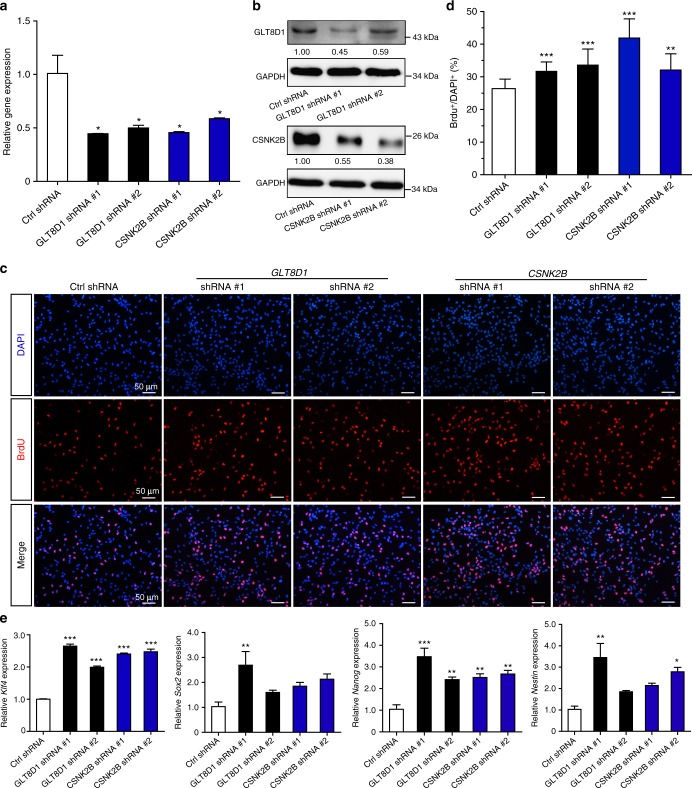
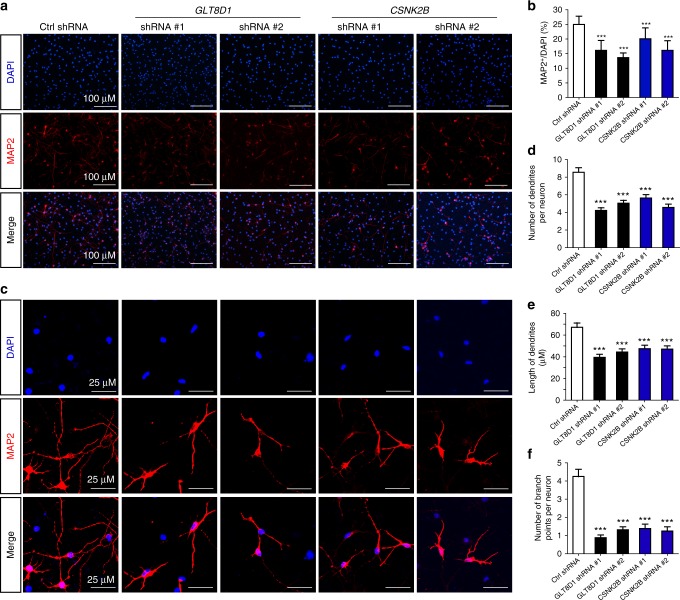
Recent genome-wide association studies (GWAS) have identified multiple risk loci that show strong associations with schizophrenia. However, pinpointing the potential causal genes at the reported loci remains a major challenge. Here we identify candidate causal genes for schizophrenia using an integrative genomic approach. Sherlock integrative analysis shows that ALMS1, GLT8D1, and CSNK2B are schizophrenia risk genes, which are validated using independent brain expression quantitative trait loci (eQTL) data and integrative analysis method (SMR). Consistently, gene expression analysis in schizophrenia cases and controls further supports the potential role of these three genes in the pathogenesis of schizophrenia. Finally, we show that GLT8D1 and CSNK2B knockdown promote the proliferation and inhibit the differentiation abilities of neural stem cells, and alter morphology and synaptic transmission of neurons. These convergent lines of evidence suggest that the ALMS1, CSNK2B, and GLT8D1 genes may be involved in pathophysiology of schizophrenia.
最近的全基因组关联研究(GWAS)已经确定了多个与精神分裂症有强烈关联的风险基因座。然而,确定报告基因座中的潜在因果基因仍然是一个主要挑战。在这里,我们使用综合基因组方法来确定精神分裂症的候选因果基因。Sherlock 综合分析表明,ALMS1、GLT8D1 和 CSNK2B 是精神分裂症的风险基因,这一点通过独立的大脑表达数量性状基因座(eQTL)数据和综合分析方法(SMR)得到了验证。一致地,精神分裂症病例和对照的基因表达分析进一步支持了这三个基因在精神分裂症发病机制中的潜在作用。最后,我们表明 GLT8D1 和 CSNK2B 的敲低可促进神经干细胞的增殖并抑制其分化能力,同时改变神经元的形态和突触传递。这些相互一致的证据表明,ALMS1、CSNK2B 和 GLT8D1 基因可能参与精神分裂症的病理生理学。