Department of Biological Sciences, University of Notre Dame, 100 Galvin Life Sciences Center, Notre Dame, IN, 46556, USA.
Sci Rep. 2018 Feb 26;8(1):3629. doi: 10.1038/s41598-018-21994-7.
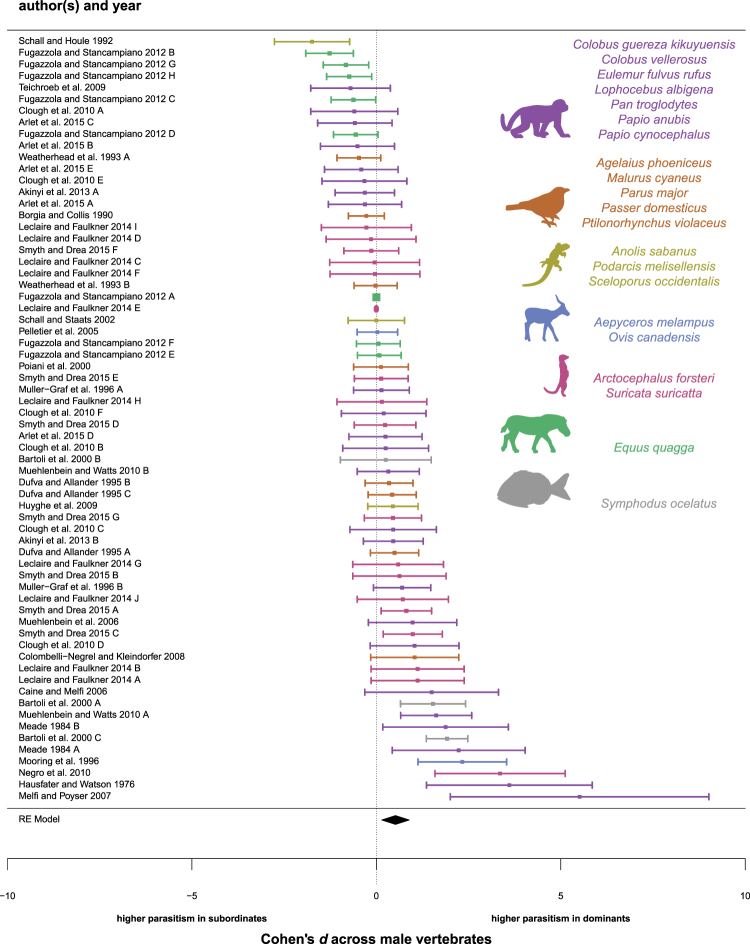
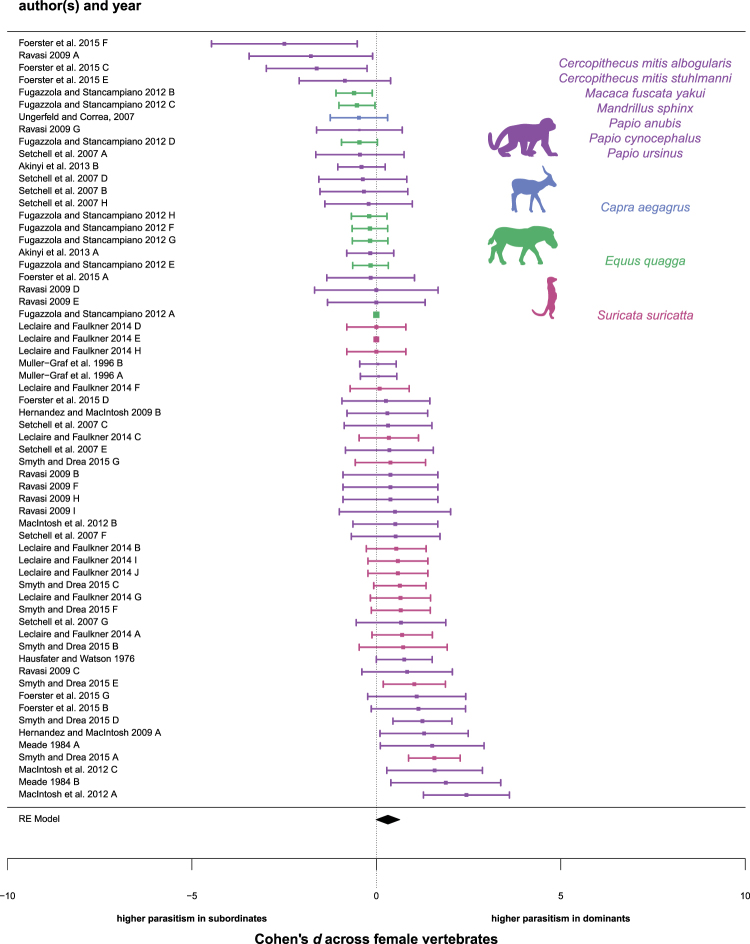
Social status is an important predictor of parasite risk in vertebrates. To date, general frameworks to explain status-related variation in parasitism have remained elusive. In this meta-analysis, we evaluated five hypotheses proposed to explain status-related variation in parasitism in male and female vertebrates by leveraging variation in hierarchy type, mating system, parasite transmission mode, and allostatic load to test associated predictions. Our meta-analyses span 66 analyses (26 studies) of male vertebrates (two orders and five classes), and 62 analyses (13 studies) of female vertebrates (four vertebrate orders). Contrary to the prevailing paradigm that low status is linked to poor health, we found that dominant animals typically faced higher parasite risk than subordinates. This pattern was especially well-supported in analyses of males versus females, in linear versus egalitarian hierarchies, in mating systems where dominance rank predicts mating effort, and for contact- and environmentally-transmitted parasites rather than vector-borne parasites. These findings supported the priority-of-access and tradeoffs hypotheses suggesting that variation in parasitism is driven by rank-associated differences in exposure to parasites and mating effort. Together, these results suggest that high parasite risk might sometimes be an unappreciated cost of high rank, and conversely, reduced parasite risk might be a benefit of social subordination.
社会地位是脊椎动物寄生虫风险的一个重要预测因子。迄今为止,解释与地位相关的寄生虫感染变化的一般框架仍然难以捉摸。在这项荟萃分析中,我们利用等级类型、交配系统、寄生虫传播模式和应激负荷的变化,评估了五个假说,以解释雄性和雌性脊椎动物与地位相关的寄生虫感染变化,并检验了相关预测。我们的荟萃分析涵盖了 66 项雄性脊椎动物(两个纲和五个目)的分析(26 项研究)和 62 项雌性脊椎动物(四个脊椎动物目)的分析(13 项研究)。与普遍认为的低地位与健康状况不佳有关的观点相反,我们发现,优势动物通常面临更高的寄生虫风险,而劣势动物则面临更高的寄生虫风险。这一模式在雄性与雌性、线性与平等的等级制度、支配地位等级预测交配努力的交配系统以及接触和环境传播的寄生虫而非媒介传播的寄生虫的分析中尤为明显。这些发现支持了优先获取和权衡假说,表明寄生虫感染的变化是由与地位相关的寄生虫暴露和交配努力差异驱动的。总之,这些结果表明,高寄生虫风险有时可能是高等级的一个未被认识到的代价,相反,减少寄生虫风险可能是社会从属的一个好处。