Department of Neurology Danish Multiple Sclerosis Center Rigshospitalet University of Copenhagen Copenhagen Denmark.
Brain Behav. 2018 Jan 5;8(2):e00875. doi: 10.1002/brb3.875. eCollection 2018 Feb.
Patients with progressive multiple sclerosis (MS) often have cognitive impairment in addition to physical impairment. The burden of cognitive and physical impairment progresses over time, and may be major determinants of quality of life. The aim of this study was to assess to which degree quality of life correlates with physical and cognitive function in progressive MS.
This is a retrospective study of 52 patients with primary progressive (= 18) and secondary progressive MS (= 34). Physical disability was assessed using the Expanded Disability Status Scale, Timed 25 Foot Walk (T25FW) test and 9-Hole Peg Test (9HPT). Cognitive function was assessed using Symbol Digit Modalities Test (SDMT), Paced Auditory Serial Addition Test, and Trail Making Test B (TRAIL-B). In addition, quality of life was assessed by the Short Form 36 (SF-36) questionnaire.
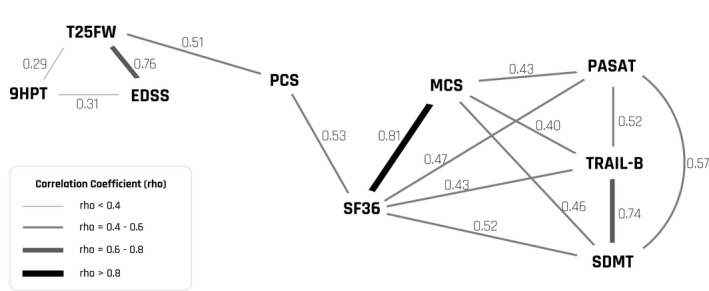
Only measures of cognitive function correlated with the overall SF-36 quality of life score and the Mental Component Summary score from the SF-36. The only physical measure that correlated with a measure of quality of life was T25FW test, which correlated with the Physical Component Summary from the SF-36. We found no other significant correlations between the measures of cognitive function and the overall physical measures but interestingly, we found a possible relationship between the 9HPT score for the nondominant hand and the SDMT and TRAIL-B.
Our findings support inclusion of measures of cognitive function in the assessment of patients with progressive MS as these correlated closer with quality of life than measures of physical impairment.
进展性多发性硬化症(MS)患者除了身体损伤外,通常还伴有认知障碍。认知和身体损伤的负担随时间推移而不断加重,可能是生活质量的主要决定因素。本研究旨在评估进展性 MS 患者的生活质量与身体和认知功能的相关性。
这是一项对 52 名原发性进展性(=18 名)和继发性进展性 MS(=34 名)患者进行的回顾性研究。使用扩展残疾状况量表、定时 25 英尺步行(T25FW)测试和 9 孔钉测试(9HPT)评估身体残疾程度。使用符号数字模态测试(SDMT)、听觉连续加法测试和追踪测试 B(TRAIL-B)评估认知功能。此外,使用简明健康调查问卷(SF-36)评估生活质量。
只有认知功能测量值与 SF-36 总生活质量评分和 SF-36 的心理成分综合评分相关。唯一与生活质量测量值相关的身体测量值是 T25FW 测试,它与 SF-36 的身体成分综合评分相关。我们没有发现认知功能测量值与整体身体测量值之间的其他显著相关性,但有趣的是,我们发现非优势手的 9HPT 评分与 SDMT 和 TRAIL-B 之间可能存在关系。
我们的研究结果支持在评估进展性 MS 患者时纳入认知功能测量值,因为它们与生活质量的相关性比身体损伤测量值更密切。