Murata Masayuki, Ishii Ayana, Fujimoto Hiroko, Nishimura Kaori, Kosaka Tomoyuki, Mori Hirotada, Yamada Mamoru
Life Science, Graduate School of Science and Technology for Innovation, Yamaguchi University, Ube, Japan.
Department of Biological Chemistry, Faculty of Agriculture, Yamaguchi University, Yamaguchi, Japan.
PLoS One. 2018 Feb 27;13(2):e0189487. doi: 10.1371/journal.pone.0189487. eCollection 2018.
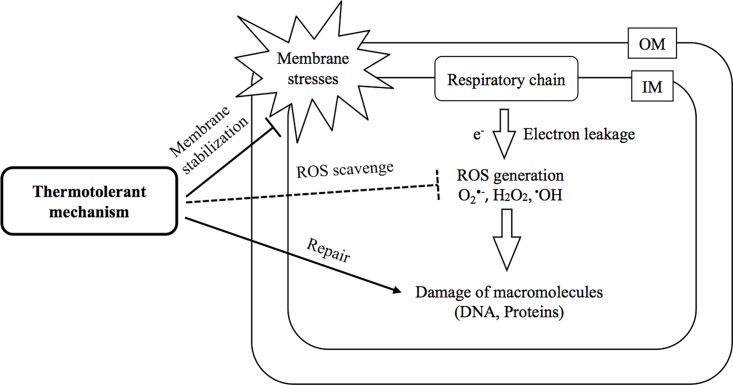
Previous screening of a single-gene knockout library consisting of 3,908 disrupted-mutant strains allowed us to identify 51 thermotolerant genes that are essential for survival at a critical high temperature (CHT) in Escherichia coli [Murata M, Fujimoto H, Nishimura K, Charoensuk K, Nagamitsu H, Raina S, Kosaka T, Oshima T, Ogasawara N, Yamada M (2011) PLoS ONE 6: e20063]. In this study, we identified another 21 thermotolerant genes. E. coli thus has 72 thermotolerant genes in total. The genes are classified into 8 groups: genes for energy metabolism, outer membrane organization, DNA double-strand break repair, tRNA modification, protein quality control, translation control, cell division and transporters. This classification and physiological analysis indicate the existence of fundamental strategies for survival at a CHT, which seems to exclude most of the heat shock responses.
此前,对一个由3908个突变菌株组成的单基因敲除文库进行筛选,使我们能够鉴定出51个对大肠杆菌在临界高温(CHT)下生存至关重要的耐热基因[村田M,藤本H,西村K,查伦斯克K,长光H,雷纳S,小坂T,大岛T,小笠原N,山田M(2011年)《公共科学图书馆·综合》6:e20063]。在本研究中,我们又鉴定出另外21个耐热基因。因此,大肠杆菌总共拥有72个耐热基因。这些基因分为8组:能量代谢、外膜组织、DNA双链断裂修复、tRNA修饰、蛋白质质量控制、翻译控制、细胞分裂和转运蛋白相关基因。这种分类和生理学分析表明,存在着在临界高温下生存的基本策略,而这似乎排除了大多数热休克反应。