Anesthesia Center for Critical Care Research, Department of Anesthesia, Critical Care and Pain Medicine, Massachusetts General Hospital, Harvard Medical School, Boston, MA, 02114, USA.
Anesthesia Center for Critical Care Research, Department of Anesthesia, Critical Care and Pain Medicine, Massachusetts General Hospital, Harvard Medical School, Boston, MA, 02114, USA.
Nitric Oxide. 2018 May 1;75:70-76. doi: 10.1016/j.niox.2018.02.006. Epub 2018 Feb 24.
To test the safety of a novel miniaturized device that produces nitric oxide (NO) from air by pulsed electrical discharge, and to demonstrate that the generated NO can be used to vasodilate the pulmonary vasculature in rabbits with chemically-induced pulmonary hypertension.
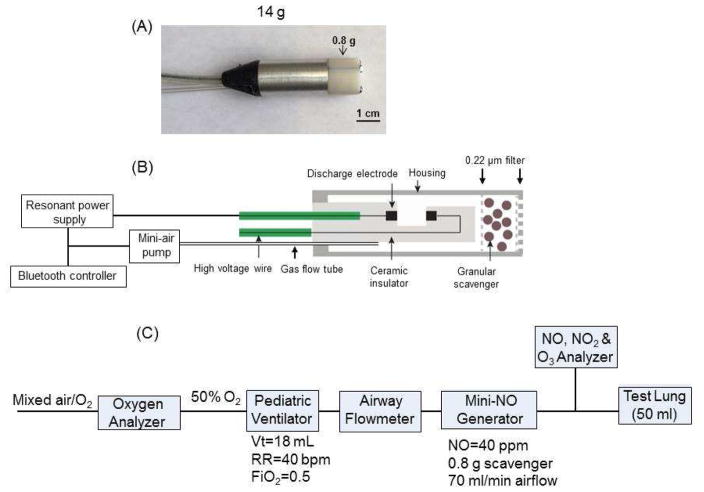
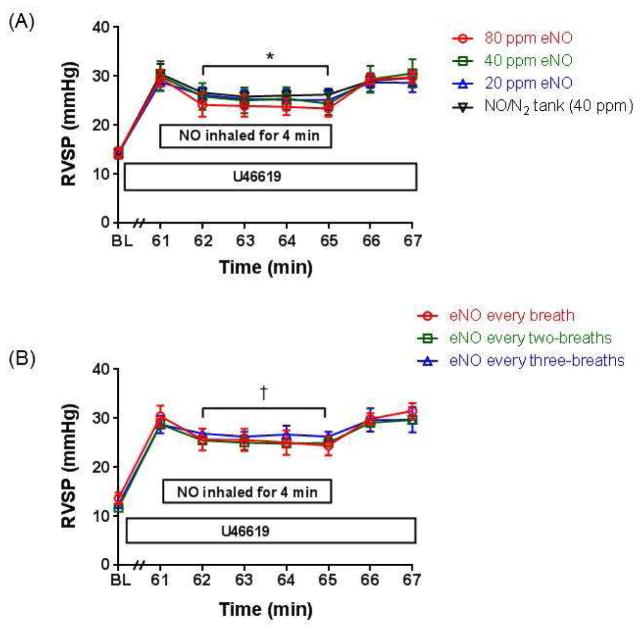
A miniature NO (mini-NO) generator was tested for its ability to produce therapeutic levels (20-80 parts per million (ppm)) of NO, while removing potentially toxic gases and metal particles. We studied healthy 6-month-old New Zealand rabbits weighing 3.4 ± 0.4 kg (mean ± SD, n = 8). Pulmonary hypertension was induced by chemically increasing right ventricular systolic pressure to 28-30 mmHg. The mini-NO generator was placed near the endotracheal tube. Production of NO was triggered by a pediatric airway flowmeter during the first 0.5 s of inspiration.
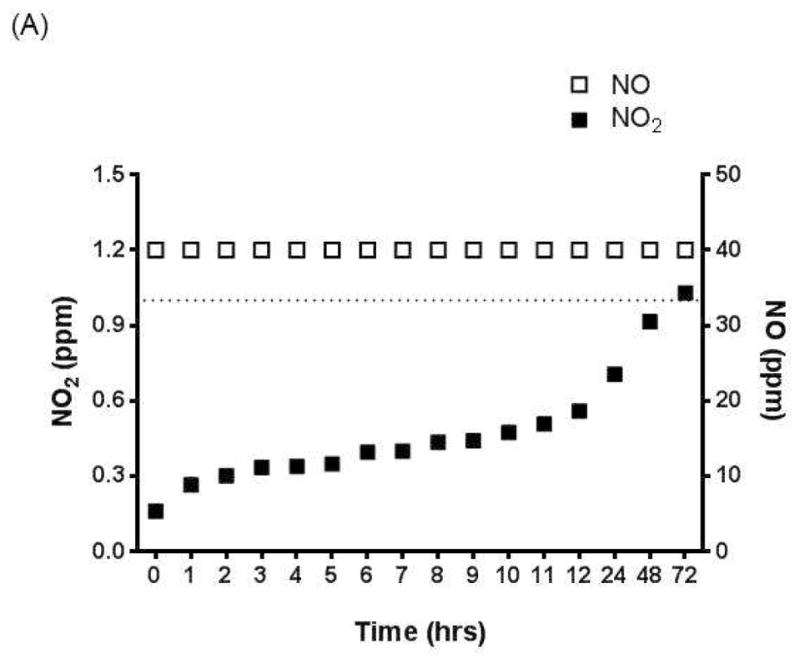
In rabbits with acute pulmonary hypertension, the mini-NO generator produced sufficient NO to induce pulmonary vasodilation. Potentially toxic nitrogen dioxide (NO) and ozone (O) were removed by the Ca(OH) scavenger. Metallic particles, released from the electrodes by the electric plasma, were removed by a 0.22 μm filter. While producing 40 ppm NO, the mini-NO generator was cooled by a flow of air (70 ml/min) and the external temperature of the housing did not exceed 31 °C.
The mini-NO generator safely produced therapeutic levels of NO from air. The mini-NO generator is an effective and economical approach to producing NO for treating neonatal pulmonary hypertension and will increase the accessibility and therapeutic uses of life-saving NO therapy worldwide.
测试一种新型微型设备的安全性,该设备通过脉冲放电从空气中产生一氧化氮(NO),并证明产生的 NO 可用于扩张化学诱导性肺动脉高压的兔肺血管。
测试了一种微型 NO(mini-NO)发生器,以确定其产生治疗水平(20-80ppm)NO 的能力,同时去除潜在的有毒气体和金属颗粒。我们研究了体重为 3.4±0.4kg(平均值±标准差,n=8)的 6 月龄健康新西兰兔。通过化学方法将右心室收缩压增加到 28-30mmHg 来诱导肺动脉高压。将 mini-NO 发生器放置在气管内导管附近。在吸气的前 0.5s 期间,通过儿科气道流量计触发 NO 的产生。
在急性肺动脉高压的兔中,mini-NO 发生器产生了足够的 NO 来诱导肺血管扩张。潜在有毒的二氧化氮(NO)和臭氧(O)被 Ca(OH)清除剂去除。通过电等离子体从电极释放的金属颗粒被 0.22μm 过滤器去除。在产生 40ppmNO 的同时,通过 70ml/min 的空气流对 mini-NO 发生器进行冷却,外壳外部温度不超过 31°C。
微型 NO 发生器可安全地从空气中产生治疗水平的 NO。微型 NO 发生器是一种有效且经济的方法,可用于产生 NO 来治疗新生儿肺动脉高压,并将增加全球范围内救命 NO 治疗的可及性和治疗用途。