Section of Physiology, Division of Pulmonary, Critical Care, and Sleep Medicine, Department of Medicine, University of California, San Diego, La Jolla, California.
Harvard University, Cambridge, Massachusetts.
Physiol Rev. 2023 Jul 1;103(3):1827-1897. doi: 10.1152/physrev.00030.2021. Epub 2022 Nov 24.
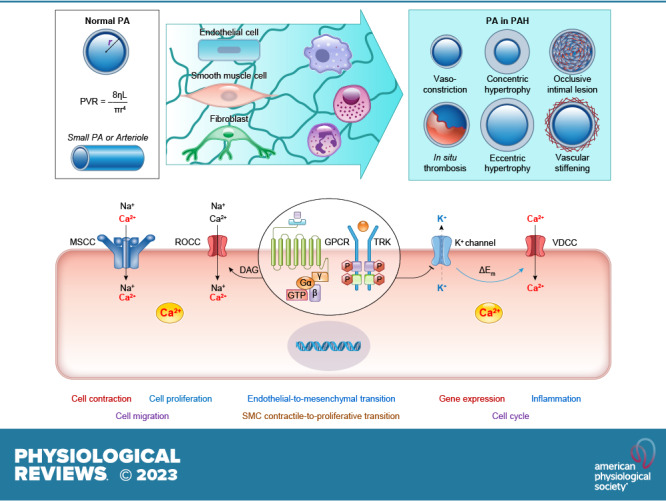
The pulmonary circulation is a low-resistance, low-pressure, and high-compliance system that allows the lungs to receive the entire cardiac output. Pulmonary arterial pressure is a function of cardiac output and pulmonary vascular resistance, and pulmonary vascular resistance is inversely proportional to the fourth power of the intraluminal radius of the pulmonary artery. Therefore, a very small decrease of the pulmonary vascular lumen diameter results in a significant increase in pulmonary vascular resistance and pulmonary arterial pressure. Pulmonary arterial hypertension is a fatal and progressive disease with poor prognosis. Regardless of the initial pathogenic triggers, sustained pulmonary vasoconstriction, concentric vascular remodeling, occlusive intimal lesions, in situ thrombosis, and vascular wall stiffening are the major and direct causes for elevated pulmonary vascular resistance in patients with pulmonary arterial hypertension and other forms of precapillary pulmonary hypertension. In this review, we aim to discuss the basic principles and physiological mechanisms involved in the regulation of lung vascular hemodynamics and pulmonary vascular function, the changes in the pulmonary vasculature that contribute to the increased vascular resistance and arterial pressure, and the pathogenic mechanisms involved in the development and progression of pulmonary hypertension. We focus on reviewing the pathogenic roles of membrane receptors, ion channels, and intracellular Ca signaling in pulmonary vascular smooth muscle cells in the development and progression of pulmonary hypertension.
肺循环是一个低阻力、低压力和高顺应性的系统,使肺部能够接收整个心输出量。肺动脉压是心输出量和肺血管阻力的函数,而肺血管阻力与肺动脉腔内半径的四次方成反比。因此,肺血管腔直径的很小下降会导致肺血管阻力和肺动脉压的显著增加。肺动脉高压是一种致命的、进行性的疾病,预后不良。无论初始致病触发因素如何,持续性肺血管收缩、同心性血管重塑、闭塞性内膜病变、原位血栓形成和血管壁僵硬是肺动脉高压和其他形式的肺前毛细血管高压患者中升高的肺血管阻力的主要和直接原因。在这篇综述中,我们旨在讨论调节肺血管血液动力学和肺血管功能的基本原理和生理机制,导致血管阻力和动脉压增加的肺血管变化,以及肺动脉高压发展和进展中涉及的发病机制。我们重点回顾了膜受体、离子通道和细胞内 Ca 信号在肺动脉平滑肌细胞中在肺动脉高压发展和进展中的致病作用。