Department of Physiology and Pharmacology, College of Veterinary Medicine, University of Georgia, 501 D.W. Brooks Drive, Athens, GA, 30602, USA.
Department of Kinesiology, University of Georgia, 115 Ramsey Center, 330 River Road, Athens, GA, 30602, USA.
J Neuroinflammation. 2018 Feb 27;15(1):60. doi: 10.1186/s12974-018-1098-4.
Several psychiatric conditions are affected by neuroinflammation and neuroimmune activation. The transcription factor nuclear factor kappa light-chain-enhancer of activated B cells (NFkB) plays a major role in inflammation and innate immunity. The neurokinin-1 receptor (NK1R) is the primary endogenous target of the neuroactive peptide substance P, and some data suggests that NK1R stimulation may influence NFkB activity. Both NK1R and NFkB have been shown to play a functional role in complex behaviors including stress responsivity, depression, and addiction. In this study, we test whether NFkB activity in the brain (stimulated by lipopolysaccharide administration) is dependent upon the NK1R.
Adult male Wistar rats were treated systemically with the NK1R antagonist L822429 followed by administration of systemic lipopolysaccharide (LPS, a strong activator of NFkB). Hippocampal extracts were used to assess expression of proinflammatory cytokines and NFkB-DNA-binding potential. For behavioral studies, rats were trained to consume 1% (w/v) sucrose solution in a continuous access two-bottle choice model. After establishment of baseline, animals were treated with L822429 and LPS and sucrose preference was measured 12 h post-treatment.
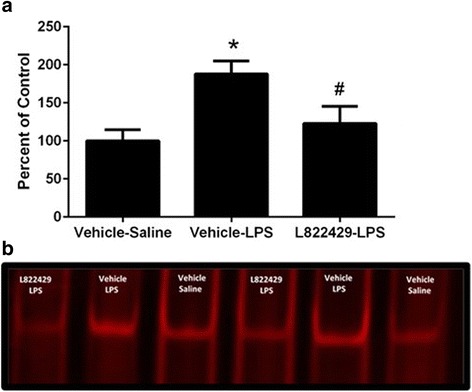
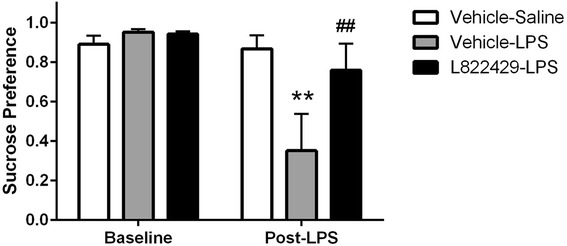
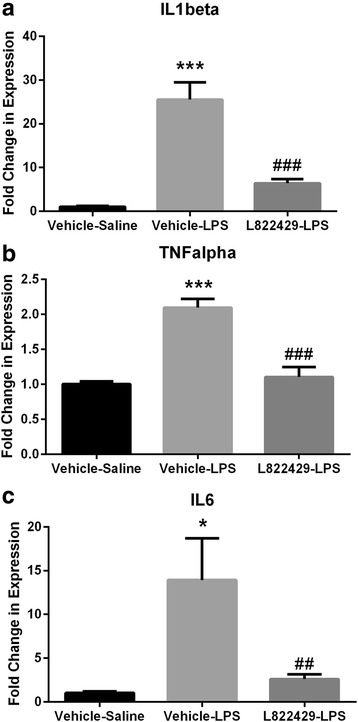
Systemic LPS treatment causes a significant increase in proinflammatory cytokine expression and NFkB-DNA-binding activity within the hippocampus. These increases are attenuated by systemic pretreatment with the NK1R antagonist L822429. Systemic LPS treatment also led to the development of anhedonic-like behavior, evidenced by decreased sucrose intake in the sucrose preference test. This behavior was significantly attenuated by systemic pretreatment with the NK1R antagonist L822429.
Systemic LPS treatment induced significant increases in NFkB activity, evidenced by increased NFkB-DNA binding and by increased proinflammatory cytokine expression in the hippocampus. LPS also induced anhedonic-like behavior. Both the molecular and behavioral effects of LPS treatment were significantly attenuated by systemic NK1R antagonism, suggesting that NK1R stimulation lies upstream of NFkB activation following systemic LPS administration and is at least in part responsible for NFkB activation.
几种精神疾病受神经炎症和神经免疫激活的影响。转录因子核因子 kappa 轻链增强子活化 B 细胞(NFkB)在炎症和先天免疫中起主要作用。神经激肽-1 受体(NK1R)是神经活性肽物质 P 的主要内源性靶标,一些数据表明 NK1R 刺激可能影响 NFkB 活性。NK1R 和 NFkB 均在包括应激反应、抑郁和成瘾在内的复杂行为中发挥功能作用。在这项研究中,我们测试了大脑中的 NFkB 活性(由脂多糖给药刺激)是否依赖于 NK1R。
成年雄性 Wistar 大鼠系统给予 NK1R 拮抗剂 L822429,然后给予全身脂多糖(LPS,NFkB 的强激活剂)。使用海马提取物评估促炎细胞因子和 NFkB-DNA 结合潜能的表达。对于行为研究,大鼠接受训练以在连续访问双瓶选择模型中消耗 1%(w/v)蔗糖溶液。在建立基线后,用 L822429 和 LPS 处理动物,并在治疗后 12 小时测量蔗糖偏好。
全身 LPS 处理导致海马内促炎细胞因子表达和 NFkB-DNA 结合活性显著增加。这些增加被 NK1R 拮抗剂 L822429 的全身预处理所减弱。全身 LPS 处理还导致快感缺失样行为的发展,表现在蔗糖偏好测试中蔗糖摄入量减少。这种行为被 NK1R 拮抗剂 L822429 的全身预处理显著减弱。
全身 LPS 处理诱导 NFkB 活性显著增加,表现为 NFkB-DNA 结合增加和海马内促炎细胞因子表达增加。LPS 还诱导快感缺失样行为。LPS 处理的分子和行为影响均被全身 NK1R 拮抗作用显著减弱,表明 NK1R 刺激位于全身 LPS 给药后 NFkB 激活的上游,并且至少部分负责 NFkB 激活。