Johnson M Brittany, Young Ada D, Marriott Ian
Department of Biological Sciences, The University of North Carolina at Charlotte Charlotte, NC, USA.
Front Cell Neurosci. 2017 Jan 4;10:296. doi: 10.3389/fncel.2016.00296. eCollection 2016.
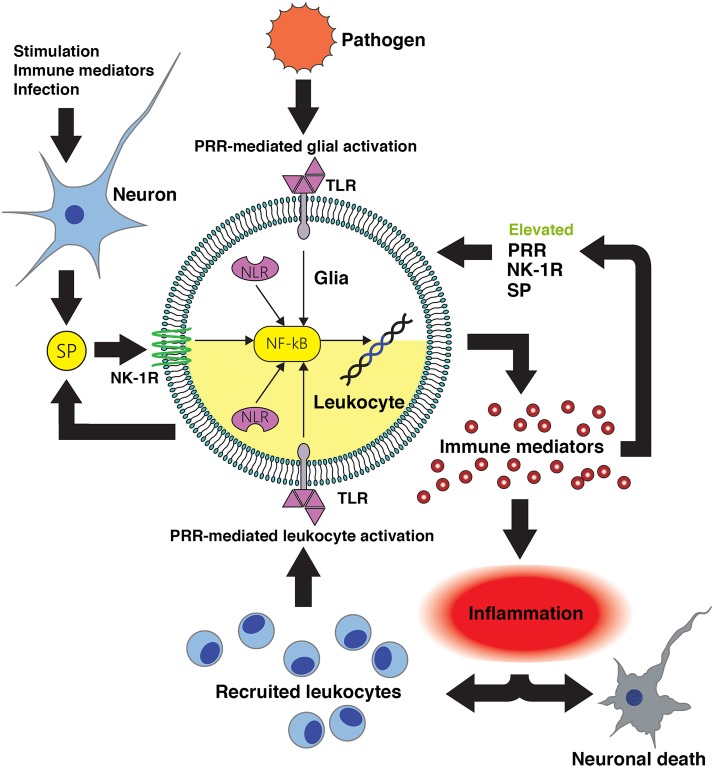
The inflammatory responses of resident central nervous system (CNS) cells are now known to play a critical role in the initiation and progression of an array of infectious and sterile neuroinflammatory disorders such as meningitis, encephalitis, Parkinson's disease, Alzheimer's disease and multiple sclerosis (MS). Regulating glial inflammatory responses in a timely manner is therefore critical in preserving normal CNS functions. The neuropeptide substance P is produced at high levels within the CNS and its selective receptor, the neurokinin 1 receptor (NK-1R), is abundantly expressed by neurons and is present on glial cell types including microglia and astrocytes. In addition to its functions as a neurotransmitter in the perception of pain and its essential role in gut motility, this tachykinin is widely recognized to exacerbate inflammation at peripheral sites including the skin, gastrointestinal tract and the lungs. Recently, a number of studies have identified a role for substance P and NK-1R interactions in neuroinflammation and described the ability of this neuropeptide to alter the immune functions of activated microglia and astrocytes. In this review article, we describe the expression of substance P and its receptor by resident CNS cells, and we discuss the ability of this neuropeptide to exacerbate the inflammatory responses of glia and immune cells that are recruited to the brain during neurodegenerative diseases. In addition, we discuss the available data indicating that the NK-1R-mediated augmentation of such responses appears to be detrimental during microbial infection and some sterile neurodegenerative disorders, and propose the repurposed use of NK-1R antagonists, of a type that are currently approved as anti-emetic and anti-anxiolytic agents, as an adjunct therapy to ameliorate the inflammatory CNS damage in these conditions.
目前已知中枢神经系统(CNS)常驻细胞的炎症反应在一系列感染性和无菌性神经炎症性疾病(如脑膜炎、脑炎、帕金森病、阿尔茨海默病和多发性硬化症(MS))的发生和发展中起关键作用。因此,及时调节胶质细胞的炎症反应对于维持正常的中枢神经系统功能至关重要。神经肽P物质在中枢神经系统内大量产生,其选择性受体神经激肽1受体(NK-1R)在神经元中大量表达,并存在于包括小胶质细胞和星形胶质细胞在内的胶质细胞类型上。除了作为疼痛感知中的神经递质发挥作用以及在肠道蠕动中起重要作用外,这种速激肽还被广泛认为会加剧包括皮肤、胃肠道和肺部在内的外周部位的炎症。最近,一些研究已经确定了P物质与NK-1R相互作用在神经炎症中的作用,并描述了这种神经肽改变活化小胶质细胞和星形胶质细胞免疫功能的能力。在这篇综述文章中,我们描述了P物质及其受体在中枢神经系统常驻细胞中的表达,并讨论了这种神经肽加剧胶质细胞和在神经退行性疾病期间被招募到大脑的免疫细胞炎症反应的能力。此外,我们讨论了现有数据,这些数据表明NK-1R介导的此类反应增强在微生物感染和一些无菌性神经退行性疾病期间似乎是有害的,并提出重新利用目前被批准为止吐药和抗焦虑药的NK-1R拮抗剂作为辅助治疗,以改善这些情况下中枢神经系统的炎症性损伤。