Department of Clinical Pharmacology, College of Medicine and Public Health, Flinders University and Flinders Medical Centre, Adelaide, Australia.
Faculty of Health and Life Sciences, De Montfort University, Leicester, United Kingdom.
Sci Rep. 2018 Feb 27;8(1):3697. doi: 10.1038/s41598-018-22099-x.
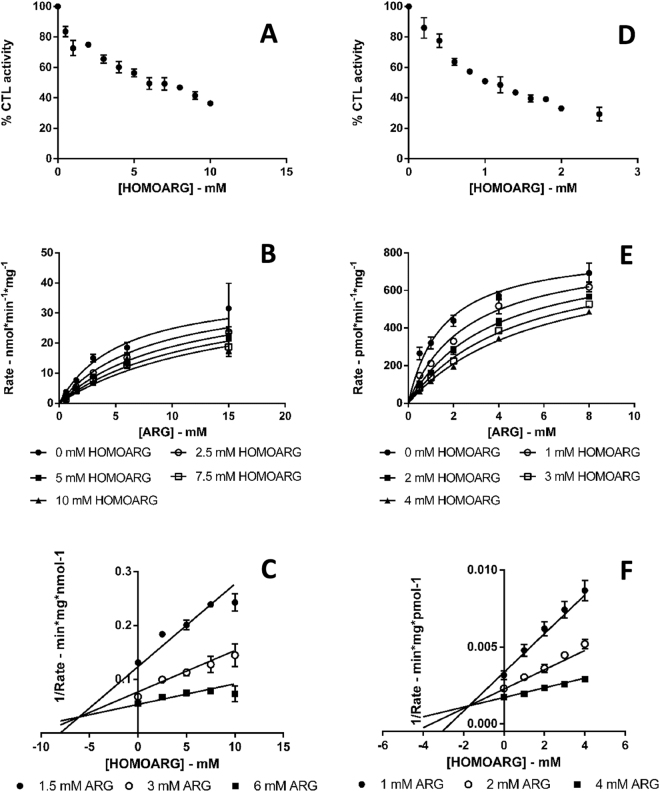
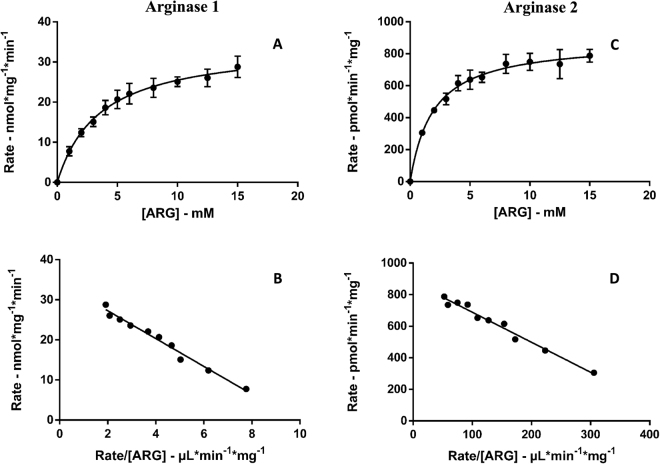
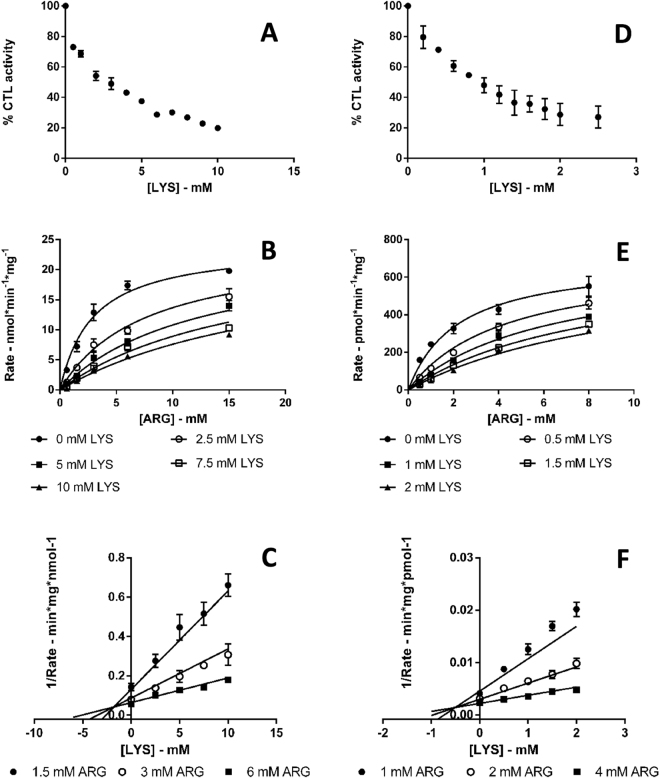
The inhibition of arginase, resulting in higher arginine (ARG) availability for nitric oxide synthesis, may account for the putative protective effect of homoarginine (HOMOARG) against atherosclerosis and cardiovascular disease. However, uncertainty exists regarding the significance of HOMOARG-induced arginase inhibition in vivo. A novel UPLC-MS method, measuring the conversion of ARG to ornithine (ORN), was developed to determine arginase 1 and arginase 2 inhibition by HOMOARG, lysine (LYS), proline (PRO), agmatine (AG), asymmetric dimethylarginine (ADMA), symmetric dimethylarginine (SDMA), and NG-Monomethyl-L-arginine (L-NMMA). Plasma HOMOARG, ARG and ORN concentrations were further measured in 50 healthy older adults >65 years (27 males and 23 females). HOMOARG inhibited arginase 1 with IC and K values of 8.14 ± 0.52 mM and 6.1 ± 0.50 mM, and arginase 2 with IC and K values of 2.52 ± 0.01 mM and 1.73 ± 0.10 mM, respectively. Both arginase isoforms retained 90% activity vs. control when physiological HOMOARG concentrations (1-10 µM) were used. In partial correlation analysis, plasma HOMOARG was not associated with ARG (P = 0.38) or ARG/ORN ratio (P = 0.73) in older adults. Our results suggest that arginase inhibition is unlikely to play a significant role in the reported cardio-protective effects of HOMOARG.
精氨酸酶的抑制作用导致精氨酸(ARG)的可用性增加,从而促进一氧化氮的合成,这可能是同型精氨酸(HOMOARG)对动脉粥样硬化和心血管疾病具有保护作用的原因。然而,HOMOARG 诱导的精氨酸酶抑制在体内的重要性仍存在不确定性。本文建立了一种新的 UPLC-MS 方法,通过测量 ARG 转化为鸟氨酸(ORN)的情况,来确定 HOMOARG、赖氨酸(LYS)、脯氨酸(PRO)、胍丁胺(AG)、非对称二甲基精氨酸(ADMA)、对称二甲基精氨酸(SDMA)和 NG-单甲基-L-精氨酸(L-NMMA)对精氨酸酶 1 和精氨酸酶 2 的抑制作用。此外,还在 50 名年龄超过 65 岁的健康老年人(男性 27 名,女性 23 名)中测量了血浆 HOMOARG、ARG 和 ORN 的浓度。结果显示,HOMOARG 对精氨酸酶 1 的抑制作用的 IC 和 K 值分别为 8.14±0.52mM 和 6.1±0.50mM,对精氨酸酶 2 的抑制作用的 IC 和 K 值分别为 2.52±0.01mM 和 1.73±0.10mM。当使用生理浓度的 HOMOARG(1-10µM)时,两种精氨酸酶同工酶的活性保留了 90%。在偏相关分析中,HOMOARG 与老年人的 ARG(P=0.38)或 ARG/ORN 比值(P=0.73)无相关性。研究结果表明,精氨酸酶抑制作用不太可能在 HOMOARG 报道的心脏保护作用中发挥重要作用。